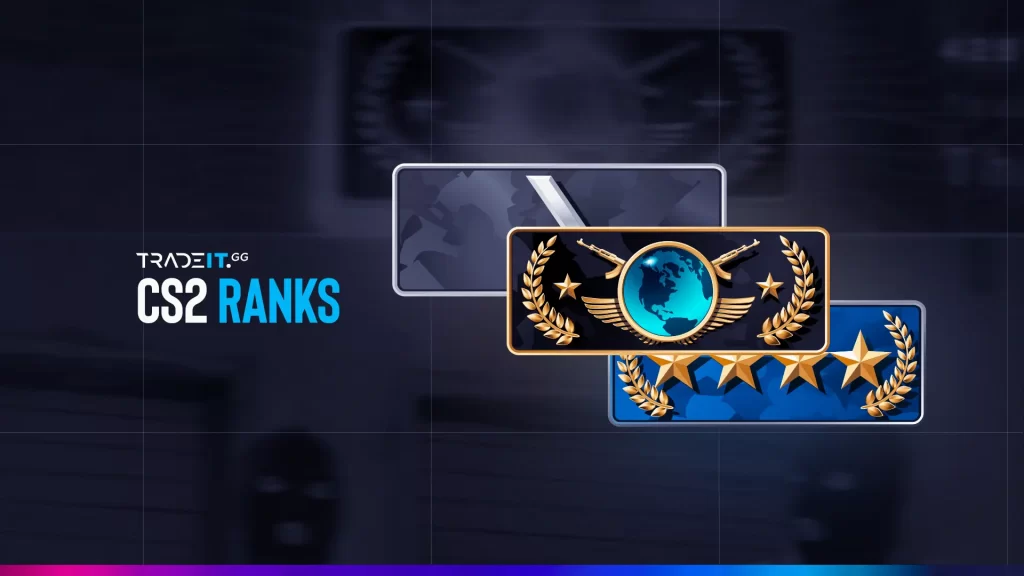


CS2 does not have one universal rank. Competitive, Premier, Wingman, FACEIT, and Profile Ranks measure different parts of your progress, so this guide separates every system before showing how they relate.
Looking for professional team standings or HLTV-style event results rather than matchmaking ranks? See the current CS2 world ranking.
On this page
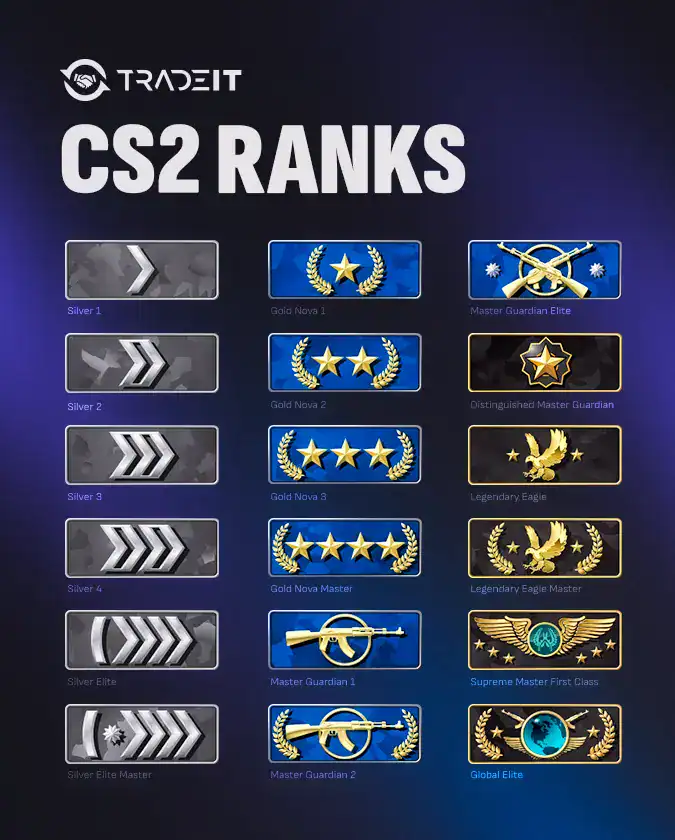
All 18 CS2 Competitive Ranks in Order
The Competitive ladder uses the same 18 Skill Groups players know as CS:GO ranks. Silver I is the lowest and The Global Elite is the highest. Since Valve’s June 2024 matchmaking update, each map holds its own rank, so you might be Master Guardian II on Mirage and Gold Nova I on Ancient at the same time.
| Rank of 18 | Rank and icon | Tier | Informal name | General benchmark |
|---|---|---|---|---|
| 1 |  Silver I Silver I | Silver | Silver 1, S1 | Learning movement, recoil, and map basics |
| 2 |  Silver II Silver II | Silver | Silver 2, S2 | Starting to use utility and common angles |
| 3 |  Silver III Silver III | Silver | Silver 3, S3 | More consistent crosshair placement |
| 4 |  Silver IV Silver IV | Silver | Silver 4, S4 | Basic trading and team positioning |
| 5 |  Silver Elite Silver Elite | Silver | SE | Developing reliable rifle mechanics |
| 6 |  Silver Elite Master Silver Elite Master | Silver | SEM | Coordinating simple executes and retakes |
| 7 |  Gold Nova I Gold Nova I | Gold Nova | Nova 1, GN1 | Competent fundamentals with visible gaps |
| 8 |  Gold Nova II Gold Nova II | Gold Nova | Nova 2, GN2 | Better team play and grenade timing |
| 9 |  Gold Nova III Gold Nova III | Gold Nova | Nova 3, GN3 | Consistent trading and sound rotations |
| 10 |  Gold Nova Master Gold Nova Master | Gold Nova | Nova Master, GNM | Structured play begins to matter |
| 11 |  Master Guardian I Master Guardian I | Master Guardian | MG1 | Strong fundamentals and punishable mistakes |
| 12 |  Master Guardian II Master Guardian II | Master Guardian | MG2 | Reliable mechanics under pressure |
| 13 |  Master Guardian Elite Master Guardian Elite | Master Guardian | MGE | Good utility knowledge and mid-round reads |
| 14 |  Distinguished Master Guardian Distinguished Master Guardian | Master Guardian | DMG | Advanced team play and efficient decisions |
| 15 |  Legendary Eagle Legendary Eagle | Legendary Eagle | LE | High-level mechanics with few free mistakes |
| 16 |  Legendary Eagle Master Legendary Eagle Master | Legendary Eagle | LEM | Refined spacing, reads, and utility |
| 17 |  Supreme Master First Class Supreme Master First Class | Supreme | Supreme, SMFC | Near-elite execution and adaptability |
| 18 |  The Global Elite The Global Elite | Global Elite | Global, GE | The top Competitive Skill Group |
Silver Ranks (Ranks 1 to 6)
Silver covers the first six positions. Matches are unpredictable because players are still building mechanical habits and learning how rounds fit together. The fastest way out is usually fewer unforced deaths, calmer crosshair placement, and a small set of grenades you can reproduce under pressure.
Silver I
Silver I, often called Silver 1 or S1, is position 1 of 18. Players here are learning movement, recoil control, buying, and objective timing. A clear benchmark is keeping the crosshair at head height while moving through familiar areas instead of aiming at the floor.
Silver II
Silver II, often called Silver 2 or S2, is position 2 of 18. Players recognize common bombsite entries and defensive angles, but decisions remain inconsistent. A useful benchmark is using one purposeful grenade each gun round and avoiding reloads while exposed to an angle an opponent could immediately swing.
Silver III
Silver III, often called Silver 3 or S3, is position 3 of 18. Aim becomes more repeatable, although movement and shooting often overlap. Players at this level should stop before firing, clear nearby angles in sequence, and communicate an enemy’s location without lengthy explanations.
Silver IV
Silver IV, often called Silver 4 or S4, is position 4 of 18. Players develop a sense of trades and rotations instead of treating every duel alone. The practical benchmark is staying close enough to trade a teammate, then resisting the urge to chase kills after the bomb is planted.
Silver Elite
Silver Elite, abbreviated SE, is position 5 of 18. Rifle mechanics and map awareness are becoming more reliable, but economy mistakes still swing matches. Players should understand when the team is saving, avoid forcing alone, and hold a chosen angle without constantly exposing themselves to several threats.
Silver Elite Master
Silver Elite Master, or SEM, is position 6 of 18. It is the final Silver rank and a test of consistency. A solid SEM player can support a simple site execute, trade the first contact, and recognize when preserving a rifle is more valuable than attempting a low-probability retake.
Gold Nova Ranks (Ranks 7 to 10)
Gold Nova contains the broad middle of the ladder. Raw aim can still carry rounds, but players increasingly punish predictable positioning and weak economy decisions. Progress comes from connecting mechanics to team timing rather than collecting isolated highlights.
Gold Nova I
Gold Nova I, called Nova 1 or GN1, is position 7 of 18. Players have workable fundamentals but often lose value through rushed decisions. A practical benchmark is entering a site behind utility, checking the highest-risk angle first, and giving teammates a concise plan before the round begins.
Gold Nova II
Gold Nova II, called Nova 2 or GN2, is position 8 of 18. Team play becomes more deliberate and grenades are used with better timing. Players should trade across common chokepoints, identify a weak bombsite from early information, and change position after revealing themselves.
Gold Nova III
Gold Nova III, called Nova 3 or GN3, is position 9 of 18. Players punish obvious rotations and unsupported aggression more often. A strong benchmark is tracking the likely locations of remaining enemies, preserving useful grenades for the retake, and making decisions from the clock rather than impatience.
Gold Nova Master
Gold Nova Master, commonly GNM, is position 10 of 18. It is the top of Gold Nova and the point where structured habits matter. Players should combine accurate first bullets with sensible spacing, reliable comms, and enough utility knowledge to create an advantage without taking an opening duel.
Master Guardian Ranks (Ranks 11 to 14)
The four Master Guardian ranks reward repeatable execution. Opponents understand defaults, common utility, and basic anti-eco discipline. To climb, you need to create information safely, notice patterns across rounds, and convert advantages without donating unnecessary fights.
Master Guardian I
Master Guardian I, abbreviated MG1, is position 11 of 18. Fundamentals are dependable enough that decision quality becomes the separator. Players should recognize favorable fights, clear sites methodically, and avoid repeating a setup after opponents have already shown the utility or timing that defeats it.
Master Guardian II
Master Guardian II, or MG2, is position 12 of 18. Mechanical errors are punished quickly and weak spacing becomes obvious. A useful benchmark is turning teammate contact into an immediate trade, counter-strafing reliably, and changing pace when the opposing team begins reading the same default.
Master Guardian Elite
Master Guardian Elite, known as MGE, is position 13 of 18. Players combine solid aim with deeper map knowledge and more intentional utility. They should be able to call a mid-round adjustment, maintain useful spacing during it, and isolate fights rather than peeking several angles at once.
Distinguished Master Guardian
Distinguished Master Guardian, or DMG, is position 14 of 18. Advanced habits now need to survive pressure. Players should convert a five-versus-four advantage, layer grenades with teammates, and recognize when denying information is stronger than seeking another duel after gaining early control.
The Top Four Ranks (Ranks 15 to 18)
Legendary Eagle through Global Elite represent a small part of the Competitive population. These matches demand clean mechanics, fast information processing, and disciplined team play. The difference between ranks is less about learning a concept and more about executing it reliably against opponents who know the same concept.
Legendary Eagle
Legendary Eagle, shortened to LE, is position 15 of 18. Players have high-level mechanics and understand the strategic cost of each death. A useful benchmark is adapting defensive setups between rounds, using sound and utility to infer rotations, and giving opponents very few isolated openings.
Legendary Eagle Master
Legendary Eagle Master, or LEM, is position 16 of 18. Refined spacing and fast mid-round reads separate successful teams. Players should consistently punish utility gaps, coordinate late-round pressure across the map, and preserve enough resources to make the final execute difficult to counter.
Supreme Master First Class
Supreme Master First Class, called SMFC or Supreme, is position 17 of 18. Near-elite opponents punish hesitation and repeated tendencies. Players need excellent counter-strafing, purposeful utility, dependable trades, and the ability to switch between aggressive and patient solutions without disrupting the team’s spacing.
The Global Elite
The Global Elite, called Global or GE, is position 18 of 18 and the highest Competitive Skill Group. It represents sustained success against the strongest matchmaking opponents. Global players minimize free deaths, read the economy, adapt quickly, and execute difficult mechanical actions without abandoning the round plan.
How Map-Specific Competitive Ranks Work
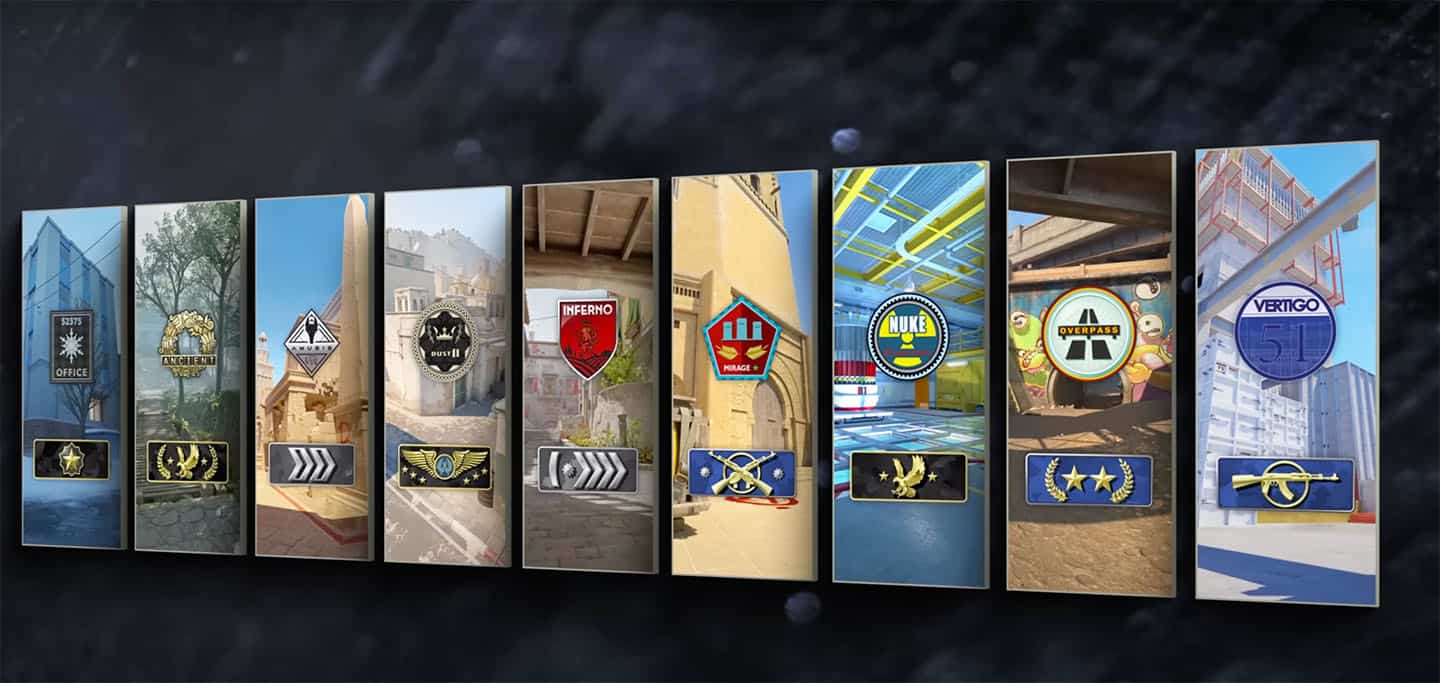
Competitive no longer assigns one Skill Group to your entire account. You unlock a rank on a map after winning two matches there, then that map’s results update its own hidden skill estimate. Playing Mirage does not directly move your Inferno badge.
This makes the rank more useful as a map-learning signal. A lower Ancient rank may show that your utility, timings, or rotations need work even when your mechanics are good enough for a higher Mirage rank. It also means “What is your CS2 rank?” needs a map name before it has a precise answer.
CS2 Premier Ranks and CS Rating Tiers
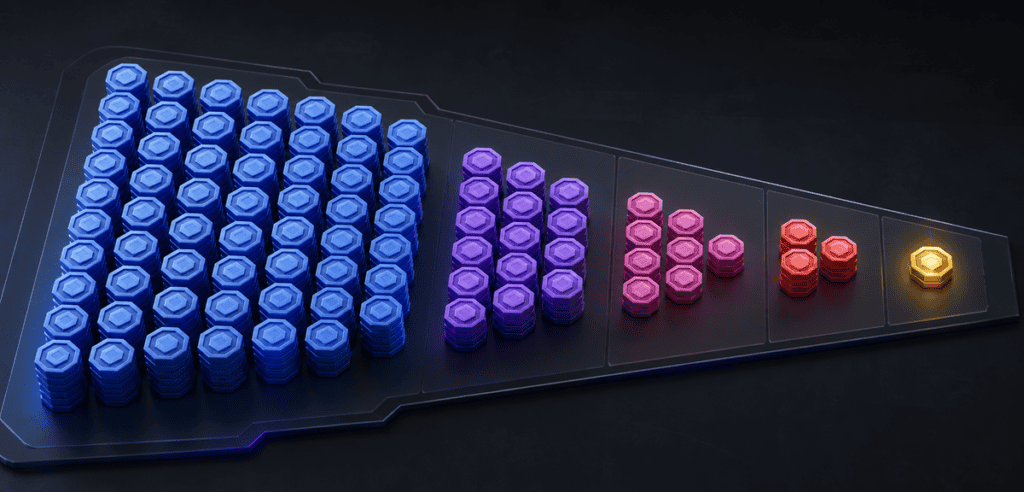
Premier uses a visible number called CS Rating instead of the 18 badges. After ten Premier wins, your rating appears and places you in one of seven colour tiers. The number is global across Premier maps, which makes it easier to compare progress than the map-specific Competitive system.
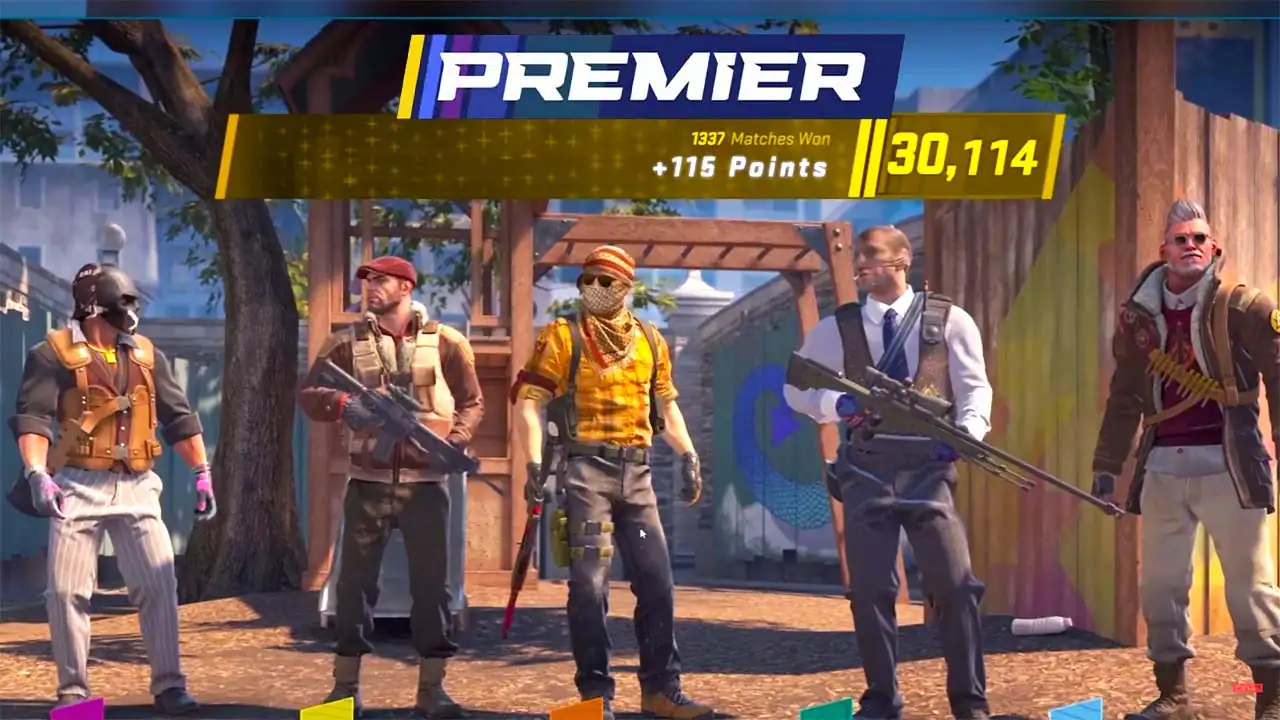
All 7 CS Rating Colour Tiers
Premier groups the visible CS Rating into seven colour bands. The colour is a quick reference, while the number itself provides the precise position within that band.
| CS Rating | Colour tier | Rough share of players | Practical meaning |
|---|---|---|---|
| 0 to 4,999 | Gray | 25.1% | Entry Premier range |
| 5,000 to 9,999 | Light Blue | 30.8% | Developing fundamentals |
| 10,000 to 14,999 | Blue | 27.6% | Established intermediate play |
| 15,000 to 19,999 | Purple | 12.8% | Advanced matchmaking range |
| 20,000 to 24,999 | Pink | 3.1% | High-level Premier play |
| 25,000 to 29,999 | Red | 0.4% | Elite rating range |
| 30,000 and above | Yellow | 0.1% | Top leaderboard territory |
The player shares use the Leetify-based March 2026 distribution published by Esports Tales. They are a dated benchmark, not a live Season 5 census.
How CS Rating Goes Up and Down
Before a Premier match begins, CS2 shows the rating you can gain for winning and lose for defeat. The visible CS Rating is often described as Elo, while MMR refers more broadly to the hidden matchmaking estimate behind the queue. Valve does not publish the complete formula.
The forecast is more useful than guessing how many matches a rank-up will take. A player at 14,850 with a projected gain of 190 knows a win crosses into purple. Individual kills can help you win, but they do not replace the match result as the visible rating event.
Loss −115
Illustrative rating forecast. The actual values shown by CS2 depend on your account and recent Premier results.
The Premier Map Pool
Premier uses the current Active Duty pool and a pick-ban phase. For Season 5, Valve added Cache and removed Overpass. The seven maps are Cache, Anubis, Ancient, Dust II, Inferno, Mirage, and Nuke. Because every Premier match starts with vetoes, a narrow one-map specialist eventually has to play outside their comfort zone.
Valve can change the pool between seasons or through major updates. The wider CS2 map pool includes maps outside the current Premier rotation, so always check the in-game veto screen before relying on an older list.
Once the veto ends, concise location names help the team turn early information into rotations without covering important audio.
Premier Leaderboards
A visible CS Rating can qualify for Valve’s global, regional, and friends leaderboards. The leaderboard gives Premier a public competitive layer that the 18 Competitive badges lack. Placement requires account eligibility and enough recent activity, and the top threshold changes as the season develops.
Public databases such as csstats.gg Premier leaderboards can provide a dated snapshot, but the in-game board remains the primary source for your current position.
Do not treat a fixed number from an old article as the permanent “best rank.” Season 5 public trackers already show leading players above 30,000, while the population and ceiling continue moving. The yellow tier begins at 30,000, but the actual leaderboard leaders can sit far beyond its lower boundary. Matchmaking position also differs from our editorial list of the best CS2 players, which considers professional competition.
CS Rating to Competitive Rank: Equivalence Table
Valve does not publish an official conversion between CS Rating and Competitive Skill Groups. The systems use different queues, pools, and calibration rules. The table below is a rough skill comparison based on Leetify’s large September 2024 Premier dataset, not a promise that one badge converts into a specific number.
- Top four15 to 18
- Master Guardian11 to 14
- Gold Nova7 to 10
- Silver1 to 6
| Premier Rating | Colour Tier | Rough Competitive Skill Range | How to Read It |
|---|---|---|---|
| 1,000 to 6,768 | Gray to light blue | Silver I to Silver Elite Master | Broad beginner and developing range |
| 7,502 to 11,178 | Light blue to blue | Gold Nova I to Gold Nova Master | Common middle-ladder level |
| 11,179 to 14,588 | Blue | Master Guardian I to Master Guardian Elite | Consistent intermediate mechanics and structure |
| 14,589 to 18,156 | Blue to purple | DMG to Legendary Eagle Master | Advanced matchmaking range |
| 18,157 to 20,000 | Purple to pink | Supreme Master First Class | Near the top of the badge ladder |
| 20,001 and above | Pink and higher | Global Elite | Elite comparison, with a very wide Premier ceiling |
Gaps between the published bands are a result of the statistical method and should not be filled with false precision. A player can also perform better in Premier because of broad map knowledge, or better in Competitive because they repeatedly queue a single strong map.
Are CS:GO Ranks the Same as CS2 Ranks?
Yes. CS2 Competitive uses the same 18 rank names and the same order as CS:GO. The badges were not removed or replaced. CS2 changed how they are assigned by tracking a separate Competitive rank on every map.
What Changed Between CS:GO and CS2 Ranks
The badge ladder stayed intact, but CS2 separated Competitive ranks by map and introduced Premier as the main account-wide numerical system. That gives players a map-specific Skill Group alongside one broader CS Rating.
| Feature | CS:GO | CS2 |
|---|---|---|
| Main badge ladder | One Competitive Skill Group across the queue | One Competitive Skill Group for each map |
| Top first-party queue | Competitive matchmaking | Premier with CS Rating and map vetoes |
| Visible numeric rating | No standard public number | CS Rating in Premier |
| Leaderboard | No comparable in-client global rating board | Global, regional, and friends leaderboards |
| Competitive placement | Placement process for the overall Skill Group | Two wins on each map to reveal its rank |
| Seasonal recalibration | Long inactivity could hide the badge | Premier seasons can hide and recalibrate CS Rating |
Your historical CS:GO badge did not become a permanent CS2 entitlement. CS2 recalibrates from its own match data, and Premier did not exist in its current form as the central numbered ladder. Mechanics, servers, smoke behavior, and presentation also changed during the wider transition from CS:GO to CS2.
Old CS:GO Rank Names Players Still Use
Legacy vocabulary remains common because the rank entities are unchanged. Players may say Silver 1, Silver 3, Nova 2, MG1, DMG, LEM, Supreme, or Global instead of reading the full Roman numeral or badge name. These informal names still refer to current CS2 Competitive ranks.
Premier vs Competitive: Which Should You Play?
Choose Premier when you want one rating, the Active Duty pool, a veto phase, and leaderboard progression. Choose Competitive when you want to select exact maps, learn them one at a time, or play with a rank that reflects your current ability on that specific map.
| Category | Premier | Competitive |
|---|---|---|
| Progress measure | One numeric CS Rating | One of 18 Skill Groups per map |
| Placement requirement | 10 wins | 2 wins on a selected map |
| Map selection | Pick-ban from Active Duty pool | Select the maps you want to queue |
| Public comparison | Leaderboards and exact number | Badge comparison on the chosen map |
| Best fit | Broad competitive test | Focused map practice |
The queues do not directly move each other. A Premier win changes your CS Rating forecast, while a Mirage Competitive result feeds your Mirage Skill Group. The separate Premier and Competitive formats also reward different approaches to map preparation.
CS2 Rank Distribution: Where Do You Actually Sit?
Rank distribution changes when Valve recalibrates players, starts a season, or adjusts matchmaking. It also depends on the dataset. Valve does not publish a live population table for every rank, so any responsible distribution needs a source, date, and explanation of what was counted.
Premier Rating Distribution
The following colour-band view uses a Leetify-based March 2026 distribution published by Esports Tales. It predates Season 5, which began in July 2026, so use it as a recent baseline rather than a live Season 5 census.
| Rating tier | Share of tracked players | What it indicates |
|---|---|---|
| Gray, 0 to 4,999 | 25.1% | Roughly one quarter of the sample |
| Light blue, 5,000 to 9,999 | 30.8% | Largest colour band |
| Blue, 10,000 to 14,999 | 27.6% | Another large middle group |
| Purple, 15,000 to 19,999 | 12.8% | About one in eight tracked players |
| Pink, 20,000 to 24,999 | 3.1% | Small high-level group |
| Red, 25,000 to 29,999 | 0.4% | Elite fraction of the sample |
| Yellow, 30,000 and above | 0.1% | Top leaderboard territory |
Competitive Rank Distribution
Leetify’s September 2024 public data contained more than five million ranked player-map records across eleven maps. Aggregating those records by rank family produces the grouped view below. It measures map records rather than unique accounts, which matters because one player can hold several map ranks.
| Rank family | Ranks included | Share of ranked player-map records |
|---|---|---|
| Silver | Silver I through Silver Elite Master | 41.92% |
| Gold Nova | Gold Nova I through Gold Nova Master | 47.23% |
| Master Guardian | Master Guardian I through DMG | 10.67% |
| Legendary Eagle | Legendary Eagle and Legendary Eagle Master | 0.18% |
| Supreme and Global | SMFC and Global Elite | Less than 0.01% |
The extreme concentration in Gold Nova and Silver reflects the map-specific system and that historical snapshot. It should not be combined with a Premier chart as if both measure the same population. The underlying CS2 rank distribution can shift after recalibration and matchmaking changes.
A new season can hide or recalibrate ratings without changing the definitions of the ladders. The dedicated CS2 rank reset guide explains what carries over, what becomes hidden, and how placement works after a seasonal reset.
How to Start Playing Ranked CS2
Ranked access begins with account eligibility, then each queue has its own calibration. New players often confuse Profile Rank, Prime Status, wins, and Skill Groups because the game presents them in nearby menus. They are related gates, not interchangeable ranks.
Prime Status and Profile Level Requirements
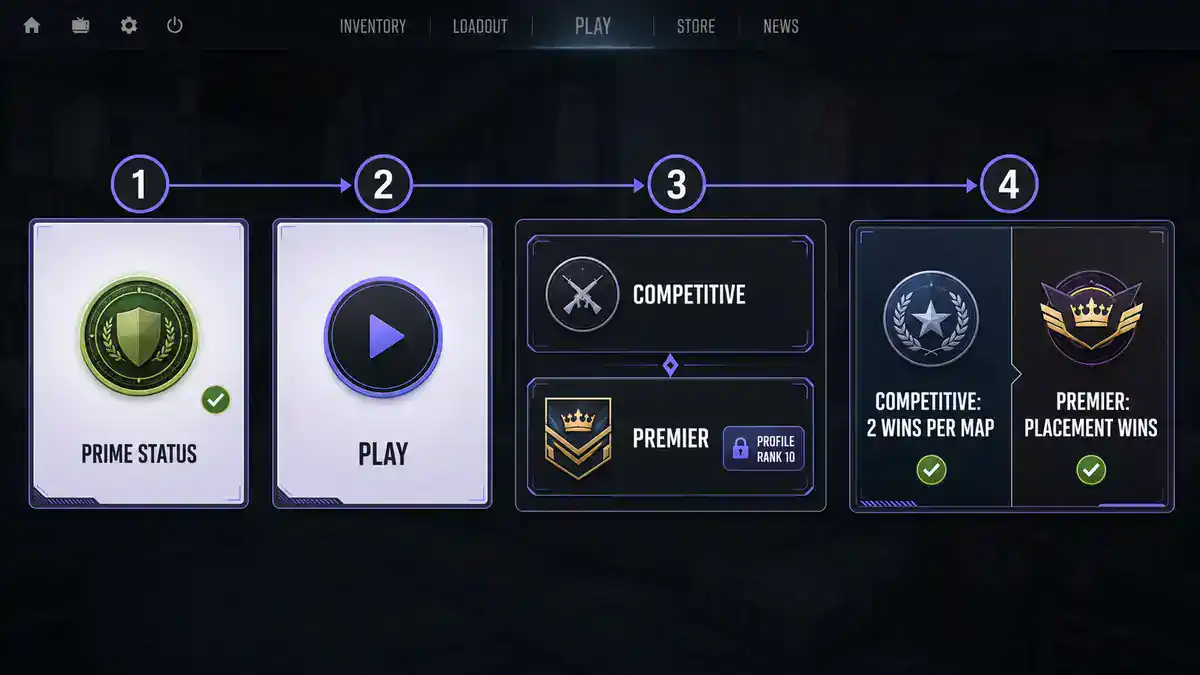
Prime Status in CS2 is required for the full ranked ecosystem and provides Prime matchmaking eligibility.
A new account also needs to reach Profile Rank 10 before Premier unlocks. Profile Rank comes from XP earned in eligible modes, not from your win-loss record. Consistent weekly play is the fastest way to gain Profile Rank XP.
Getting Your First Rank: 2 Wins vs 10 Placement Wins
Competitive reveals a Skill Group after two wins on a selected map, while Premier reveals your CS Rating after ten Premier wins.
- Choose the queue. Competitive lets you select maps. Premier uses the Active Duty veto process.
- Complete the required wins. Win two Competitive matches on a map to reveal that map’s Skill Group, or win ten Premier matches to reveal CS Rating.
- Keep the systems separate. Another map, Wingman, and FACEIT each maintain their own progression.
Players who meet the account requirements can unlock Premier in CS2 before beginning the ten-win calibration.
If matchmaking itself refuses to connect, diagnose the unreliable matchmaking connection rather than confusing a network error with a rank restriction.
Can You Queue With Friends at a Different Rank?
Yes, but CS2 can block an incomplete party when its Skill Groups or CS Ratings are too far apart. Competitive commonly uses a five-Skill-Group limit. Premier no longer has a trustworthy universal 5,000 or 10,000 figure, and current full five-stacks can span a much wider rating gap.
Rating gap too wide
Wider range allowed
Illustrative lobby message. The live client is the source of truth for the current party restriction.
How Many Wins to Rank Up in CS2?
There is no fixed number of wins that guarantees a rank-up after placement. Two Competitive wins on one map reveal that map’s first Skill Group, while ten Premier wins reveal the first CS Rating. After that, Competitive uses a hidden calculation and Premier shows the rating gained or lost before each match.
| Queue | Initial requirement | After placement |
|---|---|---|
| Competitive | Two wins on a selected map | No public fixed win count. Results, opponent strength, and hidden confidence all affect movement. |
| Premier | Ten wins | The client shows the CS Rating change available for the next match. |
| Wingman | Separate calibration | Its 2v2 Skill Group moves independently of Competitive and Premier. |
A streak can move a rank faster than alternating wins and losses, but nobody outside Valve can convert a streak into a guaranteed promotion. Track several sessions, not one scoreboard.
How to Rank Up Faster in CS2
Valve does not expose the exact matchmaking formula, so nobody can promise a rank-up after a set number of kills or wins. The practical goal is to make winning more repeatable. After reviewing my own ranked sessions, the largest improvements came from fixing recurring round losses rather than chasing a higher scoreboard position.
Train Aim and Crosshair Placement
Use a short routine you can maintain. Ten focused minutes of counter-strafing, first-bullet accuracy, and recoil work is more useful than an occasional hour of unfocused deathmatch. Purpose-built CS2 aim training maps make those drills measurable.
Learn the Map Pool Properly
Start with spawn timings, default defensive positions, two entry smokes, two flashes, and the common post-plant positions. Then add situational lineups. This order makes knowledge usable in real rounds. Competitive’s per-map ranks are ideal for the process because a weak map can improve without hiding behind results from your best map.
Clear CS2 map callouts make that knowledge useful to the rest of the team when a round changes quickly.
Manage the Round Economy
Five coordinated rifles are usually stronger than two rifles surrounded by weak buys. Check team money before purchasing, account for the CS2 loss bonus and economy, and decide whether the round is a full buy, low investment, or save. Better purchases cannot guarantee a win, but they create more rounds with realistic equipment.
Play With a Regular Team
A teammate dying is not automatically a failed entry if you immediately trade and secure the site. Stay close enough to react, but not so close that one spray or grenade removes both players. On defense, avoid giving separate one-versus-one fights when a crossfire can force the opponent to clear two threats.
Useful comms state location, number of enemies, damage when known, and immediate intent. “Two B, bomb seen, falling back” is actionable. Long complaints cover footsteps and distract teammates. If you are dead, share the necessary information once, then let the surviving player hear the round.
Fix Your Settings and Peripherals
Stable CS2 settings make performance easier to compare across sessions.
Keep your CS2 sensitivity stable long enough to judge progress instead of copying a different professional whenever a practice session feels difficult.
Professional configurations can provide useful reference points, but CS2 pro settings should not replace analysis of your own decisions.
Why Am I Not Ranking Up in CS2?
A rank can stay unchanged when wins and losses cancel out, when results come against weaker opposition, or when useful team impact remains inconsistent. Valve does not expose the hidden calculation, so focus on repeatable round outcomes instead of searching for one missing statistic.
Watch the rounds where the team had an advantage and still lost. Ask whether your position could be traded, whether you had useful utility at death, and whether the clock supported the peek.
Account behaviour can also affect CS2 Trust Factor, but Trust Factor is separate from your visible Skill Group or CS Rating.
If ranked matchmaking will not connect, treat it as a network or client problem rather than a rank restriction. Work through these unreliable matchmaking connection fixes before queueing again.
CS2 Wingman Ranks
Wingman is a separate two-versus-two mode played on compact bombsite layouts. It uses the same 18 badge names from Silver I to The Global Elite, but your Wingman rank does not set your five-versus-five Competitive rank or Premier rating. Shorter rounds and fewer players make trading, clutching, and grenade efficiency unusually important.
Use Wingman for rapid repetitions of close-site decisions, not as a direct conversion tool for the main ladders. The smaller two-player Wingman format changes the value of trades, grenades, and individual survival.
The Wingman rank system still uses the familiar 18 badges, even though its results remain separate from five-versus-five matchmaking.
Danger Zone also had its own historical progression, represented by a separate set of Danger Zone ranks.
CS2 Ranks vs FACEIT Levels
FACEIT is a third-party competitive platform with its own Elo rating and Levels 1 through 10. It does not share matchmaking data with Valve, so there is no official conversion. FACEIT’s public guide places a new general account around 1,000 Elo, and the Challenger designation is reserved for the top 1,000 Level 10 players in a region.
| FACEIT level | FACEIT Elo | Rough CS2 comparison | Important caveat |
|---|---|---|---|
| 1 to 3 | Up to 1,050 | Silver through Gold Nova | New accounts and skill variance make this broad |
| 4 to 6 | 1,051 to 1,550 | Gold Nova through Master Guardian | Team structure differs by queue |
| 7 to 8 | 1,551 to 1,850 | MGE through Legendary Eagle | FACEIT map and veto experience matters |
| 9 | 1,851 to 2,000 | LEM through Global Elite | No official Valve conversion exists |
| 10 | 2,001 and above | Global Elite and high Premier | Level 10 has a very wide skill ceiling |
Level 10 is not a single narrow equivalent to Global Elite because it includes everyone above its entry threshold, including professional players. This wide ceiling is why FACEIT ranks and Elo should be treated as their own benchmark.
CS2 Profile Level and XP Ranks (Rank 1 to 40)
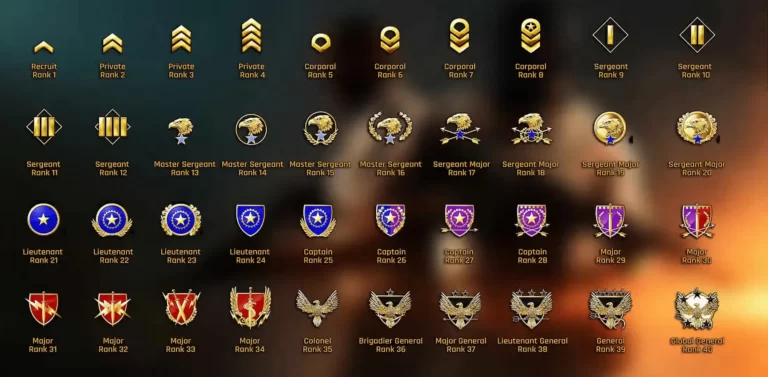
Profile Rank is the account XP ladder from Rank 1 to Rank 40. It measures activity and unlock progress, not matchmaking skill. You gain XP from eligible game modes, receive a weekly bonus pool, and can reset Rank 40 for the current Service Medal when Valve makes that year’s medal available.
Profile Rank matters because it gates features such as Premier access for newer accounts. It does not rise when your CS Rating rises, and a Level 40 account can still have a modest Competitive rank. The separate XP Overload indicator also reflects activity rather than matchmaking skill.
How to Check Your CS2 Rank and Stats
Open Play in CS2 and choose the relevant mode. Competitive shows the badge attached to each calibrated map. Premier shows CS Rating on the mode card, lobby, and leaderboard once you have completed the placement requirement. Wingman displays its own badge when that queue is selected.
For broader performance history, trusted stat tools can supplement CS2’s match data. When checking CS2 statistics, focus on metrics that explain recurring round outcomes rather than one summary score.
Some external services request a numeric account identifier. A Steam ID lookup confirms the correct identifier without changing any rank or match data.
Stats are most useful when they answer a specific question. Opening-duel success can test whether early aggression is working. Trade rate can reveal poor spacing. Utility damage can show whether lineups create value. A single overall rating should not replace round review or become an excuse for ignoring team outcomes.
Do CS2 Ranks Reset? Seasons and Recalibration
Premier follows seasons. When a new season starts, Valve can archive the previous leaderboard, hide visible CS Rating, and require ten wins before the recalibrated number appears. Valve announced Season 5 in July 2026 through an official counter-strike.net update, introducing Cache to the Active Duty pool in place of Overpass.
A Premier season reset does not automatically mean every map-specific Competitive rank was erased. Competitive ranks can separately expire or require recalibration after inactivity or a Valve adjustment. That distinction matters when a player sees one mode hidden and assumes the entire account lost its progress.
The exact CS2 rank reset rules depend on the mode and the type of recalibration Valve applies.
Season 5 changed the map pool and Premier cycle without turning every rank into the same system. After any CS2 seasonal update, focus on the displayed placement requirement rather than trying to reconstruct the hidden formula from a few matches.
Common CS2 Rank Misconceptions
The most common rank mistakes come from treating separate systems as one ladder. Competitive rank is map-specific, Premier is account-wide, Profile Rank measures XP, and cosmetics do not influence matchmaking.
“My Competitive Rank Is My Overall CS2 Rank”
Competitive ranks are map-specific. Saying “I am DMG” is incomplete unless you identify the map. Premier provides the closest thing to one broad first-party rating because it follows you across the entire Active Duty pool.
“Kills Directly Award Rating Points”
Premier shows a win and loss forecast before the match. Strong individual play helps create the result, but CS2 does not display a fixed number of rating points per kill. Playing only for exit frags can improve a scoreboard while reducing the team’s chance to win.
“A Specific Number of Wins Guarantees a Rank-Up”
The placement requirements are visible, but later rank movement is not a simple punch card. Opponent strength, current estimates, recent outcomes, and Valve’s hidden systems matter. A streak can move a player quickly, while alternating wins and losses may hold the same visible range.
“The Global Elite and 30,000 Premier Are the Same Rank”
They are different systems with different populations and ceilings. The Global Elite is the eighteenth Competitive badge on one map. A 30,000 CS Rating begins the Yellow Premier tier and sits in rare leaderboard territory. Any conversion between them is approximate.
“Expensive Skins Improve Matchmaking”
Skins change appearance, not recoil, hitboxes, rating gains, or teammate quality. Inventory value has no competitive effect.
Account behaviour can affect CS2 Trust Factor, but that system is separate from cosmetics and visible matchmaking rank.
CS2 Ranks FAQs
These short answers cover the rank lookups players most often need after comparing Competitive, Premier, and CS:GO terminology.
How many ranks are there in CS2?
CS2 has 18 Competitive ranks, from Silver I to The Global Elite, tracked separately on each map. Premier is a separate system with a CS Rating split into seven colour tiers.
What is the highest rank in CS2?
The Global Elite is the highest Competitive rank. In Premier, the highest visible colour tier is Yellow, which begins at 30,000 CS Rating.
What is the lowest rank in CS2?
Silver I is the lowest Competitive rank. The Gray Premier tier covers CS Ratings below 5,000.
What is a good CS2 rank?
Gold Nova Master and above represents solid Competitive progress, while 10,000 CS Rating reaches the Blue Premier tier. The current CS2 rank distribution gives those numbers the necessary population context.
Are CS:GO ranks the same as CS2 ranks?
Yes. The same 18 rank names carried into CS2 Competitive. CS2 now tracks them separately for each map instead of assigning one badge across the entire pool.
What CS Rating is equivalent to The Global Elite?
Valve provides no official conversion. Community samples place The Global Elite roughly around 20,000 CS Rating and above, but the two systems measure different player pools.
Can you play ranked CS2 with friends at a different rank?
Yes, within the lobby rules shown by the live client. Competitive commonly limits incomplete parties to five Skill Groups, while a full Premier five-stack can span a wider rating gap than a smaller party.
Do you need Prime to play ranked in CS2?
Yes. CS2 Prime Status is required for ranked matchmaking, and Premier also requires Profile Rank 10.
Why is my CS2 rank not showing?
A rank can be hidden after inactivity, during Premier recalibration, or before you complete the required wins. Competitive also hides a map rank until you win twice on that map.
Do CS2 ranks reset every season?
Premier CS Rating is recalibrated when a new season begins. Competitive map ranks and Profile Rank are separate, so the current CS2 reset rules must be checked by mode.