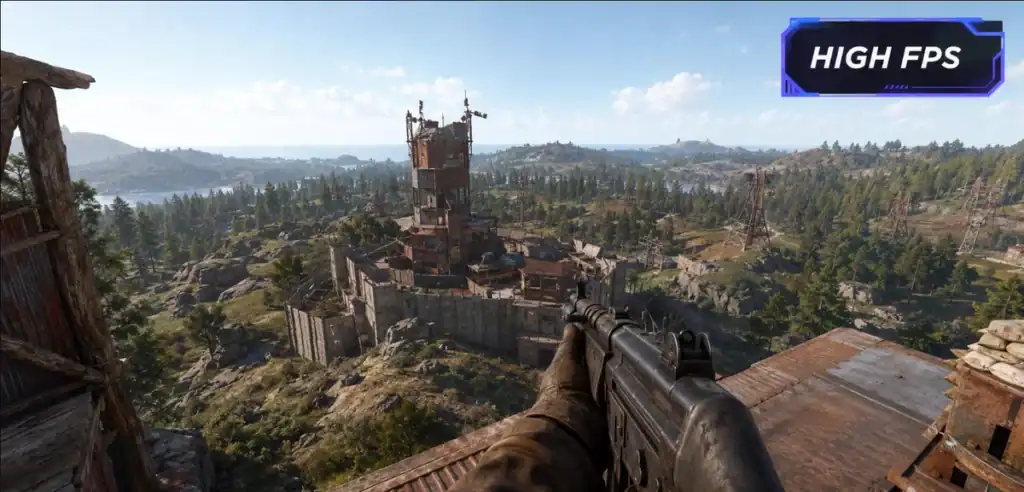

Rust might look perfectly fine right up until the point where the server gives your PC something unpleasant to think about. A peaceful spawn beach is easy. A forest beside a monument, with two compounds in view and players moving through the area, is not. That’s when the graphics setup either holds together or starts dropping frames at the worst possible time.
Best Rust graphics settings for 2026: start with shadows on Low, water reflections Off, and draw distance between 1500 and 2000. Keep native resolution until GPU usage is consistently near 100 percent, then test DLSS or render scale. The goal is a stable frame rate in compounds and monuments, not the highest number on an empty beach.
Peak FPS is given far too much attention. The number might look wonderful while you are standing still, then it will plummet as soon as you turn toward a large base. These dips are more significant because they affect aiming, movement, and the timing you build around Rust recoil patterns. Instead of watching the game fluctuate between impressive and awful, I would rather cap it at a number that it can realistically maintain.
Use Tradeit’s Rust guides to connect graphics, controls, monuments, and progression without mixing unrelated changes into one test.
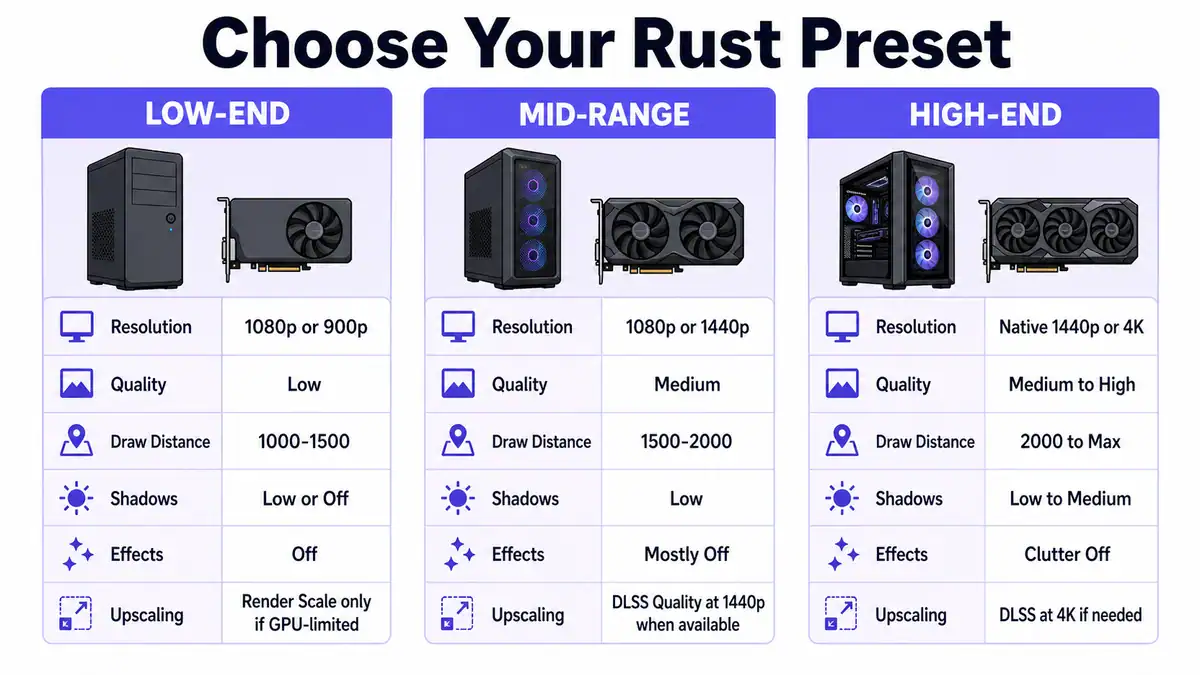
Explore Rust GuidesRecommended Settings by System Tier (Low / Mid / High)
Hardware labels only go so far in Rust. A powerful graphics card combined with an older CPU may run beautifully in open terrain and then stumble near a crowded compound. Another system may be limited by the GPU nearly everywhere because it pushes 1440p or 4K with heavy shadows. The game alternates between both types of bottleneck.
Opt for the tier based on where performance actually breaks down, not just the one that sounds flattering.
Low-End
GTX 1060 class, older CPU, 16 GB RAM
If possible, stay at 1080p. Set Graphics Quality to Low, shadows to off or low, and keep object and tree quality low. A draw distance around 1000 to 1500 is usually enough to stop the game from wasting resources on scenery you cannot meaningfully use.
Turn effects off. Render scale should be kept the same at first; decrease it only if GPU usage approaches its maximum. If 1080p still pushes the card hard, then 900p is likely to be the next good option.
Mid-Range
RTX 3060 or RX 6600 class
Native 1080p should be comfortable, and 1440p can work with a few concessions. Begin with Medium Graphics Quality, leave shadows on Low, and set object and tree quality to around Medium. A draw distance of 1500 to 2000 avoids the worst pop-in without placing too heavy a burden on the CPU.
Most effects can still go. Owners of RTX graphics cards playing at a higher resolution can try DLSS Quality before decreasing the output resolution itself.
High-End
RTX 4070 and above
Run native 1440p or 4K, use Medium to High Graphics Quality, and keep object and tree settings in the medium-to-high range. If the CPU remains comfortable, then draw distance can extend past 2000.
There is still little reason to maximize each option. Low or medium shadows are easier to justify, effects can remain off for cleaner fights, and the FPS cap should be set below the point where performance begins to swing wildly.
| Setting | Low-End | Mid-Range | High-End |
|---|---|---|---|
| Resolution | 1080p, test 900p only if GPU-limited | 1080p or 1440p | 1440p or 4K |
| Graphics Quality | Low | Medium | Medium to High |
| Shadows | Off or Low | Low | Low to Medium |
| Draw Distance | 1000 to 1500 | 1500 to 2000 | 2000 or higher if CPU headroom allows |
| Object and Tree Quality | Low | Medium | Medium to High |
| Water Reflections | Off | Off | Off for PvP, optional for screenshots |
| Upscaling | Off at native 1080p, lower render scale only if needed | DLSS Quality at 1440p on RTX | DLSS Quality at 4K on RTX |
Check the limiter before you start cutting things. Find a demanding view and turn slowly while watching FPS and GPU usage. A GPU that is running around 95 to 100 percent, followed by a clear FPS improvement when you lower the resolution or render scale, indicates a graphics bottleneck.
But what if GPU usage is significantly lower? Try lowering the resolution anyway as a quick test. If performance barely moves, then the CPU is likely busy with players, structures, entities, or world streaming. Rust frequently changes its mind from one part of the map to another, which is frustrating but normal.
For a GPU limit, I would first investigate shadows, water reflections, foliage, and effects. For a CPU limit, draw distance and object-heavy detail matter more, while shutting down background programs may help more than reducing resolution. Mixed case? Fix the worst dips and leave the prettier areas alone.
Keep an eye on the 1% lows in addition to the average. An average of 110 FPS tells only half the story if combat drops into the 40s. A mostly flat 80 can feel better because aiming does not suddenly turn heavy when the area gets crowded.
Which In-Game Graphics Settings Actually Improve FPS?
For a proper test an ugly location is needed. Trees, buildings, a road, a monument or large compound, and preferably some player activity. Testing on an empty hillside generates neat numbers, but they do not survive contact with the server.
Use a Repeatable Five-Minute Loop
Don’t overcomplicate it. Spend about a minute standing in the same spot, then run a short route for two minutes. For another minute, turn quickly toward the busiest view. Use the final minute to aim across foliage, rooftops, fences, or anything else that tends to shimmer or pop in.
Record your normal frame rate (FPS), the worst dip you see, and GPU usage. That is sufficient. The route itself is more important than creating a lab that’s absolutely perfect for the test.
Change One Group at a Time
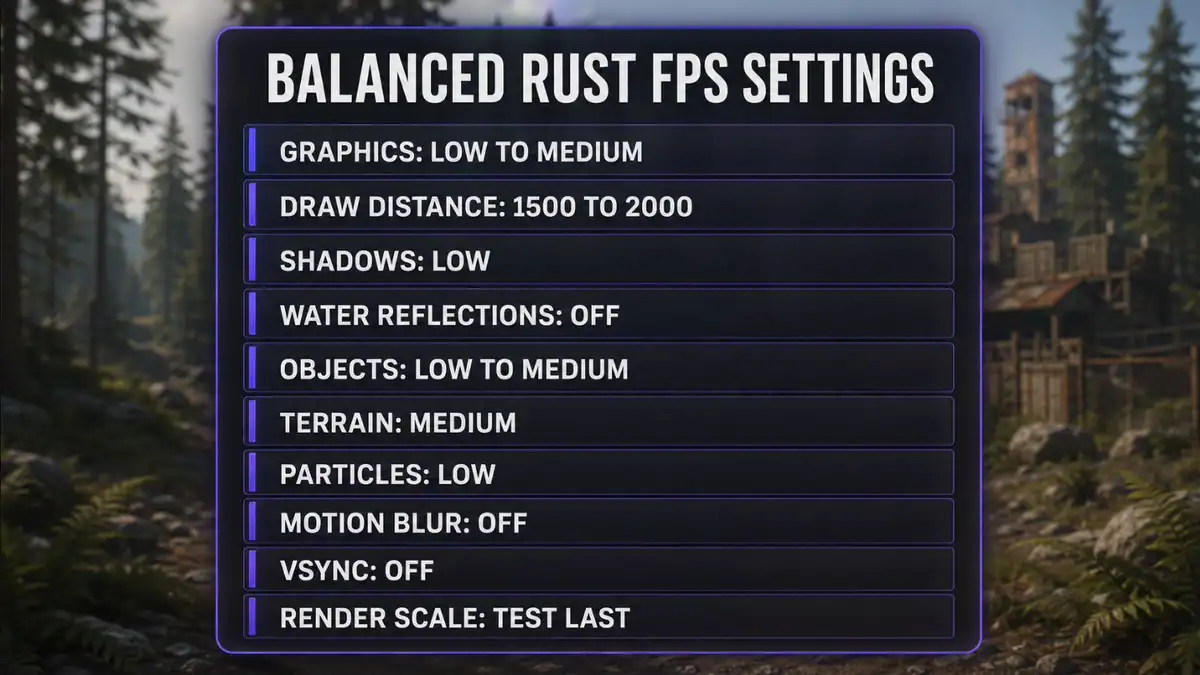
Start with shadows, as forests and layered buildings punish them quickly. Lower shadow quality and cascades, then run the route again. Retain the change only if the rough sections improve.
The draw distance is up next, but move it by smaller increments. A huge reduction might help a CPU-bound area while at the same time causing structures and silhouettes to appear later. That can cost more in a fight than the recovered frames are worth.
Object Detail and Terrain
Drop object quality one notch, and glance sideways across fences, roof pieces, deployables, and distant cover. If these shapes start to change too aggressively as you move, increase the setting again. Terrain can often stay on Medium, especially when Low makes the ground visibly swap detail beneath you.
Render Scale Last
Render scale lowers the internal resolution of the whole scene. It can bring a saturated GPU under control, but the softness affects everything, including distant targets. It will not rescue a CPU bottleneck. That correction is important.
Settings have implications outside the frame counter. Low shadows may make dark corners easier to read. Reduced draw distance may calm a busy CPU, then create distracting pop-in. Lower object detail cuts scene complexity, yet cover can become less stable at range. There is no clean win across every slider.
Graphics Quality and Draw Distance
| Setting | Starting Point | Expected Change to Test |
|---|---|---|
| Graphics Quality | Low to medium | A Low preset can improve GPU-limited scenes by roughly 10 to 25%, but individual overrides preserve visibility better. |
| Draw Distance | 1500 to 2000 | A 500-point reduction can recover around 3 to 10% in CPU-heavy compounds. Too many cuts make movement harder to read. |
| Shadow Quality | Low | Moving from High to Low commonly returns about 8 to 20% in GPU-limited forests and compounds. |
| Water Reflections | Off | Turning reflections Off can return about 3 to 8% near water, depending on the GPU and scene. |
These ranges are testing targets, not guarantees. Server population, base density, CPU limits, resolution, and the current Rust build can move them substantially. Measure each change on the same route and keep it only when the worst dip improves.
Draw distance deserves restraint. Push it too low and the world starts assembling itself in front of you. That is particularly distracting when using the best guns in Rust across medium range, where a late-appearing object or silhouette can alter a shot.
Mesh, Object, and Terrain Quality
Object quality at Low or Medium is usually enough. Going lower may save a little more, but fences, building pieces, and deployables can switch detail too visibly. I would rather give back a few frames than have cover change shape while I am tracking someone.
Tree quality is different. If forests are where the game consistently struggles, lower it without much ceremony. Grass can also sit on Low for a cleaner image and lighter GPU load, though it does not reveal players who should remain concealed.
Terrain is worth keeping at Medium when the lowest setting creates rough transitions during movement. Particles, meanwhile, should stay Low. Raids and explosions already make the screen busy enough.
Lowest is not automatically better. When geometry flickers, swaps detail too early, or appears late, readability has become part of the performance problem.
Image Effects (Disable These)
Motion blur should be turned off, along with depth of field, lens dirt, and bloom. Also disable sun shafts if you need headroom. This might make the game lose some of its atmosphere. It will make gunfights easier to read.
Switch off motion blur, depth of field, lens dirt, and bloom. Disable sun shafts as well when more headroom is needed. Rust will lose some atmosphere. The gunfight will be easier to read.
Screen and Resolution
Native resolution should be the baseline, because edges, text, and distant movement remain cleaner. Only step down after confirming that the GPU is saturated. Lowering the resolution on a CPU-bound setup will often give you the same bad FPS with a blurrier picture.
fps.limit to a value the PC can hold during crowded scenes, not the number reached on an empty road.
Cosmetics should not interfere with the tuning process. Once the game is stable, browsing the Tradeit Rust store is separate from performance work, but changing appearance and graphics settings at the same time makes comparisons unnecessarily messy.
Best Rust Launch Options for FPS (2026)
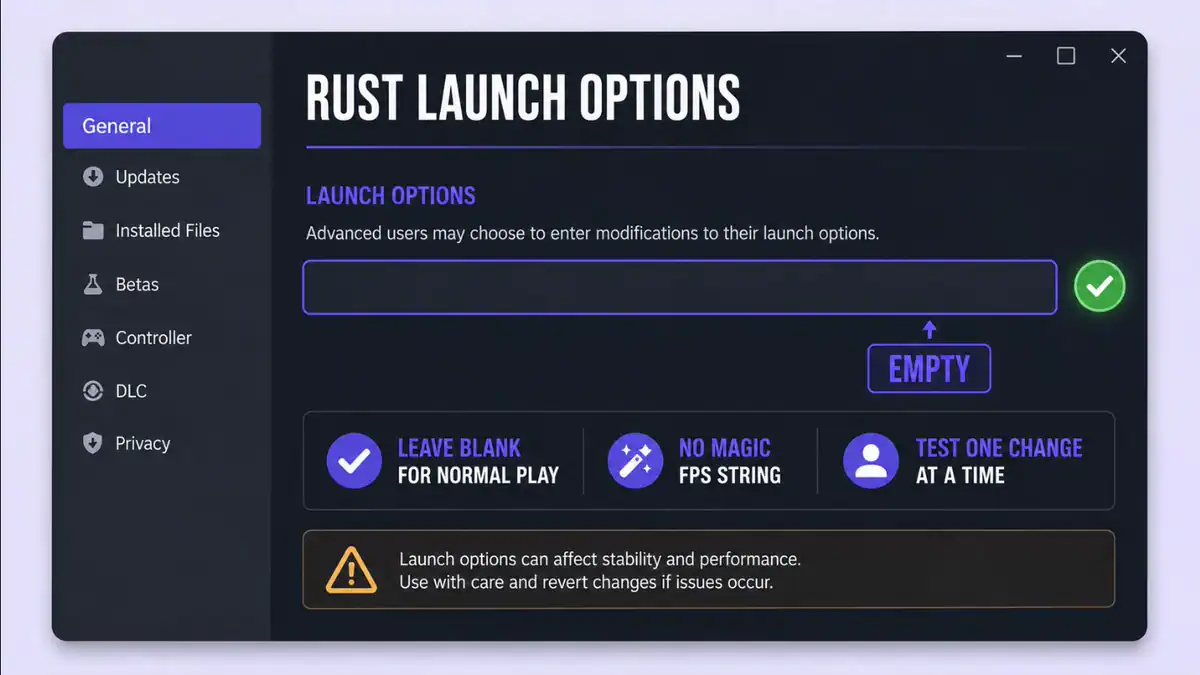
Leave the Steam launch-options field blank.
That sounds less exciting than a long string of commands, which is exactly why bad launch-option advice keeps circulating. Many copied flags are outdated, undocumented, or simply placed in the wrong location. Console commands such as graphics.waves do not belong in Steam launch options.
Leave this field blankA specific option may occasionally be part of diagnosing a specific fault. Fine. Add it deliberately, record what it changes, and remove it when the test is over. Dumping a bundle of memory, CPU, and graphics flags into the field makes every later problem harder to trace.
| Circulated Flag | Why It Should Not Be in the Launch Field | 2026 Recommendation |
|---|---|---|
-graphics.waves 0 | graphics.waves is an in-game console variable, not a supported Steam launch argument. | Do not use it as a launch option. |
-effects.maxgibs -1 | This is another console-style variable commonly copied into the wrong field. | Remove it and tune effects in game. |
-force-d3d11-no-singlethreaded | Old Unity advice is repeatedly recycled without a current Rust-specific benefit. | Leave it out unless Facepunch support requests it for diagnosis. |
-high | Forcing process priority can make background audio, input, or Windows scheduling less predictable. | Use Windows normally and fix the actual bottleneck. |
-malloc=system | Legacy allocator flags are not a reliable FPS fix for the current Rust client. | Remove it from copied bundles. |
NVIDIA and AMD Driver Settings for Rust
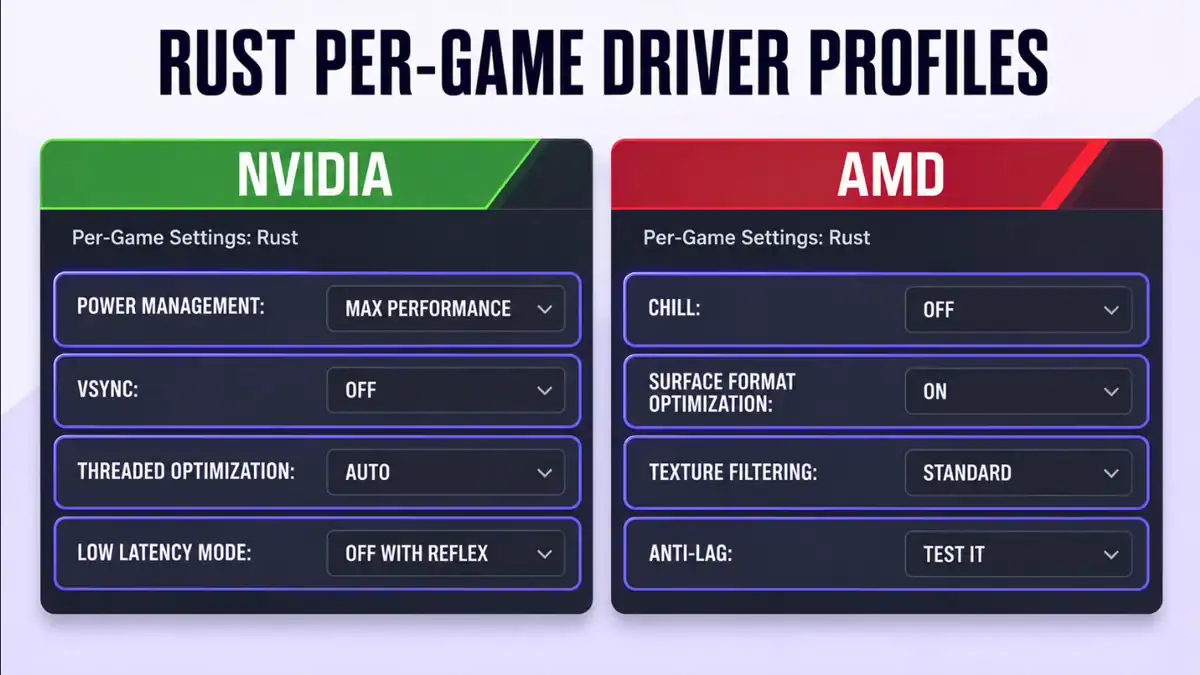
Driver profiles are best kept boring. A small Rust-specific profile is easier to test and undo than a collection of global overrides affecting every game on the PC.
NVIDIA
Configure Power Management to Prefer maximum performance for the Rust profile. Leave VSync turned off and Threaded Optimization set to Auto. When NVIDIA Reflex is enabled inside the game, leave driver-level Low Latency Mode off rather than stacking both systems.
AMD
Turn Chill off. Surface Format Optimization can be retained, and Texture Filtering should continue to remain Standard. Test Anti-Lag, but do not assume that it will improve every setup. If both input feel and frame behavior remain steady, retain it. Otherwise discard it.
Keep performance work separate, then browse Rust skins once your frame rate and visibility are stable.
Browse Rust SkinsWindows Settings That Actually Help Rust
Windows changes should be tested with the same restraint as in-game settings. Their effect is usually smaller than lowering shadows or fixing a saturated GPU, but they can improve consistency on a system with background scheduling or virtualization overhead.
| Windows Setting | Recommended Test | What to Expect |
|---|---|---|
| Game Mode | On | Usually neutral to slightly better. It can reduce background interruptions, so check 1% lows rather than expecting a large average-FPS jump. |
| Hardware-Accelerated GPU Scheduling | Test On and Off | Results vary by GPU and driver. Keep the state with steadier frame times, even if the average changes by only 0 to 3%. |
| VBS / Memory Integrity | Leave security features on unless a measured CPU bottleneck justifies a test | Disabling them can recover a few percent on some CPUs, but it reduces Windows security. Do not trade security for an unmeasured claim. |
| Ultimate Performance | Optional on plugged-in desktops | It mainly prevents aggressive power saving. Expect little change when a normal High Performance plan already holds full clocks. |
No change? Revert it. Driver menus invite tinkering because every option sounds technical, but an option that produces no measurable or noticeable benefit is just another variable waiting to confuse the next diagnosis.
DLSS, FSR and Upscaling in Rust
There’s an important distinction that needs to be kept straight here. Facepunch added native NVIDIA DLSS support to Rust in 2021 for RTX hardware. Render scale is the broader fallback. Both reduce GPU workload, but they do not rebuild the image in the same way.
At 1440p or 4K, DLSS Quality is where I would start. This reduces the internal rendering load while generally retaining more fine detail than a simple render-scale cut. Performance mode is more aggressive and should be used on systems experiencing a serious GPU limitation, not as the first toggle pressed because the label promises more frames.
Non-RTX cards can still use render scale. Lower it gradually, then move through foliage, turn toward rooflines, and watch distant players or structures. The FPS counter might improve before the image stops being pleasant to use. That is the catch.
Neither option fixes a CPU-bound compound. If GPU usage is low and the frame rate is not changing after reducing internal resolution, then stop lowering it. You are only making the picture softer.
How to Reset Rust Graphics Settings
Resetting everything at once can seem decisive, but it throws away the evidence. Work backward instead.
Clear Launch Options
Remove all entries from Rust’s Steam launch-options field. The old flags will be removed before any files are touched.
Verify Files
You can check the game files using Steam and replace any files that are missing or damaged.
Rename the Config Folder
Close Rust and Steam, open Steam\steamapps\common\Rust\cfg\, and rename the folder to cfg_backup. Rust creates a clean cfg folder at the next launch, while the backup preserves personal binds and settings.
Launch the game at defaults first. Then rebuild the graphics configuration in small increments. It is a bit tedious, admittedly. However, it’s much less tedious than discovering that an old config, a launch flag, and a driver override have all been fighting each other.
Common Issues and Troubleshooting
Stutter After Loading Monuments
Storage and memory deserve attention before graphics quality. Keep Rust on an SSD, let shader compilation settle after updates, and verify that the system still has RAM headroom available. A page file should be available rather than disabled. Background programs that hammer storage or CPU can turn normal streaming into visible hitching.
FPS Loss Near Large Bases
Large compounds often expose a CPU limit because the game is processing structures, deployables, entities, and players. Reduce draw distance and object-heavy detail first. Reducing the resolution typically has little impact here, except image quality.
GPU at 100% With Low FPS
Lower shadow quality, water reflections, and effects. Then try DLSS on supported RTX cards or reduce render scale. Also check the temperatures and clock speeds, since a hot GPU might be throttling rather than performing at its expected level.
Low GPU Usage With Poor FPS
The CPU may be the limit, or another program may be consuming resources. Lower draw distance and object detail. Close browsers, recording tools, and CPU-heavy utilities, then test the same area again.
Input Latency Feels Off
Disable VSync, choose an FPS cap the system can maintain, and avoid stacking several low-latency modes without testing them separately. More switches may create less predictable behavior, not less delay.
Reset carefully. Clear launch options, verify files, and rename configuration files instead of deleting them. Keep backups of keybinds. Random flag bundles and irreversible resets tend to bury the cause instead of fixing it.
After frame pacing is settled, cosmetic changes are harmless. Platforms focused on Rust skin trading should be on the customization side of the game, rather than in the middle of a performance test.
FAQ
Does DLSS work in Rust?
Yes. Rust supports DLSS on supported RTX GPUs. Quality mode is the better first choice at 1440p or 4K, while Performance mode trades more image clarity for relief from a heavier GPU bottleneck.
Does Rust support FSR?
Rust’s reliable built-in upscaling path is NVIDIA DLSS on supported RTX hardware. If an AMD or non-RTX setup does not expose a native FSR option in the current graphics menu, use native resolution or reduce render scale gradually and check distant-target clarity after every step.
Should I use Rust launch options for more FPS?
No general launch string is a dependable 2026 FPS upgrade. Start with the Steam launch-options field blank. Add a flag only for a specific, documented troubleshooting case, then remove it after the test.
Best resolution for PVP?
Native 1080p or 1440p provides the cleanest balance of target clarity and stable presentation. Only lower the resolution after confirming that the GPU, rather than the CPU, is preventing the game from holding the desired frame rate.
Do driver tweaks help?
They are able to help with consistency and correct some awkward behavior, but very large FPS gains should not be expected. Make changes within a Rust-specific profile and test them individually, rather than making global overrides.
Fullscreen or borderless?
First try fullscreen mode, then borderless mode in the same difficult location. Select the mode that gives stable frame times on your computer. Whether the mode that is theoretically superior actually works better on the machine does not matter if it performs worse.
Does grass off help?
Lower grass settings reduce visual clutter and some GPU load. They do not expose players who are meant to remain hidden, so treat the change as a modest clarity and performance adjustment rather than a visibility advantage.