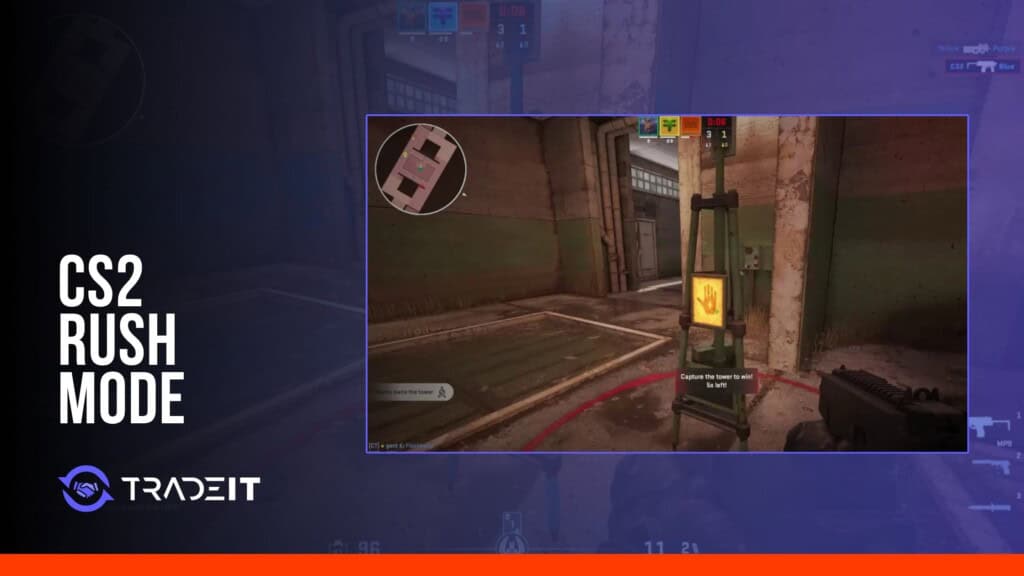


Rush is CS2’s new fast 3v3 mode. Instead of planting a bomb, teams fight to control a tower and push a chain of arenas toward the opposing castle. The Rush Hour update also changed Premier map selection, sound cues, crosshairs and several cosmetic systems. This guide separates Valve’s confirmed changes from the match details that still need first-hand testing.
Quick answer
In CS2 Rush, two teams of three contest a tower in short, randomly selected battle arenas. Hold control when time expires or after eliminating the other team to win the round and push the fight toward its castle. Capture the tower in the enemy castle to win the match. Rush launched with the Rush Hour update on 22 September 2026.
Valve’s mode rules and patch notes are the source for confirmed mechanics. Community-reported economy, timing and arena details are labelled until tested in game.
Teams3 vs 3
ObjectiveControl the tower
Match finishTake the enemy castle
LeaderboardFriends wins
What Is Rush Mode in CS2?
Valve describes Rush as a queued 3v3 fight through a set of randomly chosen arenas. A round is not won merely by getting kills. The team must control the tower once the opponents have been eliminated, or hold it when the round timer ends. Each round moves the battle along the arena chain. A successful capture in the other team’s castle ends the match.
This is a compact objective mode rather than a smaller Competitive match. It has no C4 plant, site retake or usual round-long buy phase. Its friends leaderboard tracks wins, but Valve has not announced a separate Rush skill rating. If you are comparing it with every existing mode, our CS2 game modes guide provides the wider context.
How to Play Rush in CS2
- Open Play in CS2. Use the standard matchmaking menu, not a community-server browser.
- Select Rush. Look for the new 3v3 mode among the official queues.
- Invite friends if you want. Queue as a group of up to three, or let matchmaking fill unused slots.
- Start matchmaking and play the tower. Watch which team controls the objective at each arena, then fight for that state rather than chasing a last elimination.
Do you need Prime?
Steam Support says non-Prime accounts can access official modes other than Premier, although only Prime accounts receive XP and Weekly Care Packages. That supports Rush being available without Prime, but account-specific matchmaking behavior should still be checked in the client. Our Prime guide explains the difference.
How a Rush Match Works
The tug-of-war
Think of Rush as a path with your castle at one end, the enemy castle at the other and a neutral starting position in between. A round win pushes the next fight toward the losing side. Early guides describe seven positions drawn from the arena pool. If that structure holds, four consecutive wins from the center reach and capture the opponent’s castle. That is an interpretation of the launch layout, not an extra rule stated in Valve’s short announcement.
A loss can pull the contest back the other way. That is why the score alone is less informative than the location of the next arena. Call out the direction of travel to teammates after every round.
Taking and holding the tower
Valve uses “tower” for the objective. The essential rule is control, not kills. If you wipe the other team, still move onto the objective before the post-elimination window expires. If the timer runs down with both teams alive, the tower controller wins. Do not abandon it to chase a player retreating away from the capture zone.
A technical reading of Rush’s map script indicates the use key interacts with the tower. The exact capture UI should be verified in the live match before treating that as a universal on-screen prompt. The same script shows why a team wipe is not identical to an instant objective capture.
Who begins with the tower?
Early play reports say the team that lost the previous round starts the next one in control, making the winner attack and the loser defend. This is useful tactical advice but needs direct match confirmation. At the start of a round, read the control indicator rather than assuming your last round’s role carried over.
Round timers and the Convoy decider
Launch guides report 40-second standard rounds and 60-second castle rounds. The exact values are not in Valve’s short announcement, and the 23 September follow-up patch changed some post-elimination countdowns. Treat older launch-day timer tables with caution. Valve increased the maximum post-elimination window to 14 seconds in end rooms and Convoy.
Community guides describe a 7-7 tie after fourteen rounds leading to a final Convoy arena. Convoy is a decider, not one of the ordinary 15 arena names below. Its moving-train layout makes positioning especially costly. The best answer for a close match is to preserve utility and avoid a careless fall, not to assume an overtime series.
All 15 CS2 Rush Arenas
The launch arena overview shows two castle rooms and 13 smaller battle spaces. The layouts below are visual reads of those overhead plans, not claimed measurements or official callout names. Each match draws a different sequence.
| # | Arena | Layout and first read |
|---|---|---|
| 1 | T Assault | T-side castle room with a broad floor, an upper rail-like obstruction and L-shaped cover near the tower. Clear the tower pocket before crossing the open lane. |
| 2 | Spire | Cross-shaped floor around a circular central pillar. Players can swing around either side of the ring, so check the far side before using the tower. |
| 3 | Wallbang | Staggered partitions break the center into several short crossing angles. Clear the gaps one by one instead of treating the middle as a safe straight lane. |
| 4 | Big Box | A large square structure blocks the direct sightline between spawns. The side openings are the practical routes into the tower area. |
| 5 | Sewer | Round chamber with curved inner barriers and a central opening. Both arcs reconnect near the tower, making the opposite flank easy to miss. |
| 6 | Dogleg | A large central square creates a right-angle route around its perimeter. Expect first contact at the far corner of the block. |
| 7 | Drop | U-shaped room around a circular central platform. Two outer wings lead toward the tower, so check the opposite wing before holding the point. |
| 8 | Crane | Wide, shallow room with the tower in an upper-center pocket and a smaller block below it. A lower cross-lane connects the approaches. |
| 9 | Playhouse | Long room divided by vertical partitions, with the tower in a boxed central area. The narrow side passages create close-range entry angles. |
| 10 | Madhouse | Square arena filled with staggered cover around the central tower. Several gaps open onto the point, so a teammate can cover a second angle. |
| 11 | Tunnel | Long, narrow corridor with small side bays and the tower on its centerline. There is little room for a wide flank once the main lane is contested. |
| 12 | King of the Hill | Broad room built around a large central platform with the tower in the middle. Short approaches converge on the same exposed objective. |
| 13 | Marksman | Long horizontal room with a central lower recess around the tower. Check the far-side long angle before stepping into that recess. |
| 14 | Horseshoe | A large U-shaped central void separates two side arms. Both arms lead toward the tower at the top of the room. |
| 15 | CT Assault | CT-side castle room with a broad lane, scattered blocks and side pockets. Use the cover to approach the final tower rather than crossing the open floor. |
Convoy is separate from these 15 rooms and is used as the 7-7 decider. The tower is the objective in every arena, but the cover and approach angles change from room to room.
Rush Economy: Money, Buys and Grenades
Rush gives little time to deliberate. Buy for the next small arena and the likely direction of the push, not for a full-length Competitive round. Early guide figures agree on some values and disagree on others. Until we record them in-game, the table below is a launch-report checklist, not Tradeit’s measured economy data.
| Reported value | Launch reports | Confidence |
|---|---|---|
| Starting money | $800 | Single guide, needs test |
| Money cap | $10,000 | Single guide, needs test |
| Buy window | 15 seconds | Single guide, needs test |
| Standard kill reward | $300 | Single guide, needs test |
| Loss bonus start and step | $2,100, then $750 increments | Two guides broadly agree |
| Loss bonus cap | $4,350 or $5,100 | Guides conflict. Do not treat either as settled |
| Round win reward | $2,500 | Single guide, needs test |
Valve’s patch notes say the grenade purchase limit setting now also limits the total grenades a player can buy in a round. Launch guides report a one-grenade Rush allowance. That connection is plausible, but Valve did not explicitly say the setting change was made for Rush.
What to buy
On tight layouts, a cheaper weapon plus armor can preserve money for the next push. A rifle is stronger on longer sightlines, but buying it at the expense of basic protection may be the wrong trade in a 3v3. Since a match can turn quickly, discuss whether the team buys together. One player saving alone can leave the tower approach effectively two against three.
How to Win in CS2 Rush: Seven Mode-Specific Tips
- Play the tower, not the scoreboard. One player should be ready to secure control while the other two watch approaches.
- Save the grenade for the objective. With a tight utility limit, a smoke or flash used on a side duel may be worth less than one that lets your team enter the tower.
- Trade together. A solo death removes one third of your team. Enter as a pair when an opponent is holding a narrow path.
- Read the spawn exits. In a small arena, the first contact arrives quickly. Identify the route that reaches the tower before the other team.
- Plan one arena ahead. Your next position depends on this result, so keep enough money for the likely follow-up fight.
- Start fast, then slow down. Get useful territory early, but do not sprint past the objective with seconds left.
- Use quiet actions behind cover. A held reload is slower but silent after this update. Use it only when its longer animation will not hand away tower control.
Our CS2 aim training maps can help with first-contact mechanics, but Rush is decided just as much by control and three-player coordination.
Is Rush Good for XP and Weekly Drops?
Some launch guides report 10 XP for a round win, but we have not measured net XP per minute across modes. A short match can feel efficient while still earning less than a longer mode after bonuses. Record several complete matches and account for weekly XP modifiers before declaring Rush the fastest route to a package.
Prime players can use official modes to earn the rank-up that unlocks a Weekly Care Package. That package now sometimes includes a Chicken Egg. The mode itself is not an egg-drop shortcut, and the egg uses both weekly reward picks.
Does Rush Have a Rank?
Valve announced a Rush friends leaderboard, not a separate competitive rank or CS Rating. Treat its wins as a social comparison, not as an equivalent to Premier or Competitive ranks. If Valve adds a rating later, this section will need revision.
Rush vs Wingman, Competitive and Premier
| Feature | Rush | Wingman | Competitive | Premier |
|---|---|---|---|---|
| Team size | 3v3 | 2v2 | 5v5 | 5v5 |
| Main objective | Tower control | Bomb site | Bomb sites | Bomb sites |
| Format | Small arena chain | Short map format | Standard map | Active Duty map |
| Rank | Friends leaderboard | Wingman rank | Map-specific rank | CS Rating |
| Prime for queue | Not indicated as required | No | No | Yes |
Choose Rush for a fast objective fight, Wingman for a two-player bomb mode, or Premier when you want the main CS Rating ladder. None is a direct replacement for the others.
Premier Map Picks: What Changed?
Rush Hour replaced Premier’s map-ban sequence with a pick process. Valve’s order is Team 1 choosing one map, Team 2 choosing two, then Team 1 choosing a fourth. The game randomly selects one of those four. The change is meant to give teams that learn a map a chance to play it rather than see it banned each time.
- Team 1 chooses the first map. This creates one of the four possible outcomes.
- Team 2 chooses two maps. It now controls two positions in the draw.
- Team 1 chooses the fourth map. Both teams have made two selections.
- The game draws a map at random. Prepare for every map in the final set instead of assuming the team’s favorite will win.
If all four picks must be distinct and the draw is uniform, each team controls two of four slots, so the chance of one of your team’s picks is 50 percent. Each individual slot would have a 25 percent chance. Valve’s short notes do not settle whether duplicate map selections are possible or how in-team voting ties resolve. That is why the percentages are conditional, not a guaranteed in-game odds display.
For solo queue, nominate a map your team can actually coordinate on. A comfort pick is less useful if nobody knows the key utility or rotations. Our Premier versus Competitive guide explains what the rating mode asks of a team.
Silent Reloads and Silent Unscoping
How to reload silently
Valve added a held-reload option. Hold the reload key to reload more quietly, at the cost of a longer animation. A normal tap retains the faster, audible reload. The patch notes do not give weapon-by-weapon timings, and we have not measured them. Avoid any chart claiming exact second counts without a repeatable test.
Why silent unscoping matters
Unscoping a sniper rifle no longer produces the former sound cue. Opponents cannot rely on hearing an AWPer leave the scope, which affects close peek decisions. The shot itself and other movement cues still matter. If you are holding an angle, do not infer that silence means the sniper is still scoped.
How to adapt
Behind safe cover, the slower quiet reload can conceal your magazine state. During a tower contest, speed may matter more than silence. Pair the action with teammate coverage and keep an eye on the short clock. Our CS2 audio settings guide has the wider sound-cue context.
Everything Else in the Rush Hour Update
Crosshairs and the Dynamic Quad default
Crosshairs are now resolution independent, and Valve grouped related options under a Crosshair/Scopes settings tab. It also added styles and changed the default to Dynamic Quad. Existing share codes should be tested rather than assumed to render exactly as before. Our crosshair code guide is the natural place for specific presets.
Clan tags return
Players can again use Steam Community Groups for clan tags. The option is account and group dependent, so check that you have joined the correct group before looking for its tag in CS2 settings. This is a display identity feature, not a new matchmaking system.
Stickers on the C4
The planted-bomb tool has become another sticker surface. The update creates room for new sticker craft ideas, but a sticker’s market price does not become a “C4 price.” Test appearance in the live inspect view before buying a combination solely for this placement.
Clearer visual feedback and grenade limits
Valve adjusted bullet impact decals and blood visibility. Those changes can make hit feedback easier to read, but they are visual indicators rather than proof that damage changed. A separate grenade purchase setting now caps total grenades bought in a round. Server and mode settings determine how it applies.
Starjunk 95 music kit
Starjunk 95’s Industrial Sunset Memories arrived in the in-game store in standard and StatTrak versions. Music kits change presentation rather than combat. For other choices, see our CS2 music kits guide.
Pet chickens
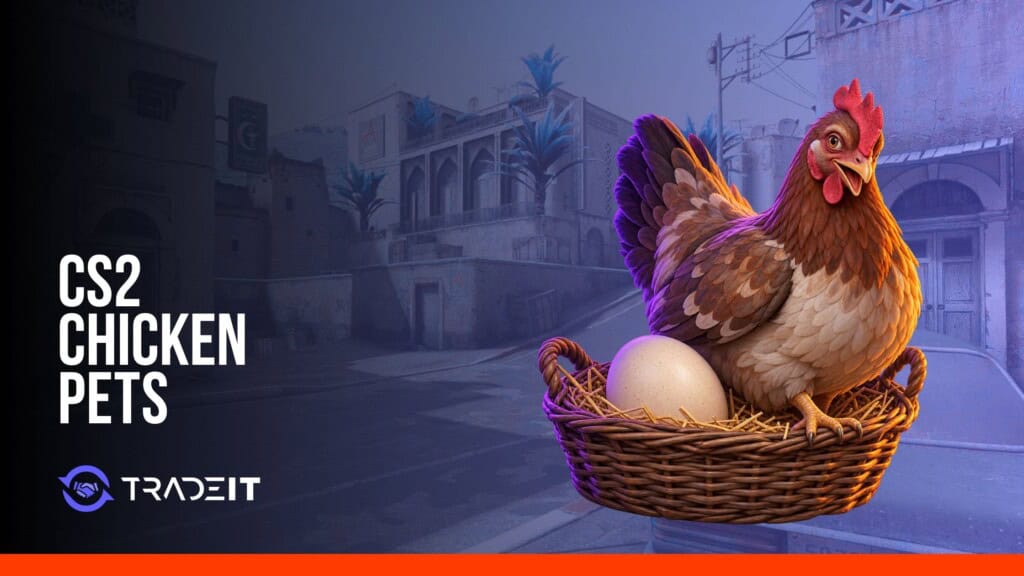
Valve did not document pets in the Rush Hour announcement, but players found Chicken Eggs in Weekly Care Packages. They are cosmetic and untradable. Our CS2 pets guide covers the egg, feed, HatchBook and the file-backed breed list without pretending the first hatch has already been verified.
Map, Workshop and scripting changes
Valve also made smaller geometry and clipping fixes on Ancient, Cache, Mirage and Train. Workshop and scripting additions included minimap and sky-camera tools plus radar and money-related scripting hooks. Those changes matter most to map makers and server creators, not to the basic Rush queue.
What Still Needs Testing?
We will not present disputed loss-bonus caps, exact match length, per-round XP efficiency, all 15 arena routes, or silent reload seconds as Tradeit measurements. The next useful update is a timed match log with screenshots of the queue, objective, buy screen, end-of-match XP and Premier picks. Valve’s Rush Hour announcement remains the source for the core mode rules.
CS2 Rush FAQs
What is Rush in CS2?
Rush is a queued 3v3 objective mode where teams push through small arenas by controlling a tower.
How many arenas are there?
Early guide lists identify fifteen ordinary arenas. Convoy is described as a separate 7-7 decider.
Do you need Prime?
Steam Support reserves Premier and weekly rewards for Prime, not the ordinary official mode queues. Confirm the Rush queue on your account if its availability looks different.
Is there a Rush rank?
Valve announced a friends leaderboard, not a separate Rush rank. For the ranked ladders, see our CS2 ranks guide.
How long is a match?
Early reports range from a few minutes for a sweep to around fifteen for a close match. We have not measured a reliable average.
Can you queue with friends?
Yes. Rush is a three-player team mode, so you can bring up to two teammates.
Is Rush good for XP?
It may be convenient for short sessions, but XP per minute has not been measured here. Prime is required for the Weekly Care Package.
Is Rush permanent?
Valve has not labelled it a limited-time event. We will revise this answer if its queue status changes.
Can you still ban maps in Premier?
No. The Rush Hour update replaced the old ban sequence with four picks and a random draw.
When did Rush Hour launch?
Valve dates the announcement to 22 September 2026. Some coverage uses 23 September because of time zones.
Final Take
Rush rewards tower control and compact teamwork more than raw kill count. Start with Valve’s core rules, use the arena list as a reference, and treat economy and timing numbers as provisional until a proper match log settles them.