

A friend asks for your CS2 rank. Do you give them your Mirage badge, your Premier rating or your FACEIT level? Those answers belong to different ladders. Here’s how to read each one, from Silver I to Global Elite and the numbered Premier tiers.
Professional CS2 world rankings measure tournament performance, not your matchmaking rank.
On this page
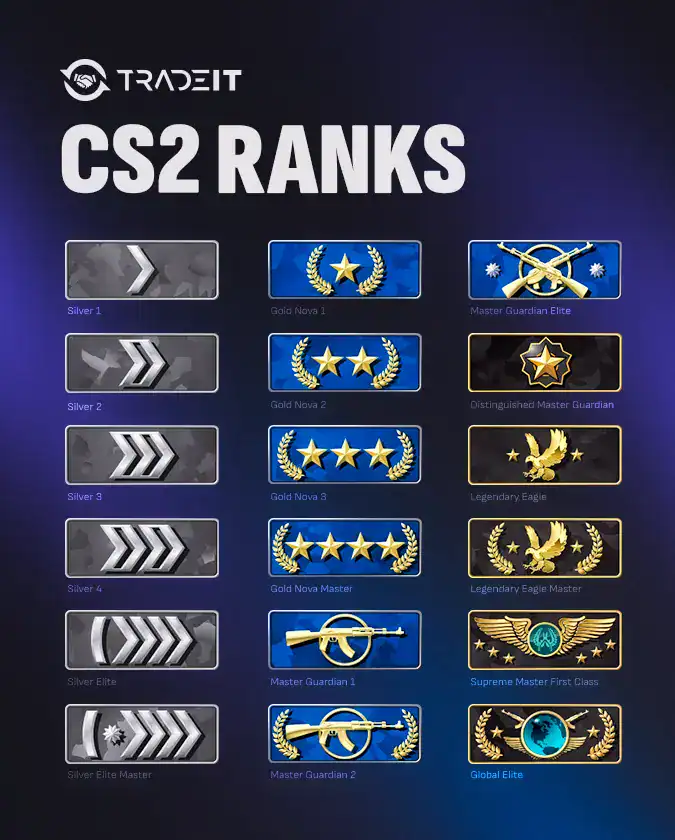
All 18 CS2 Competitive Ranks in Order
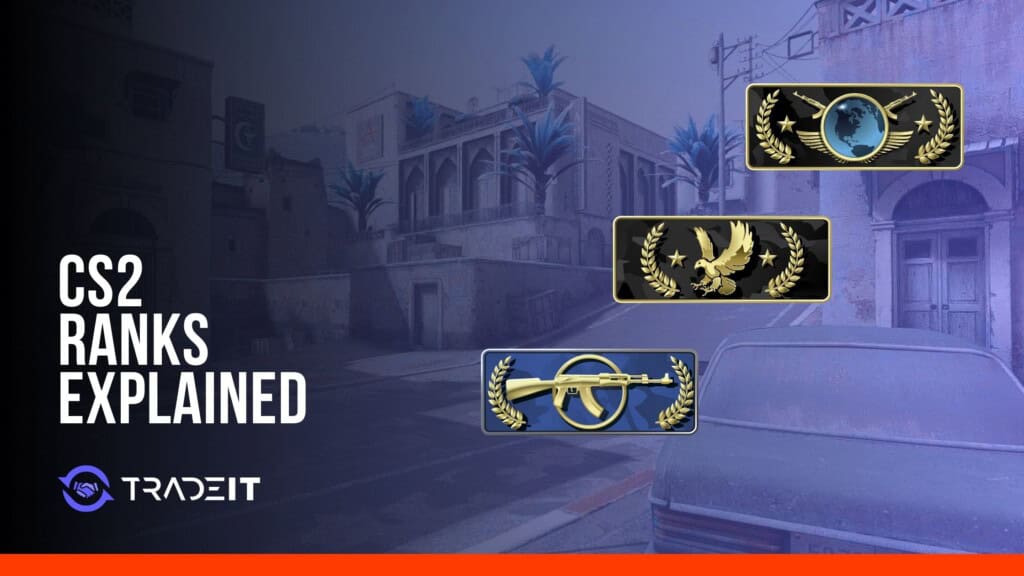
The familiar badges survived CS:GO: Silver I remains the first, The Global Elite the eighteenth. CS2’s 2023 launch changed what the badge belongs to. It’s now a map rank, so Master Guardian II on Mirage can sit beside Gold Nova I on Ancient on the same account. We’ve included practice suggestions for each rank below. They aren’t Valve’s promotion checklist, or a claim that everyone with a particular badge plays the same way.
| Rank of 18 | Rank and icon | Tier | Informal name | General benchmark |
|---|---|---|---|---|
| 1 |  Silver I Silver I | Silver | Silver 1, S1 | Learning movement, recoil, and map basics |
| 2 |  Silver II Silver II | Silver | Silver 2, S2 | Starting to use utility and common angles |
| 3 |  Silver III Silver III | Silver | Silver 3, S3 | More consistent crosshair placement |
| 4 |  Silver IV Silver IV | Silver | Silver 4, S4 | Basic trading and team positioning |
| 5 |  Silver Elite Silver Elite | Silver | SE | Developing reliable rifle mechanics |
| 6 |  Silver Elite Master Silver Elite Master | Silver | SEM | Coordinating simple executes and retakes |
| 7 |  Gold Nova I Gold Nova I | Gold Nova | Nova 1, GN1 | Competent fundamentals with visible gaps |
| 8 |  Gold Nova II Gold Nova II | Gold Nova | Nova 2, GN2 | Better team play and grenade timing |
| 9 |  Gold Nova III Gold Nova III | Gold Nova | Nova 3, GN3 | Consistent trading and sound rotations |
| 10 |  Gold Nova Master Gold Nova Master | Gold Nova | Nova Master, GNM | Structured play begins to matter |
| 11 |  Master Guardian I Master Guardian I | Master Guardian | MG1 | Strong fundamentals and punishable mistakes |
| 12 |  Master Guardian II Master Guardian II | Master Guardian | MG2 | Reliable mechanics under pressure |
| 13 |  Master Guardian Elite Master Guardian Elite | Master Guardian | MGE | Good utility knowledge and mid-round reads |
| 14 |  Distinguished Master Guardian Distinguished Master Guardian | Master Guardian | DMG | Advanced team play and efficient decisions |
| 15 |  Legendary Eagle Legendary Eagle | Legendary Eagle | LE | High-level mechanics with few free mistakes |
| 16 |  Legendary Eagle Master Legendary Eagle Master | Legendary Eagle | LEM | Refined spacing, reads, and utility |
| 17 |  Supreme Master First Class Supreme Master First Class | Supreme | Supreme, SMFC | Near-elite execution and adaptability |
| 18 |  The Global Elite The Global Elite | Global Elite | Global, GE | The top Competitive Skill Group |
Silver Ranks (Ranks 1 to 6)
There are six badges to work through before Gold Nova. For practice, choose something small enough to notice in the next match. That might be aim kept at head height, a clean stop before the first shot, or getting closer to the player you’re supposed to trade. A couple of grenades you can recall without looking them up will also go a long way.
Silver I
S1, or Silver 1, is where the badge list begins. Try walking your normal route out of spawn and looking at where the crosshair sits. If somebody appeared around the next corner, how far would you have to move it? Bringing it up from the floor is a simple correction to practise alongside movement, recoil and buying.
Silver II
S2 comes next. Pick an entrance you use often and identify the positions that overlook it. A smoke may remove one of those worries while you cross. Before reloading, find cover too. A few rounds left in the magazine can still win a fight; being caught halfway through a reload makes that much harder.
Silver III
S3 is the third Silver badge. Look at the first shot in a lost fight before blaming the spray. Had you stopped moving? Practice the stop and shot together, then take the habit into clearing individual angles. On voice, a quick location beats explaining the whole fight while your teammate is still in it.
Silver IV
At S4, try reviewing a teammate’s death from your own position. Could you see their opponent in time to trade? If not, your distance may be worth changing. After a plant, the objective changes too: keeping the bomb safe can be worth more than chasing a retreating player for another kill.
Silver Elite
Silver Elite, or SE, is fifth. Check the team’s money before spending your own. Buying a rifle during everyone else’s save can leave you broke for their next full buy. Then check your position: can two opponents from different angles shoot you, or have you kept the fight in front of you?
Silver Elite Master
SEM finishes the Silver group. Put a few habits together in one simple site take: a grenade, contact and a teammate ready to trade. Don’t judge the plan on a single round. And when a retake is unlikely to work, keeping the rifle can give the next round a better start.
Gold Nova Ranks (Ranks 7 to 10)
The four Gold Nova badges fill places seven to ten. Timing is a useful practice theme here. Did the flash arrive before the entry? Did you rotate because of information, or because nothing had happened near you for a while? A kill that arrives too late to affect the round won’t rescue the earlier decision.
Gold Nova I
Nova 1 or GN1 starts the tier. Before an entry, agree on one small plan: who flashes, who goes first and which angle needs clearing. Running past that angle to hunt deeper can leave the same defender waiting for everyone behind you. The first kill isn’t the only measure of a useful entry.
Gold Nova II
GN2 is the second Nova badge. Watch a narrow entrance in your demo: were you blocking the first player, or so far away you couldn’t trade them? After an early peek, remember that information travels both ways. If you showed the angle, the opponent has a reason to aim there next time.
Gold Nova III
At GN3, review the decisions made between fights. The clock and the last known enemy positions can help explain whether a rotation made sense. Utility doesn’t have to be spent immediately either. An unused smoke may be valuable on the retake; throwing it at an empty entrance removes that option.
Gold Nova Master
GNM is the tenth badge and the last Nova. Try helping create the opening without taking the opening duel yourself. A flash, a short call or being close enough to trade may be the contribution the entry needs. You can keep practising aim and still find rounds where support was the missing piece.
Master Guardian Ranks (Ranks 11 to 14)
Master Guardian covers another four badges. When watching a demo, pause before the result is decided. What did you know at that moment? How did the opponent answer your usual opening? It is easier to spot a bad decision there than to call every lost round an aim problem.
Master Guardian I
MG1 is eleventh overall. Pick one setup that failed and ask what gave it away. Maybe the opponent had seen the angle, or you repeated the timing. Change that detail next time. You don’t have to abandon careful angle clearing just because a familiar opening stopped working.
Master Guardian II
For MG2 practice, time your arrival after a teammate dies. The trade may have become difficult before you took the duel, simply because you were late. Counter-strafe drills still have a place outside matches. In the match, notice when the opponent has learned your usual pace and try changing it.
Master Guardian Elite
MGE, badge thirteen, is a good excuse to review your calls. Could a teammate tell where to go from what you said? Name the destination and move together, using utility to remove an angle where possible. A good mid-round idea needs a clear instruction, not a speech while the clock runs down.
Distinguished Master Guardian
Distinguished Master Guardian is the full name behind DMG. Find a round where an early five-versus-four lead disappeared. Was the next duel necessary, or could you have held the advantage with utility and less information given away? Winning a fight doesn’t make every follow-up peek a good idea.
The Top Four Ranks (Ranks 15 to 18)
From Legendary Eagle there are four badges left, including Global Elite at the end. Find a round where your team had to abandon its first plan. Who knew about the change, and when? A player moving towards the new opening while everyone else is still following the old call can end up taking a fight alone.
Legendary Eagle
LE begins the top four. Before repeating a defensive angle, replay the previous round from the attackers’ point of view. Did they see you there? Did a sound or grenade reveal the setup? Leave room for another explanation when reading their own clues, rather than betting the whole rotation on one sound.
Legendary Eagle Master
LEM follows LE. Watch an enemy smoke or incendiary near an entrance and plan the move for when it expires. Tell the teammate helping you before that moment arrives. Otherwise you may be through while they’re still preparing, with nobody in place to trade and the rest of the entry still to clear.
Supreme Master First Class
SMFC is usually called Supreme, one step below Global. In a demo, pause after a successful aggressive opening. What would holding that position have achieved? Pushing farther may be justified, but check whether a teammate could still trade it. The first kill doesn’t make an isolated second fight automatically worthwhile.
The Global Elite
Global, or GE, ends the eighteen-rank ladder. In CS2 it still belongs to a map: Global on Mirage doesn’t give you Global on Ancient. Review the avoidable deaths and poor buys even after reaching it. Another map can expose different gaps in timing and utility, and has its own badge to earn.
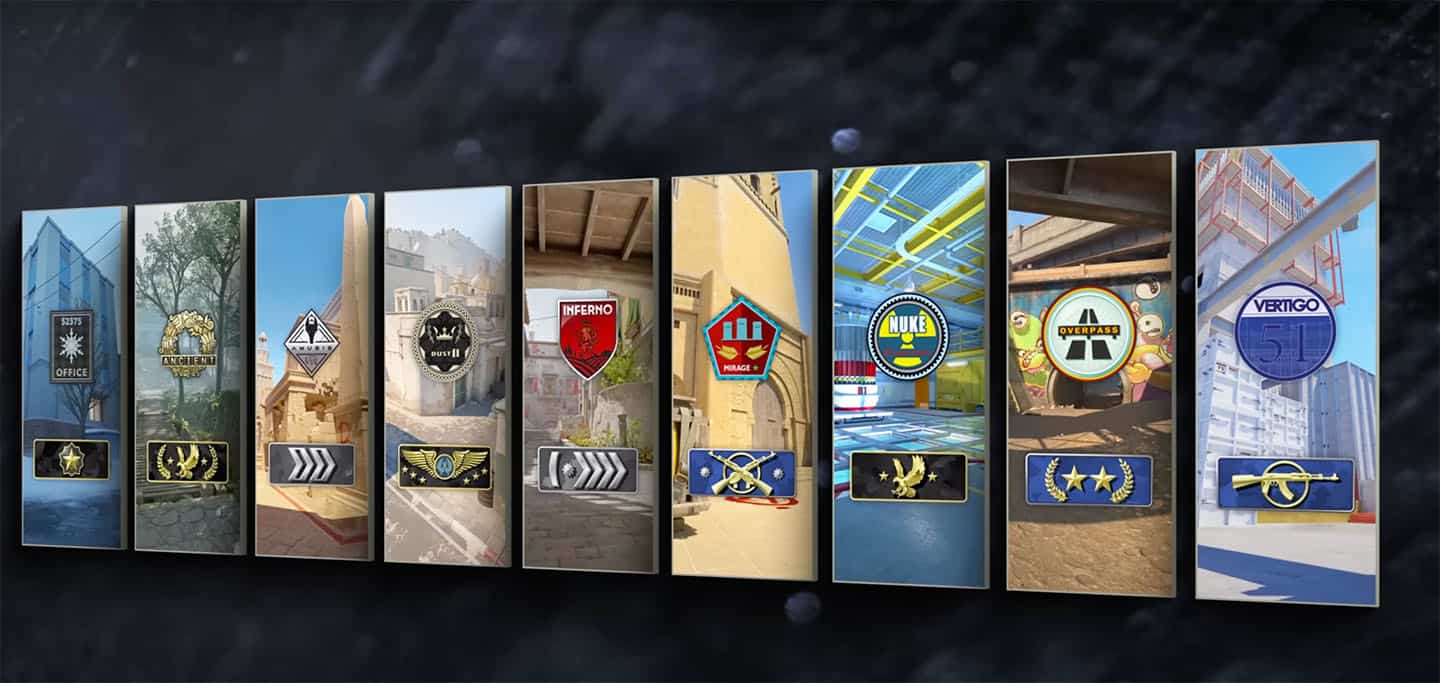
How Map-Specific Competitive Ranks Work
Win twice on a Competitive map to reveal its Skill Group. From there, results on that map feed its own hidden skill estimate. A Mirage session doesn’t directly raise or lower your Inferno badge. There isn’t one Competitive rank sitting above them all.
That separation is useful when learning maps. Your aim might be comfortable on both Mirage and Ancient while your Ancient utility and rotations still need work. A lower badge there can reflect the difference. When someone asks your Competitive rank, include the map with the answer.
CS2 Premier Ranks and CS Rating Tiers
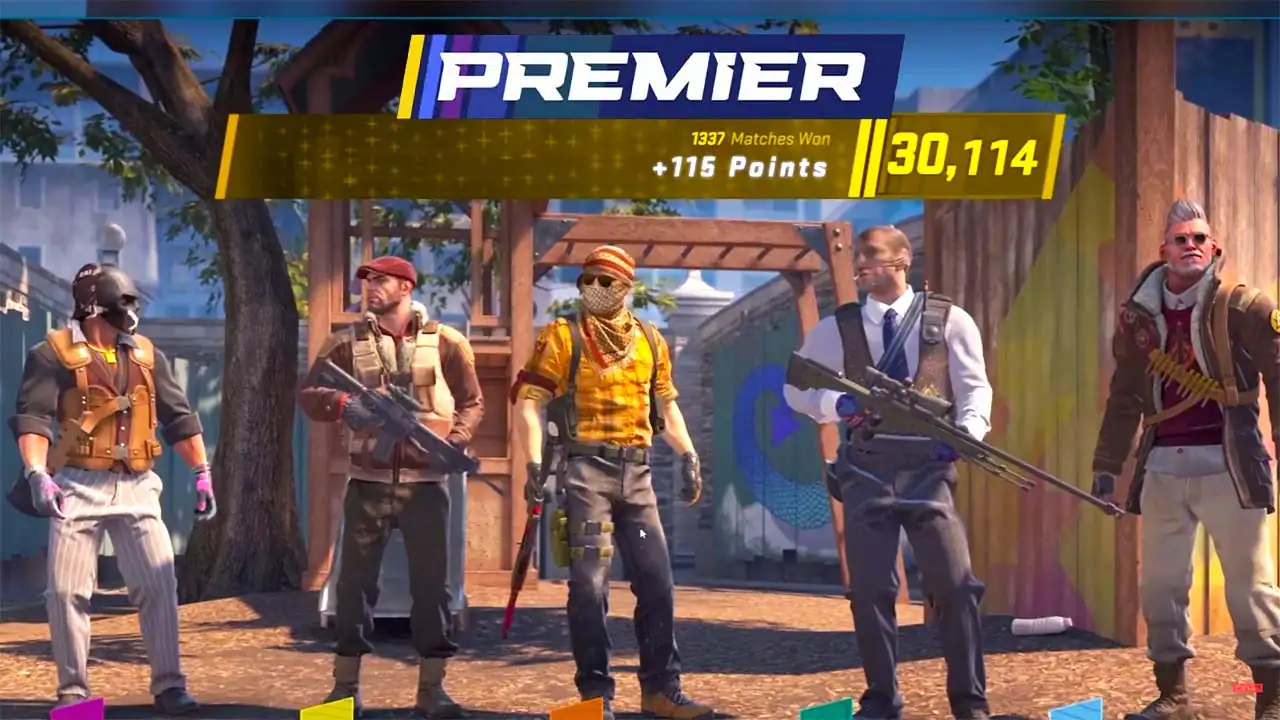
Premier gives you a number instead of a badge: CS Rating. It appears after ten Premier wins and falls into one of seven colour bands. All Premier maps contribute to that number, so you don’t have to name a map when comparing your rating with a friend’s.
All 7 CS Rating Colour Tiers
The colour tells you the rating band at a glance. Read the number for the detail: two people in blue can still be thousands of points apart.
| CS Rating | Colour tier | Rough share of players | Practical meaning |
|---|---|---|---|
| 0 to 4,999 | Gray | 21.2% | Entry Premier range |
| 5,000 to 9,999 | Light Blue | 23.9% | Developing fundamentals |
| 10,000 to 14,999 | Blue | 26.5% | Established intermediate play |
| 15,000 to 19,999 | Purple | 18.8% | Advanced matchmaking range |
| 20,000 to 24,999 | Pink | 7.7% | High-level Premier play |
| 25,000 to 29,999 | Red | 1.6% | Elite rating range |
| 30,000 and above | Yellow | 0.1% | Top leaderboard territory |
The percentages describe the March 2026 Leetify-based sample published by Esports Tales. They aren’t a live count of Premier players. Rounding leaves the seven bands at 99.8% rather than exactly 100%.
How CS Rating Goes Up and Down
Before you play a Premier match, CS2 shows the rating you’ll gain for a win or lose for a defeat. That’s the useful number to follow. Players often call CS Rating Elo, while MMR usually refers to the hidden matchmaking estimate. Valve hasn’t published the complete calculation behind that estimate.
A win worth 190 points would move 14,500 to 14,690, inside the blue band. Crossing a colour boundary is different: promotion and relegation matches apply at the 5,000-point steps. Follow the promotion prompt in the game instead of assuming the next gain will cross it. Kills contribute to winning, but there isn’t a fixed rating payment for each one.
Loss −115
Illustrative rating forecast. The actual values shown by CS2 depend on your account and recent Premier results.
The Premier Map Pool
Both teams pick two Active Duty maps. CS2 then selects one of the four at random, so preparing only your favourite leaves a lot to chance. Season 5 replaced Overpass with Cache, giving this seven-map pool: Cache, Anubis, Ancient, Dust II, Inferno, Mirage, and Nuke.
The wider CS2 map pool is bigger than Premier’s rotation. Valve can swap Active Duty maps between seasons or in major updates, so check the selection screen if an older list doesn’t match the client.
Once you know the map, short location calls are easier for teammates to act on without talking over footsteps and other useful sounds.
Premier Leaderboards
You can compare Premier ratings on global, regional and friends leaderboards. Account eligibility and recent activity affect whether an account appears. There’s no permanent rating requirement for a particular position either: the board moves when other players win or lose.
The csstats.gg Premier leaderboards are an external view of those results. For your current position, check the board inside CS2.
30,000 is the start of yellow, not a rating cap. One yellow player could still be thousands of points ahead of another. Nor does that ladder rank the best CS2 players by their professional tournament results; that’s a separate comparison.
CS Rating to Competitive Rank: Equivalence Table
A Premier rating doesn’t convert officially into a Competitive badge. The comparison below comes from Leetify’s September 2024 Premier percentiles and August 2023 CS:GO ranks. Those are two older player populations. The table compares their positions on the ladders; it doesn’t award a present-day CS2 map rank to someone with that rating.
- Top four15 to 18
- Master Guardian11 to 14
- Gold Nova7 to 10
- Silver1 to 6
| Premier Rating | Colour Tier | Historical CS:GO Rank Range | How to Read It |
|---|---|---|---|
| 1,000 to 6,768 | Gray to light blue | Silver I to Silver Elite Master | Broad beginner and developing range |
| 7,502 to 11,178 | Light blue to blue | Gold Nova I to Gold Nova Master | Common middle-ladder level |
| 11,179 to 14,588 | Blue | Master Guardian I to Master Guardian Elite | Consistent intermediate mechanics and structure |
| 14,589 to 18,156 | Blue to purple | DMG to Legendary Eagle Master | Advanced matchmaking range |
| 18,157 to 20,000 | Purple to pink | Supreme Master First Class | Near the top of the badge ladder |
| 20,001 and above | Pink and higher | Global Elite | Elite comparison, with a very wide Premier ceiling |
Notice the gaps between some published ranges. They are another reason not to use this as an exact converter, even for the old sample. None of the bands is a promotion requirement, and current CS2 map badges aren’t the CS:GO ranks used in this comparison.
Are CS:GO Ranks the Same as CS2 Ranks?
Yes for names and order, no for what the badge covers. CS2 kept all eighteen names but attached the Competitive rank to an individual map. CS:GO used one badge across the queue.
What Changed Between CS:GO and CS2 Ranks
The big split is between a map’s Skill Group and your Premier number. Competitive still uses the badge ladder, separately for each map. Premier’s CS Rating follows you across its pool instead.
| Feature | CS:GO | CS2 |
|---|---|---|
| Main badge ladder | One Competitive Skill Group across the queue | One Competitive Skill Group for each map |
| Top first-party queue | Competitive matchmaking | Premier with CS Rating and team map picks |
| Visible numeric rating | No standard public number | CS Rating in Premier |
| Leaderboard | No comparable in-client global rating board | Global, regional, and friends leaderboards |
| Competitive placement | Placement process for the overall Skill Group | Two wins on each map to reveal its rank |
| Seasonal recalibration | Long inactivity could hide the badge | Premier seasons can hide and recalibrate CS Rating |
Having a CS:GO badge doesn’t entitle the account to keep it forever in CS2. The new game recalibrates from its own matches, and the central numbered Premier ladder didn’t exist in that form in CS:GO. The wider transition from CS:GO to CS2 also changed smoke behaviour, mechanics, servers and presentation.
Old CS:GO Rank Names Players Still Use
Silver 1, Silver 3, Nova 2, MG1, DMG, LEM, Supreme and Global still mean the familiar badges. They’re shortened names players carried over, not another hidden ranking system. You can use them for CS2’s Competitive Skill Groups as well.
Premier vs Competitive: Which Should You Play?
Want to spend the evening learning Ancient? Choose it in Competitive. Want one number that reflects play across Active Duty, with team map picks and leaderboards? That’s Premier. Competitive gives you more control over what you practise and a separate badge for each map.
| Category | Premier | Competitive |
|---|---|---|
| Progress measure | One numeric CS Rating | One of 18 Skill Groups per map |
| Placement requirement | 10 wins | 2 wins on a selected map |
| Map selection | Each team picks two maps; one of the four is selected at random | Select the maps you want to queue |
| Public comparison | Leaderboards and exact number | Badge comparison on the chosen map |
| Best fit | Broad competitive test | Focused map practice |
A Mirage Competitive win feeds the Mirage Skill Group, not your Premier rating. The reverse is separate too. Those different Premier and Competitive formats are why focused map practice and an account-wide rating can coexist without matching each other.
CS2 Rank Distribution: Where Do You Actually Sit?
A distribution isn’t permanent. New seasons, recalibration and matchmaking adjustments can move it. There are two samples below, and they count different things: Premier players in one, ranked player-map records in the other. Neither is a count of every CS2 account.
Premier Rating Distribution
For the Premier table we’ve grouped the 1,000-point buckets in Esports Tales’ March 2026 Leetify-based sample into colours. Gray plus light blue comes to 45.1% of that sample, below the 10,000 threshold. That tells us where 10,000 sat in the sample, not its guaranteed percentile now. Rounded together, all seven bands add to 99.8%.
| Rating tier | Share of tracked players | What it indicates |
|---|---|---|
| Gray, 0 to 4,999 | 21.2% | About one fifth of the sample |
| Light blue, 5,000 to 9,999 | 23.9% | Just under one quarter of the sample |
| Blue, 10,000 to 14,999 | 26.5% | Largest colour band in this sample |
| Purple, 15,000 to 19,999 | 18.8% | Just under one fifth of the sample |
| Pink, 20,000 to 24,999 | 7.7% | A smaller high-level group |
| Red, 25,000 to 29,999 | 1.6% | A small elite share |
| Yellow, 30,000 and above | 0.1% | Top leaderboard territory |
Competitive Rank Distribution
The Competitive sample is Leetify’s September 2024 public data: over five million ranked player-map records, covering eleven maps. We’ve grouped the badges into rank families below. A person with ranks on several maps contributes several records, so this isn’t a count of unique people.
| Rank family | Ranks included | Share of ranked player-map records |
|---|---|---|
| Silver | Silver I through Silver Elite Master | 41.92% |
| Gold Nova | Gold Nova I through Gold Nova Master | 47.23% |
| Master Guardian | Master Guardian I through DMG | 10.67% |
| Legendary Eagle | Legendary Eagle and Legendary Eagle Master | 0.18% |
| Supreme and Global | SMFC and Global Elite | Less than 0.01% |
Adding Silver and Gold Nova gives 89.15%, about nine in ten records. Don’t turn that into nine in ten accounts: one account may appear on several maps. That difference matters when reading CS2 rank distribution charts from different modes or different recalibrations.
A CS2 rank reset can hide or recalibrate ratings without changing the definitions of the ladders. Placement requirements and retained history depend on the mode.
How to Start Playing Ranked CS2
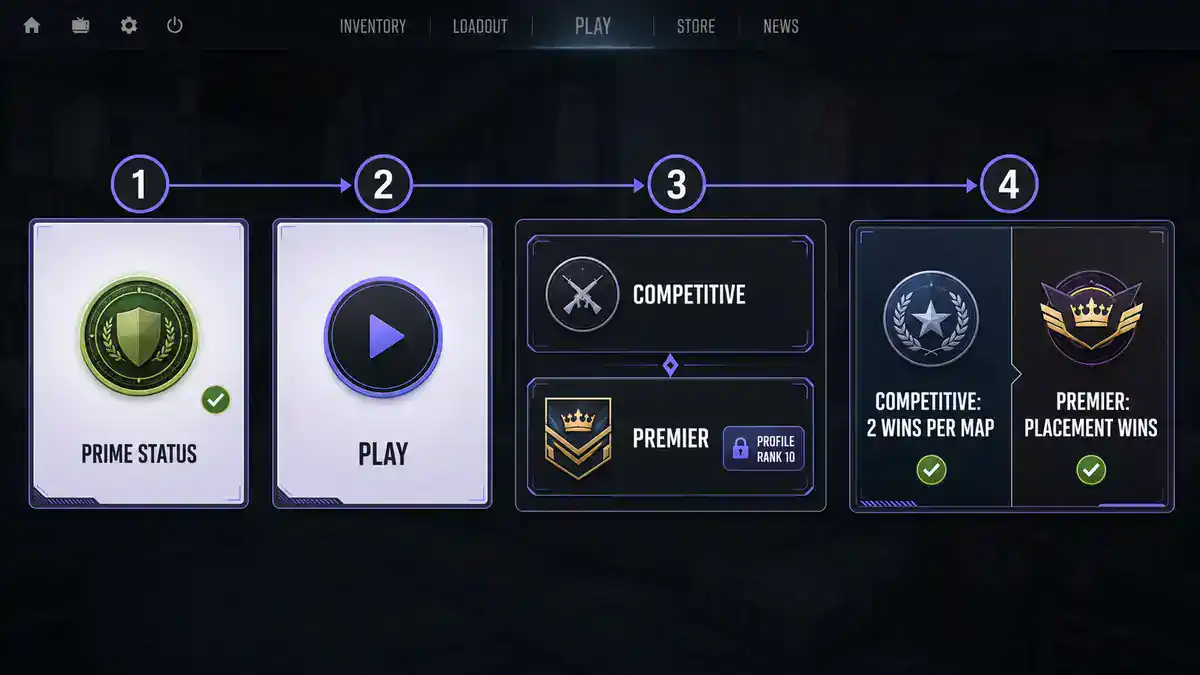
First check access, then worry about placement wins. Prime is an account status, Profile Rank is the XP level and a Skill Group is the Competitive badge. The game displays them near one another, but they aren’t interchangeable requirements.
Prime Status and Profile Level Requirements
Prime Status in CS2 is required for the full ranked ecosystem and provides Prime matchmaking eligibility.
On a new account, Premier also needs Profile Rank 10. You reach that through XP, not a required win-loss record. Eligible modes and the weekly bonus help with earning Profile Rank XP before you begin Premier calibration.
Getting Your First Rank: 2 Wins vs 10 Placement Wins
Competitive reveals a Skill Group after two wins on a selected map, while Premier reveals your CS Rating after ten Premier wins.
- Choose the queue. Competitive lets you select maps. Premier has each team pick two Active Duty maps, then randomly selects one of the four.
- Complete the required wins. Win two Competitive matches on a map to reveal that map’s Skill Group, or win ten Premier matches to reveal CS Rating.
- Keep the systems separate. Another map, Wingman, and FACEIT each maintain their own progression.
Players who meet the account requirements can unlock Premier in CS2 before beginning the ten-win calibration.
If matchmaking itself refuses to connect, diagnose the unreliable matchmaking connection rather than confusing a network error with a rank restriction.
Can You Queue With Friends at a Different Rank?
Yes, although an incomplete party can be refused if the ranks are too far apart. Competitive commonly uses a five-Skill-Group limit. Don’t assume an old 5,000 or 10,000-point rule will predict Premier eligibility: there isn’t a reliable universal figure, and full five-stacks can cover a much wider gap.
Rating gap too wide
Wider range allowed
Illustrative lobby message. The live client is the source of truth for the current party restriction.
How Many Wins to Rank Up in CS2?
You can count down placement wins: two on a Competitive map for its first badge, ten in Premier for the first CS Rating. After that, there isn’t a universal win count to the next rank. Premier shows the points at stake before each match; Competitive doesn’t publish how many wins its hidden calculation needs for your next promotion.
| Queue | Initial requirement | After placement |
|---|---|---|
| Competitive | Two wins on a selected map | Your results update that map’s Skill Group. Valve publishes neither a fixed promotion win count nor the complete calculation. |
| Premier | Ten wins | The client shows the CS Rating change available for the next match. |
| Wingman | Separate calibration | Its 2v2 Skill Group moves independently of Competitive and Premier. |
A winning streak does not come with a guaranteed promotion date. Look at several sessions rather than treating the next match as the one that must move your badge.
How to Rank Up Faster in CS2
There is no published formula you can use to turn a kill target into a rank-up. Instead, find a round your team nearly won and ask what went wrong. Could somebody have traded your peek? Did you die with the flash that would have helped the entry?
Train Aim and Crosshair Placement
Pick a short routine you can repeat. Ten minutes of counter-strafing, first-bullet placement and recoil drills is one option, not a magic duration. On CS2 aim training maps, watch one thing at a time: whether you stopped before firing, for example, rather than just how many bots you killed.
Learn the Map Pool Properly
Learn the routes you use every round before memorizing a rare lineup. Start with spawn timings, defensive positions, a couple of entry smokes and flashes, then common post-plant positions. Competitive tracks each map separately, so you can work on a weaker map without confusing its results with your strongest one.
Clear CS2 map callouts make that knowledge useful to the rest of the team when a round changes quickly.
Manage the Round Economy
Look at everyone’s money before you buy. Two teammates forcing rifles while the rest save leaves the next round awkward too. Agree on a full buy, a small investment or a save, using the CS2 loss bonus and economy to plan what comes next.
Play With a Regular Team
An entry death can still win space if the next player trades it. Stay near enough to react, but leave enough room that one spray or grenade does not take both of you. On defense, hold a crossfire together rather than giving the same attacker two separate duels.
Keep calls short: location, enemy count, known damage and what you are doing next. “Two B, bomb seen, falling back” tells a teammate something they can act on. If you die, give the useful information once, then leave room for the survivor to hear footsteps.
Fix Your Settings and Peripherals
Stable CS2 settings make performance easier to compare across sessions.
Keep your CS2 sensitivity stable long enough to judge progress instead of copying a different professional whenever a practice session feels difficult.
Professional configurations can provide useful reference points, but CS2 pro settings should not replace analysis of your own decisions.
Why Am I Not Ranking Up in CS2?
The badge doesn’t explain the calculation behind it. Start with your recent match results and the close rounds you lost. One scoreboard cannot tell you why the rank stayed put, and Valve’s unpublished formula means a better K/D is not a promise of promotion.
Watch the rounds where the team had an advantage and still lost. Ask whether your position could be traded, whether you had useful utility at death, and whether the clock supported the peek.
Account behaviour can also affect CS2 Trust Factor, but Trust Factor is separate from your visible Skill Group or CS Rating.
If ranked matchmaking will not connect, investigate the connection problem separately from rank restrictions.
CS2 Wingman Ranks
Wingman puts two players against two on compact bombsite layouts. Its 18 badges run from Silver I to The Global Elite, but they stay separate from your five-versus-five Competitive rank and Premier rating. With only one teammate to rely on, a missed trade or wasted grenade is hard to recover from.
Use Wingman for rapid repetitions of close-site decisions, not as a direct conversion tool for the main ladders. The smaller two-player Wingman format changes the value of trades, grenades, and individual survival.
The Wingman rank system still uses the familiar 18 badges, even though its results remain separate from five-versus-five matchmaking.
Danger Zone also had its own historical progression, represented by a separate set of Danger Zone ranks.
CS2 Ranks vs FACEIT Levels
FACEIT has its own Elo ladder and Levels 1 through 10. Once you are playing there, its results are separate from Valve matchmaking. Eligible new accounts can start with Elo based on their Premier rating; otherwise the fallback is 1,000 Elo. The top 1,000 Level 10 players in a region receive Challenger status.
| FACEIT level | FACEIT Elo | Rough CS2 comparison | Important caveat |
|---|---|---|---|
| 1 to 3 | Up to 900 | Silver through Gold Nova | New accounts and skill variance make this broad |
| 4 to 6 | 901 to 1,350 | Gold Nova through Master Guardian | Team structure differs by queue |
| 7 to 8 | 1,351 to 1,750 | MGE through Legendary Eagle | FACEIT map and veto experience matters |
| 9 | 1,751 to 2,000 | LEM through Global Elite | No official Valve conversion exists |
| 10 | 2,001 and above | Global Elite and high Premier | Level 10 has a very wide skill ceiling |
Level 10 is not a single narrow equivalent to Global Elite because it includes everyone above its entry threshold, including professional players. This wide ceiling is why FACEIT ranks and Elo should be treated as their own benchmark.
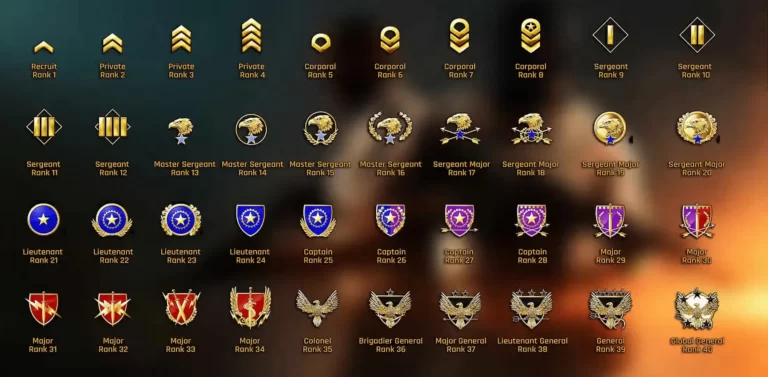
CS2 Profile Level and XP Ranks (Rank 1 to 40)
Profile Rank is the account XP ladder from Rank 1 to Rank 40. It measures activity and unlock progress, not matchmaking skill. You gain XP from eligible game modes, receive a weekly bonus pool, and can reset Rank 40 for the current Service Medal when Valve makes that year’s medal available.
Profile Rank matters because it gates features such as Premier access for newer accounts. It does not rise when your CS Rating rises, and a Level 40 account can still have a modest Competitive rank. The separate XP Overload indicator also reflects activity rather than matchmaking skill.
How to Check Your CS2 Rank and Stats
Open Play in CS2 and choose the relevant mode. Competitive shows the badge attached to each calibrated map. Premier shows CS Rating on the mode card, lobby, and leaderboard once you have completed the placement requirement. Wingman displays its own badge when that queue is selected.
For broader performance history, trusted stat tools can supplement CS2’s match data. When checking CS2 statistics, focus on metrics that explain recurring round outcomes rather than one summary score.
Some external services request a numeric account identifier. A Steam ID lookup confirms the correct identifier without changing any rank or match data.
Choose a question before opening the stats. Are your early peeks winning enough duels? Are you close enough to trade? Does that grenade lineup actually damage anyone? Use the relevant numbers to find rounds worth watching, not one overall rating to explain every result.
Do CS2 Ranks Reset? Seasons and Recalibration
Premier follows seasons. At a season change, Valve can archive the old leaderboard and hide CS Rating until you win ten matches for recalibration. Season 5, announced in July 2026, also brought Cache into Active Duty in place of Overpass.
A Premier season reset does not automatically mean every map-specific Competitive rank was erased. Competitive ranks can separately expire or require recalibration after inactivity or a Valve adjustment. That distinction matters when a player sees one mode hidden and assumes the entire account lost its progress.
The exact CS2 rank reset rules depend on the mode and the type of recalibration Valve applies.
Season 5 changed the map pool and Premier cycle without turning every rank into the same system. After any CS2 seasonal update, focus on the displayed placement requirement rather than trying to reconstruct the hidden formula from a few matches.
Common CS2 Rank Misconceptions
A Competitive badge, a Premier number and a Profile Rank describe different things. Mixing them up leads to most of the claims below.
“My Competitive Rank Is My Overall CS2 Rank”
Competitive ranks are map-specific. Saying “I am DMG” is incomplete unless you identify the map. Premier provides the closest thing to one broad first-party rating because it follows you across the entire Active Duty pool.
“Kills Directly Award Rating Points”
Premier tells you the rating at stake before the match. It does not award a displayed fixed number of points for each kill. An exit frag may look good on the scoreboard while doing nothing to recover a round you could have helped your team win earlier.
“A Specific Number of Wins Guarantees a Rank-Up”
The wins needed for placement are stated. A universal number for later rank-ups is not. Competitive’s calculation is private, while Premier displays the rating change for your next result. Someone else’s streak cannot tell you which match will promote your account.
“The Global Elite and 30,000 Premier Are the Same Rank”
Global is the eighteenth Competitive badge on a particular map. Reaching 30,000 CS Rating puts you in Premier’s Yellow tier. They do not convert directly: the queues have different player populations and different ranking scales.
“Expensive Skins Improve Matchmaking”
Skins change appearance, not recoil, hitboxes, rating gains, or teammate quality. Inventory value has no competitive effect.
Account behaviour can affect CS2 Trust Factor, but that system is separate from cosmetics and visible matchmaking rank.
CS2 Ranks FAQs
Still sorting out a badge, a rating or a placement requirement? Here are the quick answers.
How many ranks are there in CS2?
CS2 has 18 Competitive ranks, from Silver I to The Global Elite, tracked separately on each map. Premier is a separate system with a CS Rating split into seven colour tiers.
What is the highest rank in CS2?
The Global Elite is the highest Competitive rank. In Premier, the highest visible colour tier is Yellow, which begins at 30,000 CS Rating.
What is the lowest rank in CS2?
Silver I is the lowest Competitive rank. The Gray Premier tier covers CS Ratings below 5,000.
What is a good CS2 rank?
Gold Nova Master and above represents solid Competitive progress, while 10,000 CS Rating reaches the Blue Premier tier. The current CS2 rank distribution gives those numbers the necessary population context.
Are CS:GO ranks the same as CS2 ranks?
Yes. The same 18 rank names carried into CS2 Competitive. CS2 now tracks them separately for each map instead of assigning one badge across the entire pool.
What CS Rating is equivalent to The Global Elite?
There is no official conversion to today’s CS2 Competitive ladder. The often-quoted 20,000 comparison comes from historical Premier-to-CS:GO percentile data, not a rule that turns a current Global Elite map rank into that rating.
Can you play ranked CS2 with friends at a different rank?
Yes, within the lobby rules shown by the live client. Competitive commonly limits incomplete parties to five Skill Groups, while a full Premier five-stack can span a wider rating gap than a smaller party.
Do you need Prime to play ranked in CS2?
Yes. CS2 Prime Status is required for ranked matchmaking, and Premier also requires Profile Rank 10.
Why is my CS2 rank not showing?
A rank can be hidden after inactivity, during Premier recalibration, or before you complete the required wins. Competitive also hides a map rank until you win twice on that map.
Do CS2 ranks reset every season?
Premier CS Rating is recalibrated when a new season begins. Competitive map ranks and Profile Rank are separate, so the current CS2 reset rules must be checked by mode.