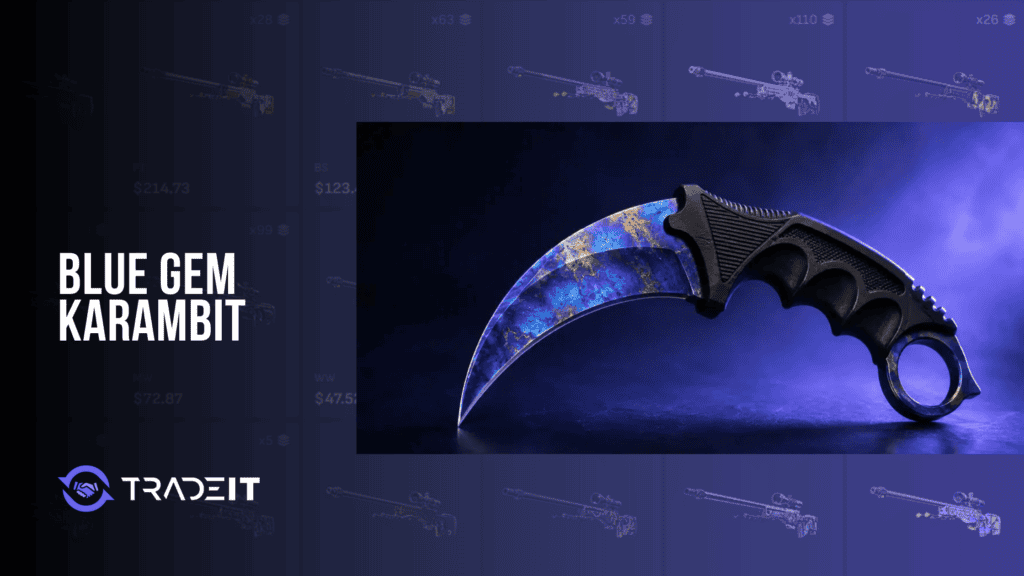


Karambit Case Hardened Blue Gems keep drawing attention for a reason. You get rarity, a clear visual identity, and a pattern system that can be checked and compared.
Among all seeds, #387 is the reference point most collectors fall back on. It shows extremely strong blue across the play side and is commonly used to judge every other Karambit Blue Gem.
Screenshots alone are not enough. It is crucial to know how seeds perform and what makes up the ‘play’ side of a seed, as well as comparing real trade with offers and discussions.
This guide remains focused on those basics. It uses a play-side method similar to Pricempire and separates confirmed activity from reported numbers and rough estimates.
For wider acquisition context, the guide to how to get a knife in CS2 compares direct buying, trading, and case opening before you choose a specific Blue Gem pattern.
What Is a Blue Gem Karambit?
A Blue Gem comes from the Case Hardened finish when a specific seed produces heavy blue on the blade. Every Case Hardened item rolls a seed between 0 and 999. That seed fixes the color layout forever, so once it is created, it never changes.
Most seeds mix gold, gray, and small bits of blue. Blue Gems stand out because the blue is dominant, especially on the visible play side. With the Karambit’s curved shape, that viewing side matters more than anything else during normal gameplay.
Marketplaces do not always agree. Some rate the full surface, while others care only about what appears during play. This guide focuses on the play side because that is what buyers see and judge in game.
A small blue patch is not enough. Confirm the seed, check the visible side, and inspect the model before treating a knife as a tiered Blue Gem pattern.
Karambit Blue Gem Pattern Tiers
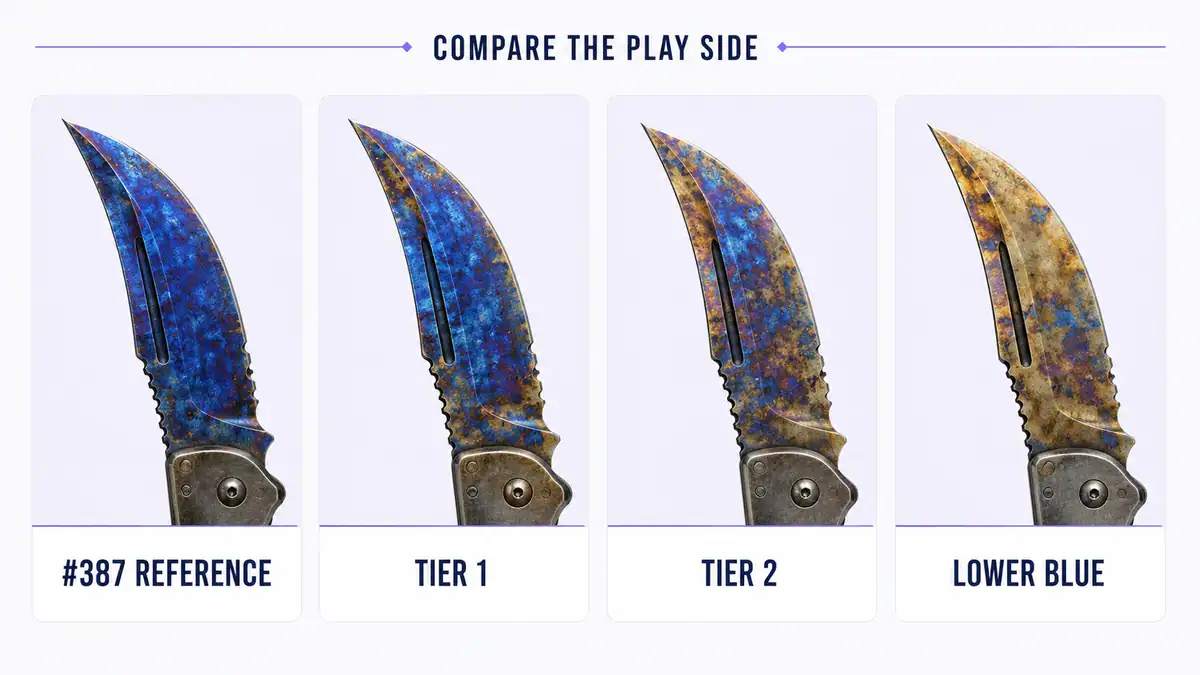
Tiers provide a way for collectors to discuss coverage without making assumptions. They are not price brackets. This guide uses a play side comparison similar to Pricempire, with the blade view seen during play. Other lists may place borderline seeds differently.
Serious comparisons use the same inspect angle and lighting. That avoids misleading reflections, animation frames, or screenshots that highlight only the best side.
| Community tier | Working count | Patterns and examples | Play-side criteria |
|---|---|---|---|
| God Tier | 1 | #387 | The recognized near-full-blue play-side benchmark. |
| Tier 1 | 9 in the Western framework | 73, 269, 321, 442, 507, 776, 853, 902, 955 | Very high blue coverage with little gold interruption. |
| Tier 2 | About 31 | Includes 4, 74, 82, 130, 179, 182, 273, 282, 341, 375, 377, 453, 470, 494, 510, 541, 661, 698, 809, 905 | Strong blue coverage with visible mixed areas. |
| Tier 3 | About 45 | Includes 11, 20, 34, 112, 202, 236, 283, 310, 420, 463, 522, 555, 575, 580, 798, 811, 841, 888 | Blue still leads, but gold and purple clearly divide the blade. |
| Tier 4 | 72 to 74, depending on the guide | Includes 25, 106, 116, 151, 244, 259, 265, 278, 323, 363, 497, 565, 697, 708, 852, 935, 961 | Entry-level blue coverage with a mostly mixed or gold blade. |
The lower-tier rows show representative patterns because the published lists do not agree on a single canonical count. Patterns 25, 588, 949, and 985 are among the seeds that move in or out of Tier 4 depending on how a guide weighs blue placement.
Verify the exact seed and play side instead of pricing from the tier label alone.
#387: The God-Tier Blue Gem
Pattern 387 stands out because the play side shows a wide, clean stretch of blue. It does not depend on small patches or angle tricks. That clarity makes it easy to recognize and more stable in how people perceive it. Many collectors treat it as its own category instead of just another Tier 1 entry.
Other Tier 1 seeds can still sell high, but they often include slight breaks like gold edges or darker spots. Small details, but they matter when prices climb and buyers want a clean look.
Why Blue Gem Karambit Tier Lists Disagree
Tier systems are community tools, not Valve data. The widely referenced Steam Blue Gem guide gives patterns 888, 463, 510, and 809 more credit than many Western price guides.
Its rankings place greater weight on concentrated play-side blue and the visual position of that blue. Other lists use a broader screenshot set or group patterns by market convention, which can move the same seed down one or two tiers.
Pattern 888 is the clearest example. One guide may treat its saturated play side as Rank 1, while another calls it Tier 3 because gold interrupts the overall surface. Neither label changes the knife. Use identical lighting, the same side, the same inspect angle, and recent comparable listings before deciding what the market will pay.
Blue Gem Karambit Price Bands by Tier (2026)
Verified as of August 4, 2026. These are market bands, not appraisals. The snapshot compares public asking evidence on Buff Market, CSFloat, and Skinport Karambit listings. Inventory is thin, and the final price can move sharply with pattern, side, float, corner, and seller patience.
| Tier | Wear | Indicative 2026 range | How to read it |
|---|---|---|---|
| #387 God Tier | Factory New | $1.5 million to $2 million estimate | Based on rejected offers and collector estimates. No confirmed public FN sale establishes this as a transaction price. |
| #387 God Tier | Well-Worn reference | About $120,000 in the documented June 2023 sale | A historical sale, not a current 2026 appraisal for another wear. |
| Tier 1 | Factory New to Field-Tested | Roughly $30,000 to $100,000+ | Named seeds, clean corners, and unusually low floats can exceed the band. |
| Tier 2 | Factory New to Battle-Scarred | Roughly $10,000 to $50,000 | Blue placement and the specific seed create a wider spread than wear alone. |
| Tier 3 | Factory New to Battle-Scarred | Roughly $2,000 to $10,000 | Compare recent sales of the same seed. Generic Case Hardened prices are weak comparables. |
| Tier 4 | Factory New to Battle-Scarred | Roughly $1,000 to $6,000 | The best-looking disputed seeds can list higher, while weak examples stay near ordinary Case Hardened pricing. |
StatTrak note: StatTrak can increase scarcity, but it does not apply a dependable percentage premium. At the high end it may also reduce liquidity because the buyer pool is smaller. Price the exact pattern, wear, float, and sale history instead of multiplying a non-StatTrak value.
Notable Sales and Verified Owners
Pattern #387 and the Blue King
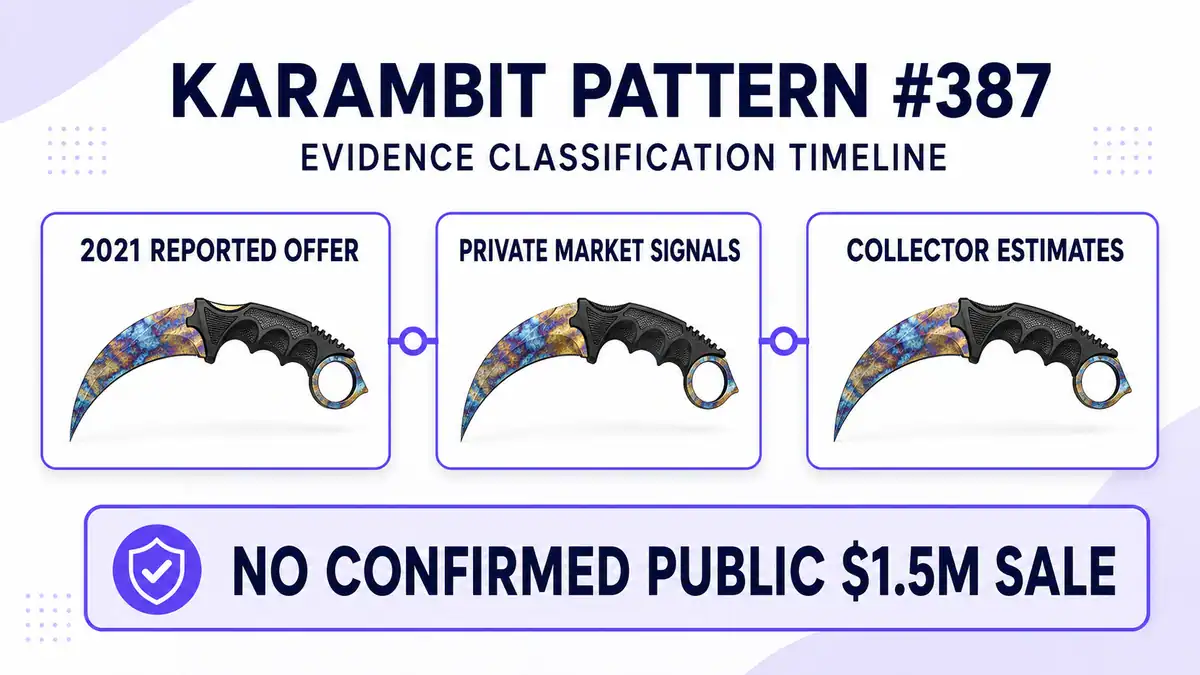
There is no verified public sale of pattern 387 at $1.5 million. The figure comes from a reported private offer in 2021.
An offer begins a negotiation. It does not prove that a transaction was completed.
Documented trades carry the most weight. Reported offers come next, followed by collector estimates based on rarity and demand.
High-value trades often happen privately. A rejected offer shows what one buyer considered at one moment, not an accepted price or wider market consensus.
Collectors generally consider pattern rarity, play-side quality, and demand together. Ownership history and documentation can improve trust, but they do not change the seed or condition.
The sole known Factory New #387 is publicly associated with the collector known as 青い王, translated as Blue King and also identified in community reporting as Newb Rage. The roughly €1.2 million Bitcoin offer reported in 2021 was rejected, so it must not be described as a sale.
Other Named Blue Gem Karambits
Patterns 442 and 269 are sometimes attached to named owners in social posts and private-trade discussions, but those attributions are not stable enough to publish as verified ownership records. This guide leaves them unnamed until an inspectable inventory, owner statement, or documented transaction can be checked.
Recent Documented Sales in 2025 and 2026
No independently verifiable public sale of the Factory New #387 was found for 2025 or 2026. Current articles and marketplace discussions still reference the rejected 2021 offer, the documented Well-Worn sale from June 2023, and present asking prices.
That is useful market context, but it is not a new completed sale. Treat undated screenshots and private-message claims as leads, not proof.
Float Value and Its Effect on Price
A top pattern usually outranks a weaker seed even when its wear is worse. Float matters more when the patterns are close.
Lower values keep the finish cleaner. Higher values introduce scratches and fading that can interrupt blue areas.
A knife with strong backside blue but weak visible-side coverage will usually sell for less. Proper inspect views are essential.
A worn top pattern can still beat a cleaner lower-tier knife. Float becomes more influential when two seeds have similar coverage and edge wear affects the Karambit’s curve.
The CS2 float value guide explains how wear ranges affect different finishes in more detail.
Live listings for Karambit skins show how sellers combine pattern, visible-side coverage, float, and asking price.
How to Check Pattern ID and Float
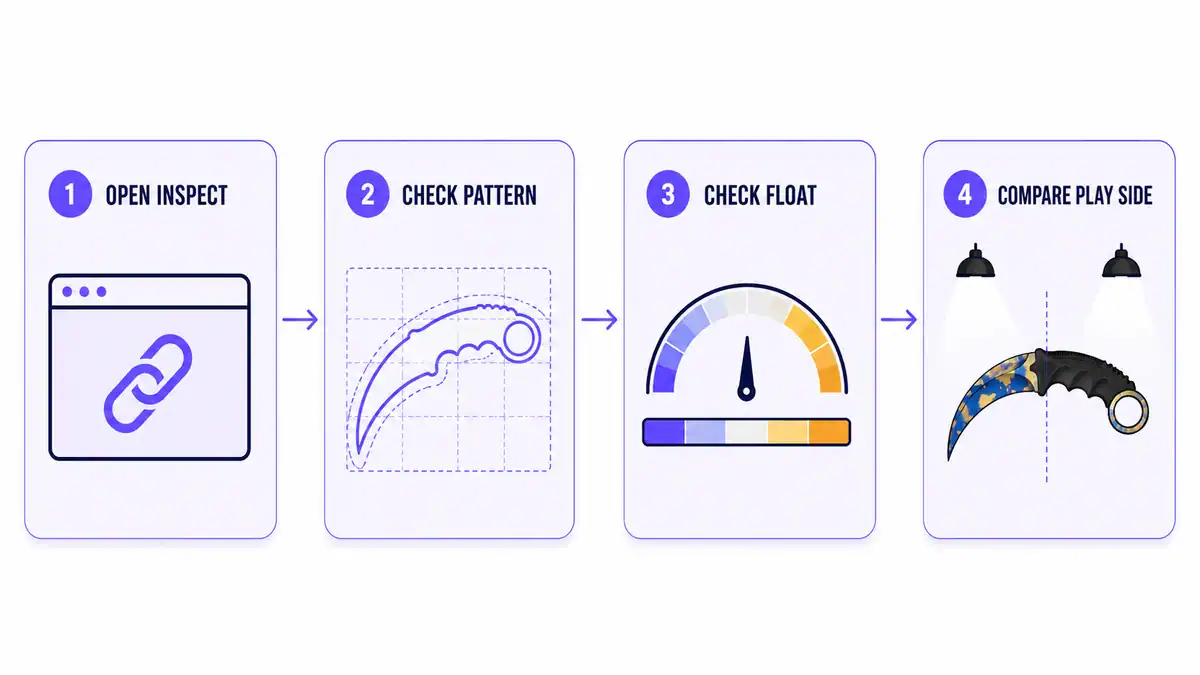
Start with the in-game inspect view. This is the only sure method of determining pattern and float without having to guess.
Find the pattern template index in the inspect panel. That number is the seed. Next observe the float value for wear. After that, turn the knife over and take a look at the play side under normal lighting.
Once you have the data, compare it with trusted references. Match the same seed under a similar angle. Consistency is important because the lighting and perspective can change how blue looks.
- Instead of just viewing a picture from the listing, use the inspect link.
- Record pattern template and float value from item data.
- Rotate to the play side and carefully check the edge, tip, and center.
- Match that angle with a trusted reference before assigning a tier.
The external tools are helpful for sorting and searching, but should not take the place of direct observation. The final call must come from verified game information.
If purchasing expensive knives, ask seller for multiple views of knife prior to purchase. Edge wear can be detected through the idle and animation frames that reveal edge wear, preventing a single bright frame from overstating blue coverage.
Unboxing Odds and Cases
Karambit Case Hardened can appear from the original knife pool in the CS:GO Weapon Case, Weapon Case 2, Weapon Case 3, Operation Bravo Case, eSports 2013 Case, eSports 2013 Winter Case, eSports 2014 Summer Case, Winter Offensive Weapon Case, Operation Phoenix Weapon Case, Operation Vanguard Weapon Case, and Revolver Case.
Legacy cases can still be opened, so supply is not fixed. Availability and case prices slow things down, but new knives still enter the market from time to time.
The odds stack up quickly. You need to hit a rare special item, then roll a Karambit, then land on Case Hardened, and finally get a Blue Gem seed. Each step cuts the chance further.
That is why opening cases for a particular high tier pattern is not feasible. The full breakdown is in the cases that can drop Karambits guide.
Cheaper Karambit Blue Gem Alternatives
Not every collector needs a top-tier pattern. Several routes preserve the blue-heavy look at a lower entry price.
Tier 2 and Tier 3 patterns can still show strong blue coverage without the scarcity premium attached to the highest-ranked seeds.
Flip Knife, Bayonet, Huntsman, and Gut Knife Case Hardened patterns often have lower entry prices.
A Bayonet, M9 Bayonet, or Butterfly Knife can also show strong play-side blue without carrying the Karambit’s collector premium.
The guide to all CS2 knife types helps compare blade shapes, while the overview of the best Karambit skins covers non-Case-Hardened options.
Confirm the seed and float, inspect both sides, and price what is visible rather than trusting the tier label in a listing.
Non-knife Case Hardened items, including AK-47 Blue Gem patterns, offer the same pattern-driven appeal with different pricing logic.
How to Buy or Sell a Blue Gem Safely
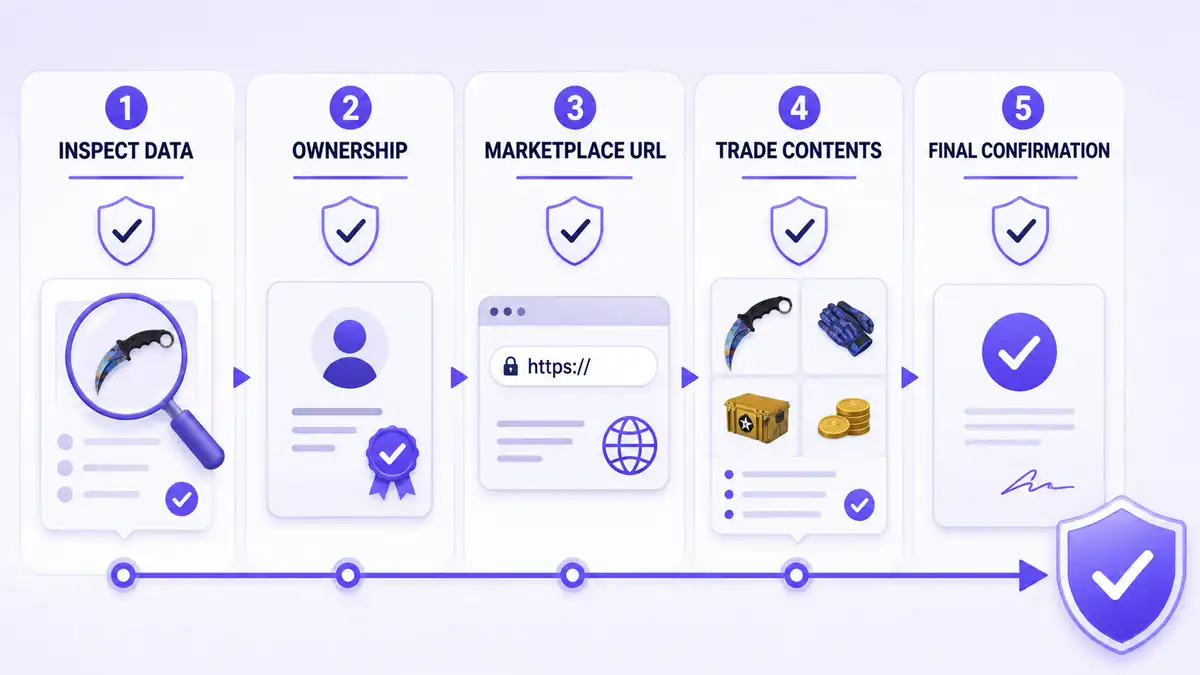
High-value skins attract both experienced buyers and scams. You need to verify everything.
- Check pattern template float exterior and correct play side through inspect link.
- Compare screenshots with trusted references at the same angle.
- Ensure ownership and disregard any unsolicited messages/trade links.
- Use a verified escrow or known marketplace for large transactions.
- Review every item in the final Steam confirmation before accepting.
The higher the value, the more careful you should be. Expensive trades may require extra verification, written terms, and slower settlement. These steps help prevent impersonation and bait and switch tactics.
Safer CS2 skin trading environments make it easier to compare listings without relying on private messages.
FAQ
Has pattern 387 ever been publicly sold?
There has been no confirmed public sale recorded.
Is backside blue less valuable?
Yes, buyers focus on the visible play side.
Can identical patterns differ in price?
Yes, float and context still affect value.
Does StatTrak increase value?
Sometimes, but the premium is inconsistent. Pattern, side, condition, and demand matter more.
Can lower tiers still qualify as Blue Gems?
Yes, the label is dependent upon overall coverage.
How do you verify before buying?
Use the inspect view and confirm the pattern ID.
Why do tier lists differ?
They are community driven and not standardized.
How much is a Blue Gem Karambit worth in 2026?
Tier 4 examples may start around $1,000, while Tier 1 can reach $30,000 to $100,000 or more. The Factory New #387 is discussed at $1.5 million to $2 million through estimates and rejected offers, not a confirmed public sale.
How many Blue Gem Karambit patterns are there?
There is no official Valve count. Depending on the community framework, roughly 150 to 175 of the 1,000 seeds receive a Blue Gem label, with Tier 4 disagreements creating most of the spread.