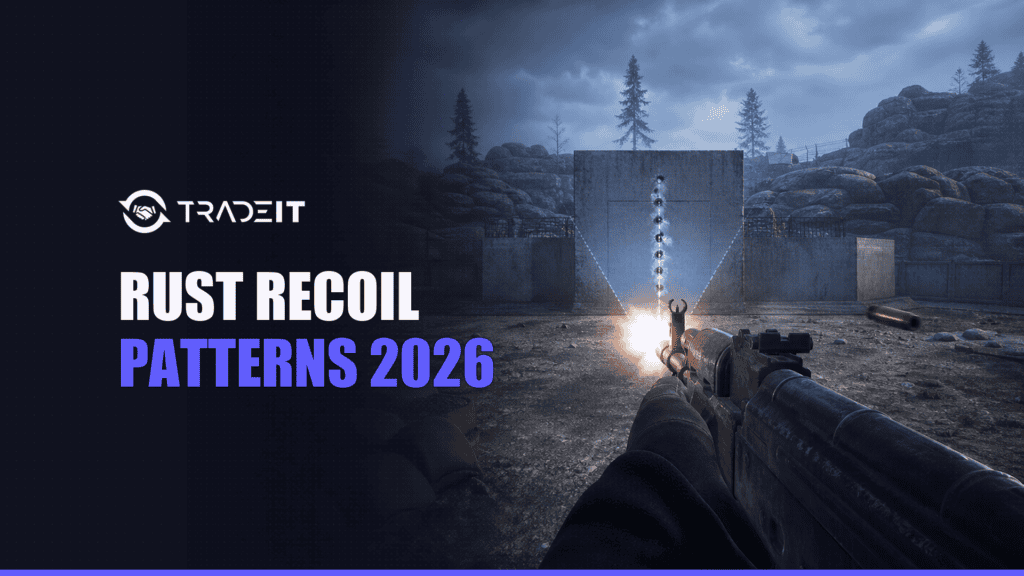


Rust recoil patterns are no longer fixed 30-bullet drawings that you can mirror perfectly with your mouse. Since the Combat Update on June 2, 2022, automatic weapons have combined gradient-based aim drift with increasing inaccuracy and a weighted aim cone. You can learn how a gun kicks, how quickly it recovers, and when its group starts opening; but the bullet-by-bullet path is not identical every time.
That changes the best way to control recoil in 2026: counter the main climb, watch the sight rather than tracing an old S-shape, and shorten your burst as distance grows. At long range, first-shot accuracy, reset timing, stance, and attachments matter more than memorising a legacy spray diagram.
For a wider comparison of damage, cost, and progression, see our guides to the best guns in Rust and the Rust weapons tier list. This page stays focused on recoil behaviour, shot dispersion, and practical control.
Current-build recoil reference
Rust recoil in 2026
Can recoil be learned?
Yes. Learn the weapon’s initial kick, climb rate, recovery, and useful burst length.
Is every spray identical?
No. Aim drift and aim-cone randomness make each sustained burst slightly different.
Best universal habit?
Release the trigger before the group opens beyond the target, then let accuracy recover.
How Rust Recoil Actually Works in 2026 (Post-2022 Overhaul)
Facepunch replaced the old pattern-based automatic recoil system in June 2022. The modern system is better understood as three layers working at the same time: what your view does, where the bullet is allowed to land, and how firing state changes both.
The three parts of modern Rust recoil
1. View recoil and aim drift
The weapon pushes your camera away from the target. Pulling down and making small corrections keeps the centre of your aim on the target.
2. Aim cone, often called bloom
Even with the reticle centred, bullets can land inside a cone around the aim point. Sustained automatic fire makes that uncertainty more important.
3. State and recovery
Firing cadence, movement, stance, aiming down sights, weapon choice, and attachments affect how quickly the group opens and resets.
Aim cone is not the same thing as recoil. Recoil moves your view; aim cone changes the possible bullet path around the point where you are aiming. Excellent mouse or stick control can keep the reticle centred, but it cannot remove all shot dispersion from an overlong burst.
Facepunch also uses a weighted aim-cone system, so shots are not distributed evenly across one flat circle. The centre receives more weight, while sustained full-auto still becomes less reliable at range. A later 2024 balance pass delayed the full movement penalty until after four rapid shots, which makes mobile taps and very short bursts more viable than running a long spray.
A practical 2026 firing rule by distance
| Distance | Starting cadence | What you are controlling | Stop the burst when… |
|---|---|---|---|
| Close: roughly 0–20 m | Controlled full-auto can work | Strong downward correction and target tracking | The target breaks line of sight or the reticle leaves the body |
| Mid: roughly 20–50 m | 3–8 rounds, weapon dependent | Initial kick, grouping, and a clean trigger reset | The group reaches the target’s edge |
| Long: 50 m+ | Taps or very short bursts | First-shot placement, recovery, and target movement | Accuracy has not fully recovered between inputs |
Build a recoil-control starting plan
Choose a weapon and distance. The planner returns a sensible first cadence to test on a training wall.
No fake “perfect spray” lineAK-47 / Assault Rifle | Mid 20–50 m | 3–6 round bursts
Use this as a starting drill, then adjust from live hit groups. The correct answer is the shortest burst that still secures the fight.
Rust Assault Rifle Recoil Patterns
Assault rifles reward the widest range of firing rhythms. The AK asks for the strongest manual correction; the LR-300 is more forgiving and has a useful burst mode; the SAR and M39 turn recoil control into timing rather than full-auto tracing.
AK-47 (Assault Rifle)
The Rust AK recoil pattern is best described as a forceful initial climb followed by continuing upward drift and lateral variation. The old advice to draw a precise lightning bolt is obsolete: your first job is to keep the sight centred through the opening kick, then react to the current burst rather than predicting an identical path.
At close range, a committed spray is reasonable while the target is exposed. At mid range, the AK becomes much more dependable in short bursts. At long range, single shots or two-to-three-round bursts preserve more of the weapon’s value than holding mouse one and hoping the aim cone stays kind.
Control plan by range
Close
Pull down immediately, track the torso, and stop when cover breaks the target.
Mid
Start with 3–6 rounds. Reset fully instead of chaining one long, widening spray.
Long
Tap or use tiny bursts. Prioritise a clean first hit and a settled follow-up.
Control cue: make one decisive downward movement for the opening shots, then use small visual corrections. Do not oversteer left and right to imitate a legacy diagram.
LR-300
The LR-300 has a calmer recoil character than the AK and is easier to keep inside a mid-range target. Facepunch reduced its horizontal recoil and improved its ranged role in the 2024 weapon pass, while its built-in burst option gives you an efficient way to trade raw fire rate for tighter, repeatable engagements.
Full-auto is still not a free long-range beam. Use the LR’s smoother view movement to track accurately, then switch to burst or disciplined manual bursts when the target becomes smaller. Let the weapon’s accuracy recover rather than stacking one burst directly onto the tail of the last.
Control plan by range
Close
Full-auto is manageable; track smoothly instead of adding unnecessary side-to-side input.
Mid
Use 5–8 rounds or the built-in burst mode for cleaner repeatability.
Long
Burst or tap. Give the sight enough time to settle between target corrections.
Control cue: use less downward force than you use for the AK. Many players miss by overcorrecting the LR and dragging the first group below the target.
Semi-Auto Rifle (SAR)
The SAR does not have a full-auto spray pattern to memorise. Its “pattern” is the relationship between recoil recovery and how quickly you click again. Fire too rapidly and the next sight picture arrives before the previous kick has settled; slow down slightly and the rifle becomes much more predictable.
At close range, fast taps can be correct because target size forgives a wider group. At mid and long range, use a cadence you can visually confirm: fire, recover, place the sight, fire again. A Burst Module can change that rhythm, but it should support deliberate shot placement rather than encourage blind three-round spam.
Control plan by range
Close
Rapid taps are viable; keep the sight moving with the target instead of staring at recoil.
Mid
Use a steady two-to-four-shot string, then pause if the group rises off centre.
Long
One accurate shot at a time. Let the sight visibly return before the next click.
Control cue: match your click speed to sight recovery. The fastest useful SAR cadence is the fastest one that still returns to your intended point of aim.
M39 Rifle
The M39 rewards even more patience than the SAR. Its recoil is manageable when each shot is allowed to recover, but rapid clicking wastes the rifle’s precision and makes the sight bounce across a smaller distant target.
Use the M39 as a placement weapon, not as a substitute automatic rifle. At close range you can accelerate the cadence, but at distance the winning rhythm is usually one clean shot, a visible reset, and one correction. Higher magnification makes view movement feel larger, so avoid turning the scope’s visual kick into excessive mouse compensation.
Control plan by range
Close
Fast taps can finish a target, but do not outrun your ability to track.
Mid
Two-shot strings work well when the first impact confirms your correction.
Long
Single, fully recovered shots. Use cover timing rather than volume.
Control cue: keep your input small. The M39 punishes the player who chases every frame of scope bounce instead of waiting for the weapon to settle.
Assault rifle recoil comparison
| Weapon | Recoil character | Best starting rhythm | Main mistake |
|---|---|---|---|
| AK | Sharp initial climb, demanding sustained control | Short bursts at mid range; taps at long range | Tracing an old zigzag while aim cone opens |
| LR-300 | Smoother view recoil and less horizontal movement | 5–8 shots or built-in burst | Overcorrecting as though it were an AK |
| SAR | Recovery-controlled semi-auto kick | Steady taps matched to sight return | Clicking faster than the rifle recovers |
| M39 | Precision semi-auto with magnified visual movement | Single shots or measured pairs | Chasing scope bounce with large corrections |
Kitted your AK yet?
Browse Rust AK skins on Tradeit and make the gun look as good as it shoots.
Rust SMG Recoil Patterns
SMGs are strongest when the target is large enough for their fire rate to matter more than perfect first-shot precision. They generally ask for less raw downward correction than the AK, but sustained fire still creates a wider shot cloud; especially once movement penalties blend in.
MP5A4
The MP5A4 feels smooth during the opening shots, but its fast cycle can turn a small control error into a large miss quickly. Use a steady downward pull rather than a violent snap, and let the reticle tell you when the group has started escaping the target.
Full-auto is appropriate in rooms and short lanes. At mid range, a short manual burst or the built-in burst mode gives the aim cone time to recover. The MP5 is not an assault rifle replacement at long distance; its strength is delivering several controllable hits before the opponent can disengage.
Control plan by range
Close
Full-auto while tracking the chest; keep the pull smooth.
Mid
Use 4–7 rounds or burst mode, then reset.
Long
Tap or disengage for a better angle; do not force a magazine-long spray.
Control cue: the MP5’s speed makes late corrections ineffective. Start controlling from shot one instead of waiting for the sight to climb.
Thompson
The Thompson has a more measured rhythm than the Custom SMG, which gives you time to see and correct the opening climb. It is forgiving enough for short full-auto engagements, yet accurate enough to reward deliberate bursts across a road, monument lane, or compound gap.
At close range, pull down and track. At mid range, start with four-to-six-round strings and stop before you feel tempted to “save” a bad burst with a huge sideways correction. At long range, use single shots or choose a rifle.
Control plan by range
Close
Controlled full-auto; keep the target in the broad centre of the sight.
Mid
Four-to-six rounds, then a clean pause.
Long
Tap sparingly; range is not the weapon’s main advantage.
Control cue: prioritise a compact opening group. The Thompson wins by landing the first useful burst, not by extending every fight to the bottom of the magazine.
Custom SMG
The Custom SMG is a close-range volume weapon with a fast firing cycle and a 30-round magazine. Its opening recoil is manageable, but the combination of speed, movement, and aim cone means the useful group can expand quickly. It is strongest when you commit to a large nearby target; not when you try to turn it into a distant laser.
Use compact sprays in doorways, interiors, and short outdoor angles. At mid range, cut the trigger sooner than you would with the Thompson. A Holo Sight or laser can improve shot placement, but neither attachment changes the Custom’s natural close-range role.
Control plan by range
Close
Short full-auto commitment with continuous target tracking.
Mid
Three-to-five rounds; reset as soon as the group spreads.
Long
Avoid the fight or tap only when no better option exists.
Control cue: stop early. The Custom’s fire rate can spend several low-value bullets in the time it takes you to notice the group has opened.
SMG recoil comparison
| Weapon | Best range | Useful first rhythm | Why the spray fails |
|---|---|---|---|
| MP5A4 | Close to mid | Full-auto close; 4–7 or burst at mid | Fast cycle magnifies late corrections |
| Thompson | Close to mid | Four-to-six-round strings | Overextending a readable opening group |
| Custom SMG | Close | Short committed spray | Fire rate spends bullets after the group opens |
Rust LMG Recoil Patterns
LMGs give you ammunition and pressure, not permission to ignore aim cone. The M249 supports longer controlled strings than most guns; the craftable HMLMG is deliberately less accurate and rewards shorter, purposeful suppression.
M249
The M249 has the capacity to hold an angle and punish repeated peeks, but its long magazine can tempt players into shooting well beyond the useful part of the burst. Counter the vertical movement, keep tracking, and treat the remaining ammunition as tactical flexibility; not as a reason to fire continuously.
At close and mid range, longer strings are practical because the weapon can keep pressure on a moving target. At long range, use controlled bursts and let the group recover. The M249 is most dangerous when you preserve enough accuracy to exploit its magazine, not when you turn every target into a wall of random impacts.
Control plan by range
Close
Longer controlled spray while tracking movement.
Mid
Eight-to-twelve rounds, then reassess the group and target state.
Long
Short bursts; use the magazine for repeated attempts, not one attempt.
Control cue: separate “I still have bullets” from “these bullets still have a good hit probability.”
HMLMG
The HMLMG was introduced as a high-damage, high-rate-of-fire weapon with deliberately low accuracy. Its recoil and dispersion make it a poor candidate for legacy “beam” practice. Use it to control a doorway, punish a close push, damage exposed targets, or suppress a position while your team moves.
Start your downward correction immediately, but keep bursts shorter than the magazine suggests. At mid range, repeated short strings are more useful than one continuous sweep. At long range, another rifle will usually convert ammunition into hits more efficiently.
Control plan by range
Close
Controlled spray with a strong initial downward pull.
Mid
Five-to-eight-round strings, then reset and re-centre.
Long
Use only for pressure or exposed large targets; do not expect rifle precision.
Control cue: measure success by space controlled and useful hits, not by whether every bullet lands in one small hole.
LMG recoil comparison
| Weapon | Strength | Recommended control | Do not confuse with… |
|---|---|---|---|
| M249 | Accurate sustained pressure and repeated peeks | Longer strings close; segmented bursts at range | A licence to hold the trigger for the entire belt |
| HMLMG | Craftable damage and suppression | Strong pull, short strings, frequent re-centres | A precision long-range automatic rifle |
How Attachments Change Recoil (Muzzle Brake, Boost, Sights)
Rust attachments modify different parts of the gunplay problem. A Muzzle Brake reduces recoil but worsens damage and shot dispersion. A Holo Sight or laser tightens aim cone without directly erasing camera kick. A Muzzle Boost increases firing speed while making control and accuracy harder. Choose the stat that is actually losing your fights.
What current recoil-related attachments actually change on PC/Steam
| Attachment | Relevant modifier | Practical effect | Trade-off / warning |
|---|---|---|---|
| Muzzle Brake | −50% recoil; removes aim sway | Much easier view control, especially on the AK and hard-kicking semi-autos | −15% damage, +0.5° ADS aim cone, +2° hip aim cone; lower recoil does not mean a tighter bullet group |
| Muzzle Boost | Approximately 10% faster firing cycle | More bullets leave the gun during a short close-range window | Worse accuracy and no recoil reduction; errors compound faster |
| Holo Sight | −20% aim cone | Tighter ADS shot placement and a clear reticle | Does not directly reduce recoil kick; still requires correct burst length |
| Simple Handmade Sight | No listed recoil or aim-cone reduction | Changes sight picture and zoom behaviour at low cost | Do not assume a cleaner-looking sight is a statistical accuracy buff |
| Weapon Lasersight | −20% ADS aim cone; −50% hip aim cone; −90% aim sway | Improves both aimed and hip-fire consistency | The visible laser can reveal your aim point; it does not remove recoil |
| Burst Module | −35% recoil and aim cone while enabling three-round bursts | Combines lower kick with tighter short strings | Changes cadence and is not compatible with every weapon; learn its reset timing |
Which attachment reduces AK recoil the most?
The Muzzle Brake has the largest listed direct recoil reduction at 50%. That does not automatically make it the best all-purpose AK setup: it reduces damage and adds aim-cone penalties, so the view looks steadier while the bullets can be less certain. It is a training aid or a deliberate close-to-mid trade; not a long-range laser switch.
The Burst Module is a more balanced control option when the weapon accepts it: it reduces recoil and aim cone together by 35% and forces a three-round rhythm. For a deeper explanation of availability and use cases, see our guide to the Rust Burst Module (recoil reduction).
Holo Sight vs Simple Handmade Sight
The Holo Sight provides a real aim-cone reduction; the Simple Handmade Sight mainly gives you a different sight picture. Pick the Handmade Sight for cost and familiarity. Pick the Holo when the statistical accuracy improvement and clear reticle justify the expense. Neither sight replaces recoil control.
Three sensible AK setups
AK attachment setups by goal
General-purpose
Holo + laser, no muzzle. Tightens aim cone while preserving normal damage and familiar recoil.
Learning hard kick
Holo + Muzzle Brake. Easier view control, but practise with the damage and dispersion trade-off visible.
Close-range pressure
Muzzle Boost only when you can already keep the opening group centred. Speed amplifies both good and bad control.
How to Practice Rust Recoil in 2026 (Trainers and Servers)
Modern recoil practice should train grouping, burst decisions, and reset timing; not the muscle memory for one historical line. Use a browser trainer to understand the broad movement, then confirm everything on a live server where current aim cone, attachments, stance, movement, and latency are present.
Our dedicated guide to Rust aim training and recoil trainer covers the wider training ecosystem. For this recoil reference, use the following short routine to turn each weapon profile into useful server habits without duplicating that broader guide.
A practical recoil session
- Baseline wall; 4 min
Fire three untouched groups at close, mid, and long range. Do not compensate first; learn what the weapon does today. - Burst ladder; 4 min
Test 3, 5, 8, and 12 rounds at one aim point. Find where the group stops fitting inside a torso-sized area. - Reset timing; 3 min
Repeat short bursts with different pauses. Use the shortest pause that restores a compact next group. - Movement entry; 2 min
Strafe into the shot, stop or crouch, and fire the opening burst. Practise the transition, not stationary perfection only. - Attachment A/B; 2 min
Keep every variable identical and change one attachment. Compare both camera movement and actual impact spread. - Finish on targets
Move from the wall to a moving target. A neat wall group is useful only when you can track and decide under pressure.
Use each tool for the job it does well
Browser trainer vs aim server vs live wipe
| Tool | Best use | Limitation |
|---|---|---|
| Rusty Recoil | Fast repetition, range changes, slow-motion study, and broad recoil familiarisation | A browser simulation cannot reproduce every live-build state, latency, or server modifier |
| UKN / aim-training server | Current game physics, live attachments, moving targets, and repeatable lanes | Server configurations can differ; verify that recoil is not modified |
| Vanilla or main server | Real movement, terrain, armour, stress, peeking, and network conditions | Repetition is slower and poor feedback can hide exactly why a burst failed |
Track outcomes, not hours
Measure the percentage of opening bursts that stay on a torso, how quickly you stop an obviously bad spray, and whether your second burst starts centred. A player who trains ten minutes with clear feedback improves faster than a player who traces an old pattern for an hour without measuring impacts.
Rust Console (Xbox/PS5) Recoil Differences
The AK recoil pattern on Rust Console is no longer based on the old pre-Steam-parity system. Patch 1.7 on October 30, 2025 updated Rust Console recoil to match the Steam version’s broad model. Patch 1.11 on March 26, 2026 then tuned individual weapons and attachments, including the LR-300, MP5A4, Thompson, Custom SMG, Holo Sight, Muzzle Brake, and Muzzle Boost.
“Matched to Steam” does not mean a mouse guide can be copied one-for-one with a controller. The recoil model may be aligned, but stick travel, deadzones, response curves, acceleration, frame rate, field of view, and console-specific balance all change what your hands need to do.
PC/Steam vs Rust Console recoil in 2026
| Factor | PC / Steam | Xbox Series / PS5 | Practical consequence |
|---|---|---|---|
| Underlying recoil model | Gradient aim drift + weighted aim cone | Updated to match Steam in October 2025 | The same burst-discipline principles apply |
| Input | Mouse distance and fine micro-correction | Analog stick travel, deadzone, and response curve | Do not copy a mouse movement shape or sensitivity number |
| Balance cadence | Facepunch monthly PC updates | Double Eleven console patches with platform-specific tuning | Re-test after major updates, even when the model is shared |
| Aim assist | Not part of normal gunplay | Officially clarified as never active; option removed in 2025 | Practise raw stick tracking and recoil correction |
| Browser trainers | Mouse input maps naturally | Often not representative of controller response | Use a live console aim server or wall test for final calibration |
AK recoil pattern tips for Rust Console
- Calibrate the opening pull first. Stand at mid range and fire five-round groups. Adjust vertical ADS sensitivity until you can counter the first climb without dragging below the aim point.
- Use less lateral stick correction than you think. Large left-right movements create oscillation and make aim drift harder to read.
- Test deadzone before changing sensitivity. A deadzone that is too large delays micro-corrections; one that is too small can introduce drift.
- Shorten bursts earlier at distance. Controller tracking plus aim cone makes a long rescue spray especially inefficient.
- Re-test after console patches. The March 2026 update changed recoil, aim cone, or ranged behaviour on several relevant weapons and attachments.
Ready to trade Rust skins?
Trade, buy, or sell Rust skins instantly on Tradeit – no Steam Wallet lock-in.
FAQ
Rust patterns, aim cone, crouching, attachments, console, and scripts.
Did Facepunch remove Rust recoil patterns in 2022?
Facepunch removed the old deterministic pattern-based automatic recoil system on June 2, 2022. Weapons still have learnable recoil characteristics; initial kick, climb, recovery, and useful burst length; but each burst is not a guaranteed bullet-for-bullet copy.
Is Rust recoil random or still predictable in 2026?
It is both learnable and partly random. You can predict and counter the weapon’s broad view movement, while aim drift and the weighted aim cone add variation to exact impacts. Good control keeps the centre on target; good burst discipline limits how much randomness you invite.
What is aim cone in Rust and how do I reduce it?
Aim cone is the area around your aim point where a bullet may travel. Reduce its practical effect by aiming down sights, using short bursts or taps, allowing accuracy to recover, and choosing attachments such as the Holo Sight, Lasersight, or Burst Module when appropriate.
Does crouching actually help spray control in Rust?
Yes. Crouching lowers screen recoil and makes follow-up control easier, especially during automatic fire. It does not eliminate aim cone, and it makes you slower and easier to pre-aim, so use it when cover and timing justify the stability.
Is the AK recoil pattern different on Rust Console (Xbox/PS5)?
The underlying console recoil model was updated to match Steam in October 2025, but the control experience is still different. Analog sticks, deadzones, response curves, frame rate, and console-specific balance mean the correct stick movement and sensitivity are not identical to a PC mouse guide.
Which weapon attachment reduces AK recoil the most?
The Muzzle Brake has the largest listed direct recoil reduction at 50%. It also reduces damage and increases aim-cone penalties, so it is not automatically the best overall setup. The Burst Module offers 35% less recoil and aim cone together when compatible.
Are recoil scripts detectable in 2026?
Facepunch and Easy Anti-Cheat explicitly target recoil cheats and scripting, and detection methods are intentionally not public. Recoil scripts violate the rules and can result in account or server bans. They are also poorly matched to a system where exact automatic impacts vary between bursts.
Accuracy note: mechanics and item values were checked against Facepunch, current Rust item references, and Rust Console patch notes available through July 20, 2026. Community and modded servers can override weapon behaviour. Re-test after major balance updates.