

The best CS2 interp setting in 2026 is usually the default: set Buffering to smooth over packet loss / jitter to None, or use cl_net_buffer_ticks 0, on a stable connection. Try 1 Packet only when your connection has occasional jitter or misdelivered packets. Reserve 2 Packets for a genuinely unstable route because extra buffering trades responsiveness for smoothness.
Do not copy the old four-command bundle built around cl_interp 0.015625, cl_interp_ratio 1, cl_updaterate 128, and cl_cmdrate 128. That advice mixes CS:GO behavior with modern CS2. Today, cl_interp reports the effective interpolation amount, cl_net_buffer_ticks is the supported user control, and the engine explicitly manages cl_interp_ratio through it. The legacy update-rate commands are not current CS2 client tuning controls.
This guide separates the settings that actually work from outdated config folklore, then gives you a safe preset, a reference table, and a clean autoexec setup. For the rest of your video, mouse, audio, and performance configuration, use Tradeit’s guide to the best CS2 settings.
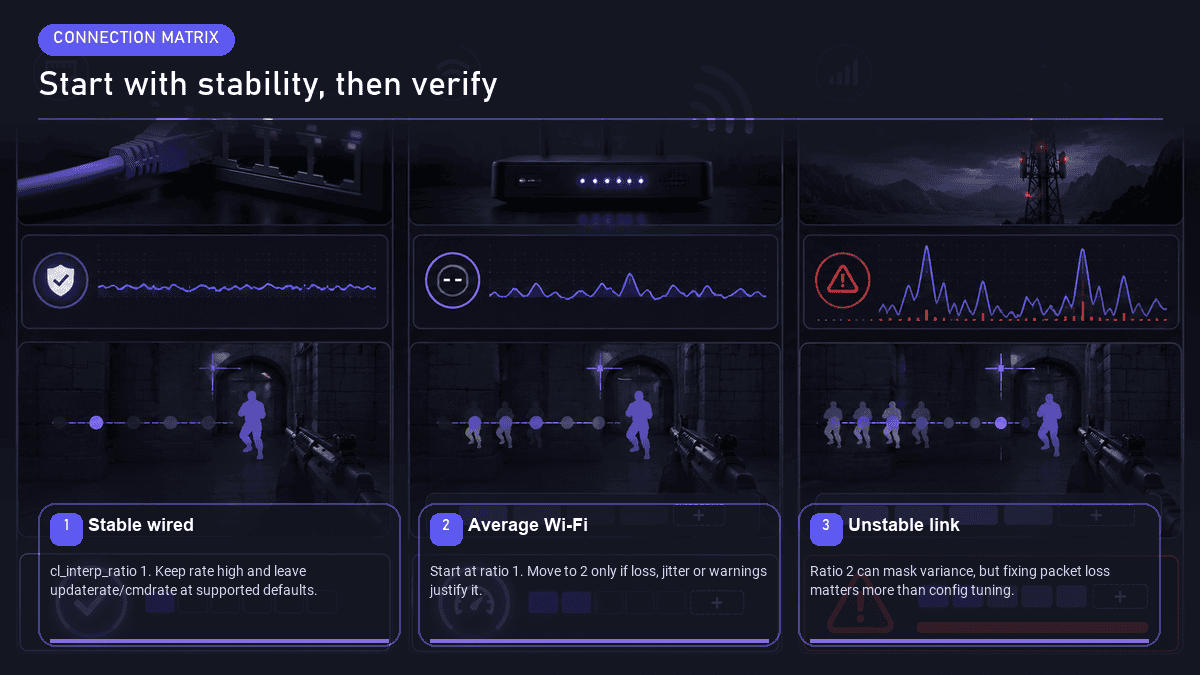
Stable Ethernet or clean fiber: cl_net_buffer_ticks 0. Occasional Wi-Fi or route jitter: test cl_net_buffer_ticks 1. Repeated packet disruption: use cl_net_buffer_ticks 2 as a temporary workaround while you fix the network problem.
0 / None
Best starting point for a steady connection.
1 Packet
Test when delivery is occasionally uneven.
2 Packets
Use only for repeated packet disruption.
What Is Interpolation in CS2?
Interpolation is the client-side process that makes remote movement look continuous between network updates. A server does not send a fresh position for every frame your monitor displays. Your client receives a sequence of snapshots, keeps a small history, and renders other players between known states instead of snapping a model from one received position to the next.
That small history is useful when packets arrive unevenly. With enough valid samples, CS2 can draw a smooth path through a brief delivery gap. The cost is time: more buffering gives the client more history to work with, but it also means you are intentionally viewing and processing the network stream farther behind the newest available state.
Interpolation
Draws movement between received server states. It smooths other players and networked objects.
Client prediction
Shows the expected result of your own movement immediately, then reconciles it with the server.
Lag compensation
Uses timing history when the server evaluates a shot. It is separate from your local smoothing choice.
Players often collapse all three systems into “interp,” especially when an enemy appears to accelerate, a model jitters, or a death lands just after reaching cover. Changing a buffer can help uneven packet delivery, but it cannot lower your physical ping, repair a bad route, raise FPS, or rewrite the server’s lag-compensation decision.
Do Interp Settings Still Work in CS2? (Yes, but Read This First)
Yes. CS2 still interpolates networked movement, and its user-facing packet buffer still changes behavior. What no longer works is treating the old CS:GO command bundle as a modern optimization. That distinction is why Reddit and forum answers look contradictory: one person says “interp commands are locked,” another says a ratio changes, and a third pastes a 128-tick config that CS2 does not use.
Limited Test restriction
A Valve update made the familiar cl_interp, ratio, and update-rate controls inaccessible. Posts from that week created the lasting “all interp is locked” claim.
Official UI control
Valve made cl_interp non-settable directly and directed players to the packet-loss buffering option instead.
Buffer command, not old bundle
cl_net_buffer_ticks is the supported 0 to 2 control. It manages cl_interp_ratio; current command data says not to change the ratio directly.
So, do interp settings still work in CS2? The accurate answer is: the buffering setting works, but many commands in old “best interp” lists do not. The blanket lock myth is too broad, while the claim that the full CS:GO setup was restored is also wrong. Some cvars remain present for reporting or engine use, but the supported player choice is the Game-menu setting or its matching cl_net_buffer_ticks value.
Typing cl_interp 0.015625 is not a hidden low-latency trick. The command is an effective-value readout in current CS2. A direct assignment can produce a yellow console warning and does not give you the old manual control described by outdated guides.
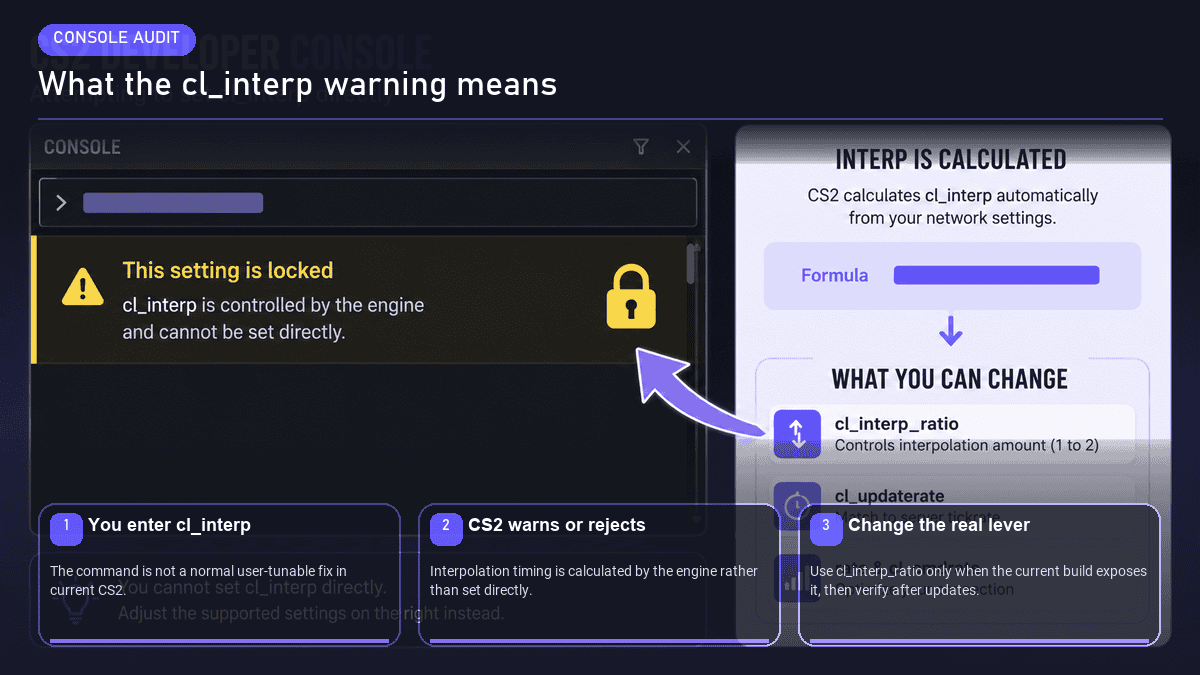
CS2 Interp Commands Explained
Enable the developer console before testing anything. Tradeit’s walkthrough on how to open the CS2 console covers the setting and keybind. Then use the audit below: it distinguishes a current user control from a readout, an engine-managed variable, and an obsolete CS:GO command.
| Command | 2026 status | What it does now | Player action |
|---|---|---|---|
cl_net_buffer_ticks |
Use | Adds 0, 1, or 2 ticks of delay for server snapshots and user commands; controls the ratio internally. | Use 0 by default. Test 1 or 2 only for real jitter or packet disruption. |
cl_interp |
Read only | Reports the effective client simulation interpolation amount in seconds. | Query it for diagnosis; do not try to assign a value. |
cl_interp_ratio |
Indirect | Represents client simulation interpolation ticks, but the current buffer cvar controls it. | Do not tune it directly. Set cl_net_buffer_ticks. |
cl_updaterate |
Legacy | Old Source / CS:GO update-rate control; not a current CS2 client tuning cvar. | Remove it from modern configs. |
cl_cmdrate |
Legacy | Old outgoing command-rate control; not a current CS2 client tuning cvar. | Remove it from modern configs. |
rate |
Current | Declares the receive bandwidth available to the game; the current unrestricted default is 786432. |
Leave it at the game’s normal unrestricted/default value on modern broadband. |
cl_net_buffer_ticks_use_interp |
Engine option | Chooses whether loss smoothing uses clock synchronization or classic interpolation delay; default is false. | Leave the default. It is not part of a normal player preset. |
Current command names can change in future builds. Query the console before carrying an old config forward.
cl_interp: Locked for Direct Changes (Effective Readout)
cl_interp no longer works as a value you should force. Entering the command by itself can show the effective client interpolation amount for the current session. Adding a number after it tries to use a direct control Valve removed from normal player tuning.
This matters because 0.015625 still looks plausible: it is one 64 Hz interval expressed in seconds. The arithmetic is real; the recommendation is stale. In current CS2, use that number to understand a reference table, not as a direct command.
cl_interp_ratio: Present, but Do Not Change It Directly
cl_interp_ratio still exists, which is why some players conclude the old method is back. The current cvar description is more specific: cl_net_buffer_ticks controls the ratio, “which you should not modify directly.” In other words, ratio remains part of the engine’s calculation, but it is not the best 2026 player-facing command.
Use the ratio values as a mental model. Zero means no extra user-selected buffer ticks; one means a one-tick buffer; two means a two-tick buffer. It does not follow that ratio zero turns off all entity interpolation. CS2 still has its core interpolation system, and cl_interpolate remains enabled.
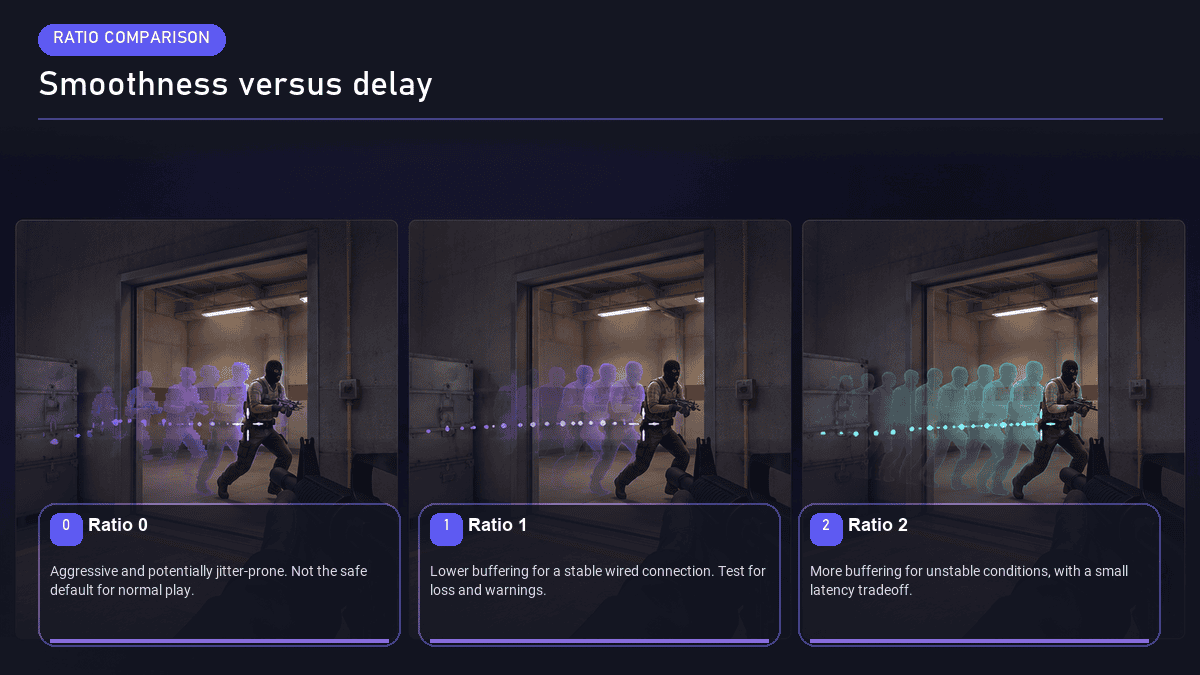
cl_net_buffer_ticks: The Setting You Actually Change
This is the practical 2026 CS2 interp command. Its supported range is 0 to 2, matching the in-game choices under Settings → Game → Buffering to smooth over packet loss / jitter:
None
No extra user-selected packet buffer. Start here for a stable wired connection and the lowest added buffering.
1 Packet
Adds one buffer step to absorb occasional uneven delivery. Test this when telemetry shows intermittent disruption.
2 Packets
Uses the maximum exposed player buffer. It can smooth a poor route but feels less immediate and does not repair the route.
The setting buffers both server snapshots and user commands, so do not describe it as free smoothing. More buffer gives packet timing more room, but responsiveness is the trade-off. Test in the same mode, on the same server region, over several rounds, not for ten seconds in an empty practice map.
cl_updaterate: Legacy CS:GO Advice, Not a Current CS2 Tuning Knob
Old guides say to match cl_updaterate to a server’s tickrate, usually with 64 or 128. That was meaningful in the older Source networking model. Current CS2 command data does not expose cl_updaterate as a normal client cvar, and sub-tick input processing is not unlocked by pasting 128 into a config.
If your console reports an unknown command, or an inherited file contains it, delete the line. The server and engine negotiate the networking cadence; your supported smoothing choice is the 0 to 2 buffer.
rate and cl_cmdrate: One Is Current, One Is Legacy
rate still exists, but it is a receive-bandwidth setting rather than the denominator in a player-controlled lerp formula. On a normal broadband connection, leave the game’s traffic bandwidth at Unrestricted. The current default cvar value is 786432. Lowering it unnecessarily can constrain traffic; raising it does not create a faster server.
cl_cmdrate is legacy CS:GO config baggage in current CS2. Remove it rather than trying 64, 128, or a monitor-refresh number. For a wider cleanup list, see Tradeit’s reference to the best CS2 console commands.
Best CS2 Interp Settings for 2026
The best setting is connection-specific, not rank-specific. Start at zero. Move up only when the network-quality graph shows uneven delivery and the higher buffer produces a repeatable improvement. A low ping with jitter can benefit from one packet; a higher but steady ping may still feel better at none.
| Connection profile | Game setting | Current command | Ratio / old commands | Bandwidth | Trade-off |
|---|---|---|---|---|---|
| Stable wired / fiber Consistent delivery, no repeated graph spikes |
None | cl_net_buffer_ticks 0 |
Engine-managed ratio; omit cl_updaterate and cl_cmdrate |
Unrestricted / default rate |
Lowest added buffering; least tolerance for disruption |
| Average Wi-Fi / occasional jitter Brief misdelivery, otherwise playable |
1 Packet | cl_net_buffer_ticks 1 |
Let the buffer manage ratio; do not force updaterate/cmdrate | Unrestricted / default rate |
More timing tolerance for roughly one nominal 64 Hz interval |
| Unstable connection Frequent jitter or packet disruption |
2 Packets | cl_net_buffer_ticks 2 |
Engine-managed; old 128-tick bundle remains irrelevant | Unrestricted if the line can sustain it | Maximum exposed smoothing, with the largest responsiveness cost |
Choose what your connection actually does
Select the closest profile. The tool returns the supported 2026 setting, not a legacy command bundle.
None / 0 ticks
cl_net_buffer_ticks 0
Use the default when delivery is consistent. Extra buffering cannot improve a connection that is already smooth.
Netcode dialed in?
Now put a skin on your favourite gun – browse the CS2 store on Tradeit.
LerpTime by cl_interp_ratio (Reference Table)
“LerpTime” is the old shorthand for the time represented by an interpolation ratio at a given update cadence. The familiar formula is:
LerpTime (ms) = cl_interp_ratio ÷ update rate × 1000
At a 64 Hz server interval, one tick is 15.625 ms. The table below is useful for understanding why the old 0.015625 number appears everywhere and what one or two buffer ticks represent. It is not a recommendation to set cl_interp_ratio directly.
| Reference ratio / ticks | Calculation at 64 Hz | Nominal time | 2026 interpretation |
|---|---|---|---|
| 0 | 0 ÷ 64 × 1000 |
0 ms | No extra user-selected buffer ticks. This does not switch off CS2’s core interpolation system. |
| 1 | 1 ÷ 64 × 1000 |
15.625 ms | One nominal server interval; use the 1 Packet option or cl_net_buffer_ticks 1. |
| 2 | 2 ÷ 64 × 1000 |
31.25 ms | Two nominal intervals; use the 2 Packets option only when the stability trade-off is worthwhile. |
| 3 | 3 ÷ 64 × 1000 |
46.875 ms | Reference only; outside the 0 to 2 user-facing buffer range. |
| 4 | 4 ÷ 64 × 1000 |
62.5 ms | Reference only; not a recommended player preset. |
| 5 | 5 ÷ 64 × 1000 |
78.125 ms | Reference only; servers can clamp interpolation-ratio ranges. |
Current CS2 defaults to smoothing packet loss through clock synchronization rather than simply delaying every effect with classic cl_interp. The buffer also applies to snapshots and user commands. Treat the milliseconds above as nominal tick intervals, not a guaranteed one-to-one increase in the ping number or end-to-end input latency.
How to Add Interp Commands to autoexec.cfg
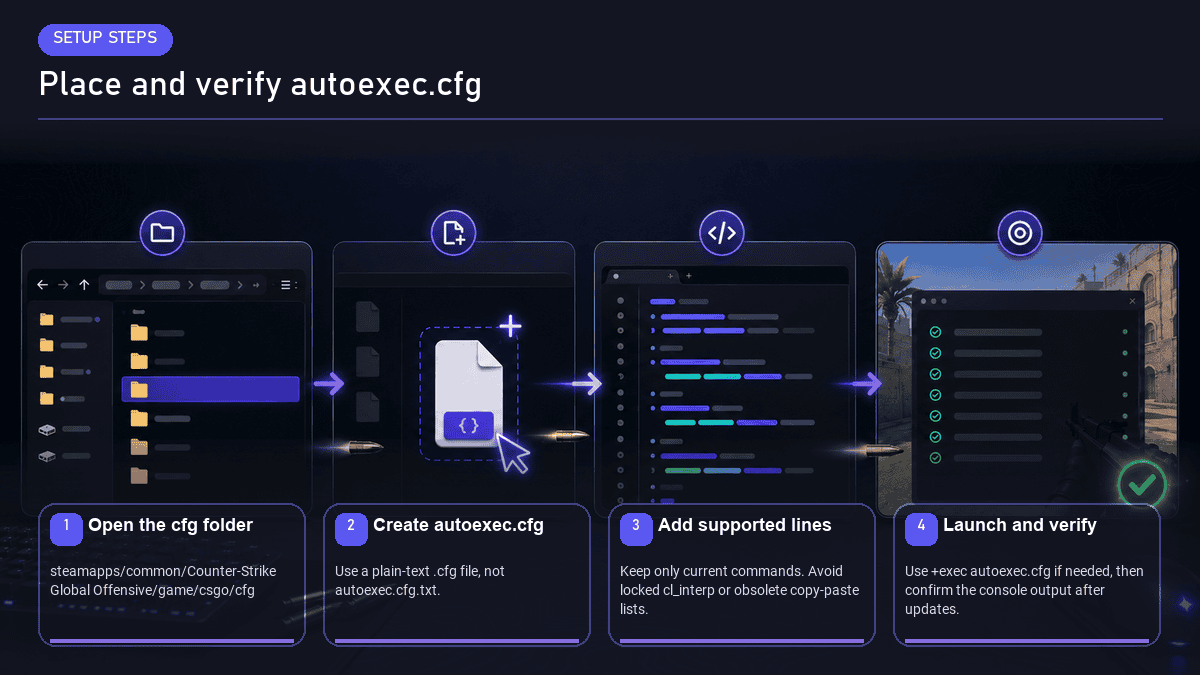
The in-game buffering option normally persists, so an autoexec is optional. Use one when you maintain a portable config, switch between network environments, or want temporary telemetry enabled while testing. Do not add the obsolete four-command bundle.
The default Windows folder is:
C:\Program Files (x86)\Steam\steamapps\common\Counter-Strike Global Offensive\game\csgo\cfg
If Steam is installed elsewhere, right-click Counter-Strike 2 in your library, choose Manage → Browse local files, then open game → csgo → cfg. Tradeit’s full CS2 config file setup guide covers file extensions, alternate libraries, and config loading in more detail.
- Create the correct file. Open Notepad, save as
autoexec.cfg, choose “All files,” and confirm Windows did not append.txt. - Choose one buffer line. Keep only the 0, 1, or 2 preset you intend to use. Comment out alternatives with
//. - Add telemetry only while testing. The optional lines below show ping and delivery quality. Remove or disable them when you no longer need the overlay.
- Save and verify. Launch CS2, open the console, run
exec autoexec, then querycl_net_buffer_ticksto confirm the value.
// CS2 network buffer: choose ONE preset
cl_net_buffer_ticks 0
// cl_net_buffer_ticks 1
// cl_net_buffer_ticks 2

// Optional network telemetry while testing
cl_hud_telemetry_ping_show 2
cl_hud_telemetry_net_misdelivery_show 2
cl_hud_telemetry_net_quality_graph_show 2

echo "Tradeit CS2 network preset loaded"Do you need +exec autoexec.cfg? Usually not. CS2 normally loads a correctly named autoexec from the correct folder. Add +exec autoexec.cfg to Steam launch options only as a fallback when the file does not run automatically. First fix the common causes: wrong folder, hidden .txt extension, or malformed commands.
Sub-Tick Architecture: Why CS2 Interp Feels Different from CS:GO
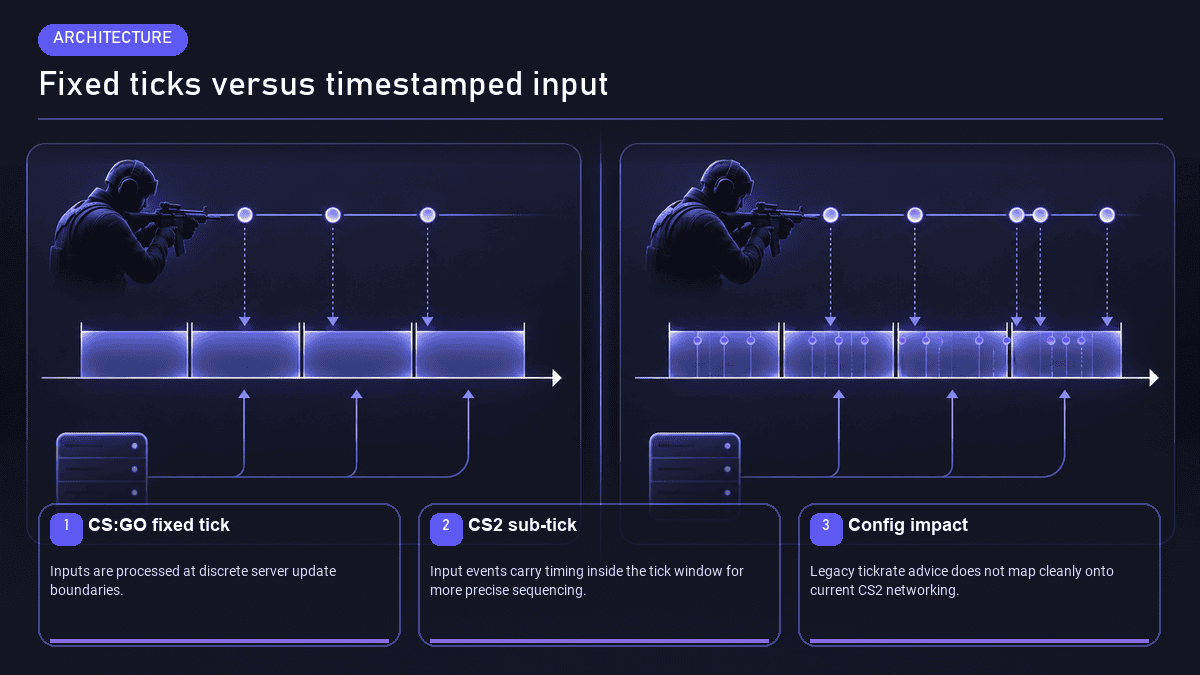
CS:GO’s networking advice revolved around fixed update and command rates. Players tried to align client values with 64- or 128-tick servers, then calculated interpolation from the update rate. CS2 changed the input side of that model: user commands carry timing information within the server tick, allowing the server to evaluate when an action happened between regular simulation boundaries.
Sub-tick does not mean the game has no ticks, no snapshots, or no interpolation. The server still advances simulation, the client still receives networked state, and your monitor still needs a rendered position for each frame. Sub-tick timing improves how movement, shots, and throws are timestamped; buffering still decides how much delivery variation the client can absorb.
Rate bundle controlled more of the path
cl_updaterate, cl_cmdrate, and a ratio were common client-side tuning points. One value changed the old lerp formula directly.
Engine timing + a narrow buffer choice
Input timing is sub-tick, while the exposed user choice is mainly 0 to 2 buffer ticks for packet-loss and jitter tolerance.
This is why changing “interp” can feel weaker in CS2. You are not reconfiguring the whole client/server cadence. You are choosing a small resilience buffer around a system whose input timestamps, clock synchronization, prediction, and server rules are otherwise engine-controlled.
It also explains why a death behind cover is not proof that your ratio is wrong. The visible result can combine your outgoing latency, the opponent’s latency, server lag compensation, packet timing, local frame time, and the fact that each player sees a slightly delayed representation of the other. A larger buffer may hide jitter; it cannot make those systems instantaneous.
Troubleshooting: Yellow Warnings and Reset Values
Most interp problems in 2026 come from an old autoexec, not from a missing secret command. Start by searching every loaded config for cl_interp, cl_interp_ratio, cl_updaterate, and cl_cmdrate. Remove direct assignments and retest with the game’s default buffer.
| Symptom | Likely cause | Fix |
|---|---|---|
Yellow warning after setting cl_interp |
A legacy config is trying to assign a read-only effective value. | Delete the assignment. Use the Game-menu buffer or cl_net_buffer_ticks. |
“Unknown command” for cl_updaterate or cl_cmdrate |
The file contains CS:GO-era commands. | Remove them. They are not required for current CS2 networking. |
| Setting returns after restart | Another config, launch option, or cloud-synced file is reapplying it. | Search the cfg folder, simplify launch options, and query the value after exec autoexec. |
| Players jerk or teleport at buffer 0 | Uneven packet delivery, Wi-Fi interference, or a route problem. | Enable telemetry, test buffer 1, then compare on the same server region. |
| Game feels delayed at buffer 2 | The maximum smoothing trade-off is larger than your connection needs. | Reduce to 1 or 0. Fix the underlying network instead of masking it. |
| No visible difference between presets | Your connection is already stable, or the issue is FPS, frame pacing, ping, or server load. | Return to 0 and troubleshoot the measured problem rather than stacking commands. |
Safe reset command
To return the user buffer to its default, use:
cl_net_buffer_ticks 0
Then set Settings → Game → Max Acceptable Game Traffic Bandwidth to Unrestricted unless you have a specific bandwidth constraint. If you enabled telemetry only for testing, switch the overlay off from the Telemetry settings menu. Do not add random network commands from a copied pro config; compare each line against the current best CS2 console commands reference.
If values 1 and 2 only make the problem less visible, test Ethernet, stop background uploads, check Wi-Fi interference, restart network equipment, and compare server routes. A config cannot repair congestion or a failing physical link.
Ready to trade CS2 skins?
Trade, buy, or sell CS2 skins on Tradeit anytime.
CS2 Interp Settings FAQ
How do you change interp in CS2?
Open Settings → Game → Buffering to smooth over packet loss / jitter and choose None, 1 Packet, or 2 Packets. The console equivalent is cl_net_buffer_ticks 0, 1, or 2. Do not set cl_interp directly, and do not force cl_interp_ratio in a current config.
What is the default cl_interp value in CS2?
There is no single user-settable default cl_interp number to paste. The command reports the effective interpolation amount calculated by the engine for the current session. The default user buffer is cl_net_buffer_ticks 0, shown as None in the Game menu.
Do professional players use custom interp settings in CS2?
There is no universal professional interp command. A stable tournament connection usually favors the default zero extra buffer, while a player may use one packet when a route has measurable jitter. Copying a pro’s old config does not recreate their network, server, or event setup.
Will changing cl_interp_ratio get me flagged on Valve servers?
Normal in-game settings and release cvars are not cheats, but current CS2 explicitly routes the player choice through cl_net_buffer_ticks and advises against modifying the ratio directly. Use the supported 0 to 2 buffer or the Game-menu option; never use third-party software to manipulate networking.
Why does the console show a yellow warning when I set cl_interp?
Because cl_interp is no longer a direct player tuning variable. It reports the effective interpolation amount. Remove the assignment from your config and set cl_net_buffer_ticks instead.
Does cl_interp_ratio 0 really disable interpolation?
No. In the current setup, zero represents no extra user-selected buffer ticks. CS2 still interpolates networked entities and keeps its core client rendering systems active. Zero is the lowest buffer preset, not a global interpolation-off switch.
Is it worth changing interp settings on Valve matchmaking servers?
Only when you have measurable delivery variation. Leave the buffer at None on a steady connection. Test 1 Packet if official-server telemetry shows intermittent jitter or misdelivery; use 2 Packets only when the added smoothness is worth the responsiveness cost. The setting does not lower matchmaking ping.
Do I need +exec autoexec.cfg in launch options for interp settings to persist?
Usually no. A correctly named autoexec.cfg in game\csgo\cfg normally runs automatically. Use +exec autoexec.cfg only as a fallback after checking the file location, filename extension, and console output.
Editorial takeaway: In current CS2, “best interp” means choosing the smallest packet buffer that keeps your connection smooth, not restoring a CS:GO-era updaterate, cmdrate, ratio, and direct-interp bundle.