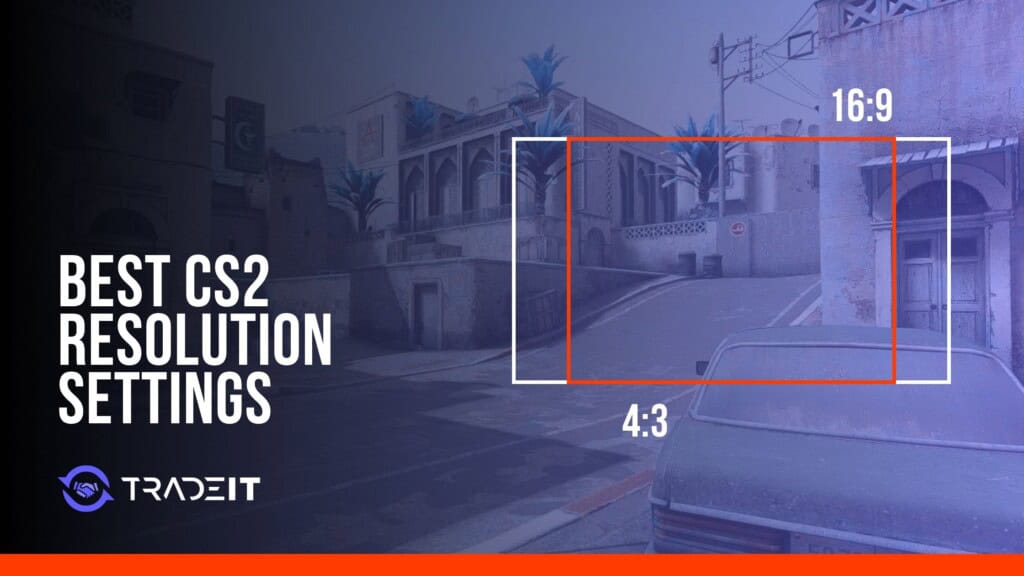

The most popular choice in the sample below is 1280×960. You get a 4:3 frame to stretch across a widescreen monitor, with fewer pixels to render than 1080p. The resulting wider-looking models are a preference, though. The game does not reward you mechanically for selecting that shape.
For a sharper picture and more side vision, start at 1920×1080 on a 1080p 16:9 monitor. The setup instructions are under How to Change Resolution in CS2. The choice between the two is mostly about what you can see comfortably and what your PC can render consistently.
On this page
The cards below answer three different needs. One keeps the familiar stretched image; another keeps native detail. The third is for a PC whose GPU needs fewer pixels to render. Choose the need that matches your situation before copying the numbers.
Best CS2 Resolution Based on Pro Players
The count in Profilerr’s 645-profile sample is 293 players at 1280×960. Dividing 293 by 645 gives 45.43%, the biggest resolution group in that list. Its separate aspect-ratio counts are 346 for 4:3 stretched and 94 for 4:3 black bars: 53.64% and 14.57%, respectively.
ProSettings describes roughly three-quarters of active pros as using 4:3. That figure comes from its own player population. It cannot be substituted into the 645-profile table or used as that table’s denominator. Profiles also change with players’ settings, and these lists are not a census of every competitive player.
The five largest listed resolution groups. Shares are calculated from their counts out of 645 profiles, not an FPS ranking.
| Resolution | Share of 645 Profiles | Profiles | Typical Presentation |
|---|---|---|---|
| 1280×960 | 45.43% | 293 of 645 | Usually 4:3 stretched |
| 1024×768 | 16.12% | 104 of 645 | Usually 4:3 stretched |
| 1920×1080 | 10.39% | 67 of 645 | 16:9 native |
| 1152×864 | 4.65% | 30 of 645 | 4:3, stretched or black bars |
| 1280×1024 | 4.50% | 29 of 645 | 5:4 stretched |
| Aspect Ratio | Share of 645 Profiles | Profiles |
|---|---|---|
| 4:3 stretched | 53.64% | 346 of 645 |
| 4:3 black bars | 14.57% | 94 of 645 |
| 16:9 native | 10.85% | 70 of 645 |
| 5:4 stretched | 4.03% | 26 of 645 |
| 16:10 stretched | 3.88% | 25 of 645 |
The examples are split four to one. In ProSettings’ profiles, m0NESY, donk, NiKo and s1mple use 1280×960, while ZywOo’s listed mode is 1024×768. That tells you what those players have chosen. It does not turn either pixel count into an accuracy setting.
A familiar crosshair position may look different after the picture is stretched. So can movement across the screen. Neither change gives the game new mechanics. Keep a setup you can read comfortably instead of changing it solely because more profiles list another one.
A CS2 pro-settings baseline includes choices beyond the display. Its resolution needs to work with the rest of the setup, including input and audio. That is why the overall CS2 settings cannot be reduced to a single popular screen size.
Why Resolution and Aspect Ratio Matter
There are two numbers to separate here. Width times height gives the pixel count used by our calculator. Width divided by height gives the shape of the frame. Two 4:3 modes therefore share a shape without necessarily sharing the amount of detail.
Fewer pixels can help a GPU that is already at its limit. They do much less for a system where CPU performance limits CS2. Lowering the resolution cannot remove work that the CPU still has to do.
The ratio changes the horizontal view available to you. Scaling then decides how that view fits your monitor. Enemy hitboxes remain the same size in the game, whatever proportions you see on screen.
Stretching takes the rendered image and widens it to fill the screen. Models look broader, and their sideways motion can appear faster. Black bars do the opposite job: they leave the proportions alone and fill the unused space at the sides.
4:3 Resolution: Stretched or Black Bars
Both 1280×960 and 1024×768 are 4:3 modes. Put either on a 16:9 monitor and there is spare space at the sides. You can leave that space as black bars, or stretch the frame across it. Stretching widens everything in the picture.
An opponent close to the edge of a 16:9 view may be outside the 4:3 view altogether. Enlarging the 4:3 picture to remove its bars cannot bring that part of the scene back. You are stretching the portion that was rendered, not adding the cropped sides to it.
- Pros: wider-looking models, familiar competitive feel, and fewer rendered pixels than 1080p.
- Cons: you give up side vision, and enlarging the low-resolution frame softens it.
- Best for: keeping a familiar aim picture when you prefer attention concentrated near the center.
Selecting 4:3 is only half of a stretched-resolution setup. If bars remain, the GPU or monitor is preserving the frame’s proportions. Change its scaling mode to fill the panel.
Best Stretched Resolution for CS2
Our starting point for stretched play is 1280×960. You keep the 4:3 shape of 1024×768 but gain pixels for reading the scene. Before committing to it, look down the angles you normally hold: can you make out a distant opponent and the edge of a smoke comfortably? If not, move up a mode.
Either side of that starting point, 1024×768 gives the GPU fewer pixels to draw and 1440×1080 gives you more detail. The latter must be offered by your monitor and driver. Leave the graphics preset alone during these trials so you can attribute the difference to resolution.
16:10 Resolution
Try 1680×1050 if the jump between 4:3 and 16:9 feels too large. At 16:10, it sits between them for side vision. Stretching remains an option, but you won’t get the same broad-looking models as with stretched 4:3.
On a 16:9 monitor, the widening relative to height is about 11.1% for a stretched 16:10 image and 33.3% for stretched 4:3. To keep the image’s proportions instead, leave the unused area of the panel as bars.
- Pros: side vision between 4:3 and 16:9; less stretching than 4:3 on a 16:9 panel.
- Cons: relatively few pro examples to copy; availability depends on the display and driver.
- Best for: a middle option if neither 4:3 nor 16:9 feels comfortable.
16:9 Resolution: Native
With upscaling off, a 1920×1080 game frame fits a 1080p panel pixel for pixel. Nothing has to enlarge a smaller frame. We’d use that picture as the reference when comparing text, distant detail and the extra side view with a stretched mode.
Coming from stretched 4:3, expect models to look narrower. Pay attention to the sides as well as the target in front of you: part of a lane that was cropped out before may now be visible.
- Pros: one game pixel per panel pixel at native 1080p, with the normal proportions and wider side view intact.
- Cons: more pixels for the GPU than the common low 4:3 modes, and none of their model-widening effect.
- Best for: someone who can sustain the frame rate and values the native picture or wider view, including for streaming.
Finding Your Ideal CS2 Resolution
Monitor size and seating distance affect what you can read. A low-resolution picture that was acceptable on one screen may look soft when enlarged on another. Make this decision from your usual playing position.
Use a round with players, smokes and effects on screen for the performance comparison. An empty practice spawn cannot show you those heavier moments. Pay attention to the dips that affect movement and aim; a high menu average is not the result you need.
Have rendering headroom? Keep the picture you prefer and check the busy rounds before cutting pixels.
Try the resolutions without changing shadows, anti-aliasing or other graphics options.
Lower pixel load only as far as needed. Stop before lost clarity becomes a competitive problem.
| PC Level | Recommended Starting Point | Aspect | Why |
|---|---|---|---|
| High-end | 1920×1080 or preferred 4:3 stretched | 16:9 or 4:3 | Native clarity or a familiar stretched view |
| Mid-range | 1920×1080, 1680×1050, or 1280×960 | 16:9, 16:10, or 4:3 | Compare these modes with the rest of the preset unchanged |
| Low-end | 1600×900 first, then 1280×960 or 1024×768 if needed | 16:9 or 4:3 | Less GPU pixel work, at the cost of detail |
High-End Gaming PCs
With enough performance to spare, we would choose the picture first. Native 1080p means 2,073,600 pixels per frame. See how your PC handles that in a busy round. A 240 Hz monitor refreshes about every 4.17 ms and a 144 Hz monitor every 6.94 ms; those are display intervals, not a promise about CS2’s frame times.
You don’t have to abandon 1280×960 after buying a better GPU. It still has 1,228,800 pixels per frame, and keeping it lets you retain the view you already know. Spend the extra rendering capacity only if you prefer what it buys you.
One option is more anti-aliasing rather than another aspect ratio. It may help with jagged distant edges. Compare the frame times before keeping it, especially during the fights where dips would bother you.
Mid-Range Gaming PCs
Check GPU use in a busy scene before deciding that resolution is the problem. Fewer pixels can help a GPU-limited PC. They do not remove the CPU’s work on the round, so a CPU-related stutter may remain even after a large resolution drop.
Try 1680×1050 and 1280×960 with the rest of the graphics preset unchanged. Their pixel counts are 1,764,000 and 1,228,800 respectively, both below 1080p. How much FPS you gain depends on the limiting workload, not just that arithmetic.
Low-End Gaming PCs
Try 900p before changing the screen’s shape. At 1600×900, CS2 still has a 16:9 view, with fewer pixels for the GPU than at 1080p. If the problem is CPU work rather than pixel rendering, this comparison may show little improvement.
Going below 900p brings 1280×960 and 1024×768 into the comparison, both with a 4:3 frame. Look for an actual response in frame times after each reduction. When the response disappears, more blur is not a useful substitute for fixing the remaining bottleneck.
Practical test: use the same map, graphics preset, and refresh rate while comparing resolutions. Check not just average FPS, but how the game feels during smokes, molotovs, multiple player models, and fast turns. Leave your NVIDIA settings for CS2 alone during this comparison too.Compare a preset or type your own width and height. The calculator multiplies the dimensions and compares the total with a 1920×1080 frame, shown as 100%. Pixel counts are all it measures; the PC’s frame rate needs a separate test.
This compares rendered pixel counts. It is not a direct FPS prediction.
Display Mode: Fullscreen Exclusive vs Borderless
- Most predictable stretched scaling
- Direct control over game resolution
- Best first test for 1280×960
- Faster app and monitor switching
- Useful for frequent alt-tabbing
- May follow desktop output more closely
We would start with Fullscreen, particularly for stretched play. It gives you a straightforward way to choose the game’s resolution and refresh rate separately from the desktop. It can also avoid presentation quirks on some systems, though it is not a promise of a fixed latency reduction.
Borderless is not automatically slow. Windows 11’s windowed-game optimizations cover compatible DirectX 10 and 11 games and can use a newer presentation model to reduce frame latency. On a supported setup, the difference from Fullscreen may be small.
If you keep switching to another app or a second monitor, Borderless is convenient. The desktop remains more involved in the output, however. That can complicate a non-native stretched setup compared with selecting the same mode in Fullscreen.
Start the 1280×960 experiment in Fullscreen. If you see bars, the remaining job is in the scaling controls: the scaler has to fill the 16:9 panel. Keeping the game in a known display mode removes one variable while sorting that out.
The GPU can scale the frame, or the monitor can do it. How that affects delay depends on the particular display, connection and software setup. Try the alternatives you actually have. A small difference may matter less to you than being able to switch apps conveniently.
How to Change Resolution in CS2
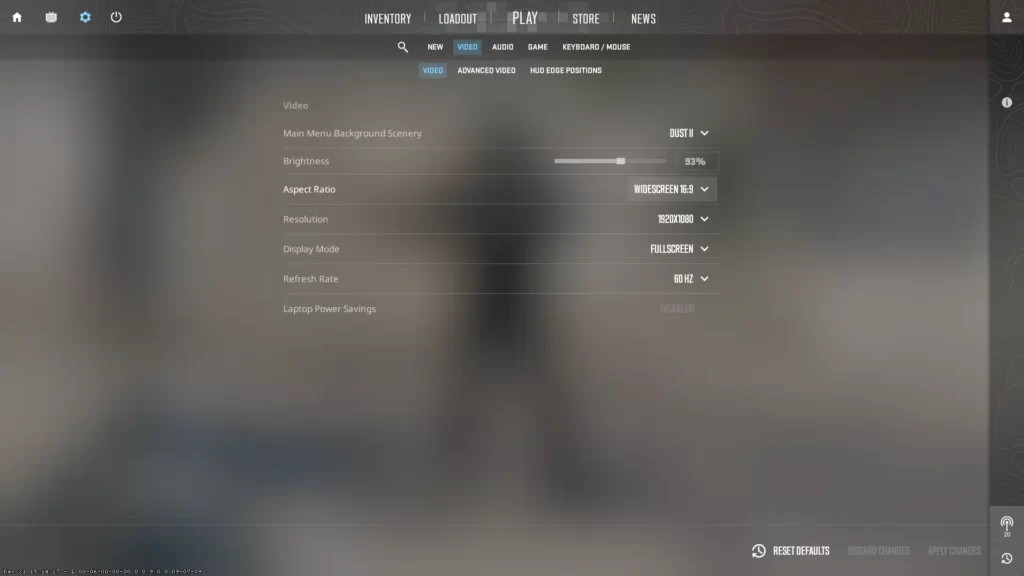
For the example used here, the Video choices are Fullscreen, 4:3 and 1280×960. Apply them before changing the scaler.
Add the dimensions only when CS2 will not retain them.
-w 1280 -h 960Steam launch optionsUse Full-screen on NVIDIA or Full panel on AMD if black bars remain.
Check refresh rate, sharpness, frame-time stability, and scaling in a practice map.
Open Settings > Video > Video and choose Fullscreen for Display Mode. For this example, select 4:3 and then 1280×960. Apply those choices before checking whether the image has bars or fills the panel.
Steam can request the frame dimensions at startup when the in-game selection will not stick. The field is at Library > Counter-Strike 2 > Properties > General > Launch Options. For this example the text is -w 1280 -h 960. Use it for that specific problem; a setting that already saves correctly does not need the workaround.
In NVIDIA Control Panel > Adjust desktop size and position, choose Full-screen and set scaling to GPU. Still getting bars when CS2 starts? Try Override the scaling mode set by games and programs so the game does not replace that scaling choice.
AMD’s equivalent is in Adrenalin’s Display settings. Turn on GPU Scaling, then choose Full panel. The layout can move between driver releases, but those are the controls to look for.
Check the result in a practice map, where a wrong mode will not interrupt a ranked round. Look at the filled screen, the sharpness and the refresh rate. If they are not right, undo the forced dimensions in Steam and return to native resolution before testing another change.
Counter-Strike 2 Pro Player Preferences
m0NESY, donk, NiKo and s1mple are listed here at 1280×960. ZywOo’s entry is 1024×768. The tables therefore show a shared preference for stretching a 4:3 image, with two different resolutions within that preference.
The panel’s specification describes what the monitor can display, not what a player must select in CS2. A high-resolution screen can still be used for lower-resolution stretched play. That is why a hardware listing on its own cannot tell you the player’s chosen mode.
| Player | Team | Resolution | Aspect |
|---|---|---|---|
| m0NESY | Falcons Esports | 1280×960 | 4:3 stretched |
| ZywOo | Team Vitality | 1024×768 | 4:3 stretched |
| donk | Team Spirit | 1280×960 | 4:3 stretched |
| NiKo | Falcons Esports | 1280×960 | 4:3 stretched |
| s1mple | BC.Game | 1280×960 | 4:3 stretched |
The broader head on the screen still has the same hitbox behind it. Weapon accuracy has not changed either. Borrowing a pro’s resolution gives you their choice of presentation to try, with the ordinary hit-detection rules intact.
Leave the mouse alone during these trials. Changing the picture and your aim speed together makes an awkward result harder to explain. Pick the display setup first, then come back to CS2 sensitivity if it still needs attention.
4:3 vs 16:9 Aspect Ratio in CS2
With 4:3 versus 16:9, you are choosing between a wider-looking target and more side vision, along with the sharpness of each resolution. The hitbox stays unchanged. Habit matters too: an unfamiliar picture can take time to judge fairly.
Models look wider, but the horizontal view is narrower.
Natural proportions, sharper presentation, and more peripheral information.
| Category | 4:3 Stretched | 16:9 Native |
|---|---|---|
| Player-model appearance | Wider on screen | Narrower, natural proportions |
| Horizontal field of view | Narrower | Wider |
| Image clarity | Softer at common low resolutions | Sharper at 1920×1080 native |
| Performance | Can help when fewer pixels reduce GPU load | More pixels at 1080p, but often easy for modern GPUs |
| Movement feel | Can look faster because the image is stretched | More natural screen-space motion |
| Best for | Competitive familiarity and wider-looking targets | Clarity, peripheral awareness, and native presentation |
Give the unfamiliar mode several full matches. Changing back after one missed shot does not tell you much about it. Some discomfort is simply the cost of a picture that no longer looks like the one you are used to.
There is no need to defend a preference for either picture. You may rely on the extra side view at 16:9, or feel more at home with stretched models. A pro changing settings does not cancel out what already works comfortably for you.
Conclusion
Start with either 1280×960 at 4:3 stretched or 1920×1080 at 16:9. Compare the broader-looking models with the sharper native picture and extra side view. Keep the option you can read comfortably when the round gets busy.
FAQs
What resolution do most CS2 pros use?
In the sample, 293 of 645 profiles use 1280×960. The calculation is 45.43%, enough to lead the list but not to exceed half of it. Among the five named examples, four use that size and ZywOo uses 1024×768. These are tracked profiles, not a count of every pro.
Is 1920×1080 good for competitive CS2?
Yes. You do not have to stretch the picture to play competitively. At 1920×1080 on a 1080p monitor, the frame fits the panel without enlargement and retains the 16:9 side view. Keep it if your PC handles the busy parts of matches smoothly.
Does stretched resolution increase FPS in CS2?
Not because it is stretched. The possible gain comes from a lower pixel count: 1280×960 asks less pixel-rendering work of the GPU than 1920×1080. Bars or no bars, that can help a GPU-limited setup. It does not solve a CPU limit.
Does 4:3 stretched make CS2 player models or hitboxes bigger?
The models look wider on your monitor, but their hitboxes are unchanged. It is the 4:3 frame being widened to fill the screen, not a larger target in the game’s hit detection.
Is Fullscreen better than Borderless in CS2?
Fullscreen is the first mode to try for a non-native stretched setup. Borderless makes switching apps convenient, and its performance can be close on an optimized Windows system. The useful answer is the comparison on your PC, not a blanket latency claim for all machines.
How do I set up 1280×960 stretched in CS2?
Use Fullscreen with 4:3 and 1280×960 in CS2. If bars remain, the scaler is preserving the frame’s proportions. Change that behavior to Full-screen on NVIDIA, or turn on GPU Scaling and select Full panel on AMD.
What launch options force 1280×960 in CS2?
The Steam Launch Options string is -w 1280 -h 960. It requests those dimensions on startup. When the forced size is no longer needed, clear it out so the saved in-game resolution can control the next launch.