
Professional settings are useful because they show what survives real tournament pressure. They are not a shortcut to professional aim. A sensitivity that works for an entry rifler with a large mousepad may feel awkward for an AWPer, and a stretched resolution chosen for model visibility may be a poor match for someone who values native clarity.
This guide treats pro configurations as data, not prescriptions. The comparison below covers twelve searched players and keeps mouse speed, resolution, aspect ratio, team, and role together. That context matters. Copying one number while ignoring the rest of the setup usually creates more confusion than improvement.
Settings verified August 4, 2026. These CS2 pro settings are reference data, not prescriptions. Start with a player whose role and desk setup resemble yours, then test one change at a time instead of copying an entire config blindly.
Pair pro sensitivity and resolution choices with Tradeit’s full CS2 settings guide for performance, visibility, audio, and input.
View Best CS2 SettingsCS2 Pro Settings at a Glance
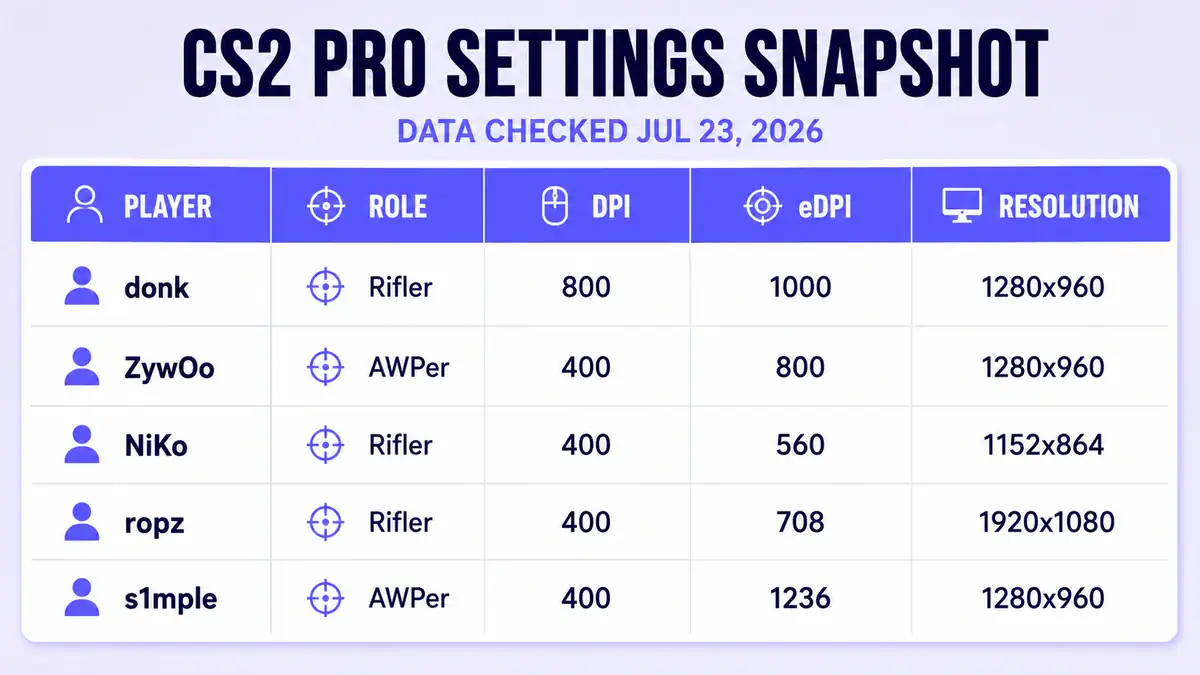
This is a curated sample of twelve active professional players. Each row was rechecked against the linked individual profile on August 4, 2026. Values include mouse model, DPI, in-game sensitivity, calculated eDPI, resolution, and aspect ratio. The table shows real competitive configurations without claiming that one of them is the best setup for everyone.
Methodology: Team, role, mouse, DPI, sensitivity, resolution, and aspect ratio were taken from the linked individual ProSettings profiles. eDPI was recalculated as DPI multiplied by in-game sensitivity. A profile was included only when the required fields were available, so the table contains no question marks or guessed values.
| Setting | Most common value | Share of tracked pros | Reading |
|---|---|---|---|
| Mouse DPI | 400 DPI | 9 of 12, 75% | 800 DPI is also common. Compare eDPI, not DPI alone. |
| In-game sensitivity | 2.00 | 4 of 12, 33% | The full sample runs from 1.04 to 3.09. |
| eDPI band | 700 to 1000 | 8 of 12, 67% | The sample median remains close to 800 eDPI. |
| Resolution | 1280×960 | 10 of 12, 83% | Usually stretched at 4:3. |
| Aspect ratio | 4:3 | 11 of 12, 92% | ropz is the native 16:9 exception in this tracked group. |
| Monitor refresh | 240 Hz or higher | 12 of 12 profiles with monitor data | Refresh is hardware context, not a config value to copy. |
| Raw mouse input | On by the CS2 input path | 100% | CS2 reads raw mouse movement rather than using an optional old CS:GO toggle. |
| Mouse acceleration | Not used | 100% | None of the tracked setups relies on Windows pointer acceleration for aim. |
The percentages above come from the twelve named profiles in this article. For graphics context, the separate 40-pro advanced-video comparison shows why one setting should not be treated as universal even when a majority uses it.
Current Settings for Top CS2 Pros (2026)
| Player | Team | Role | Mouse | DPI | Sensitivity | eDPI | Resolution | Aspect ratio | Source | Last checked |
|---|---|---|---|---|---|---|---|---|---|---|
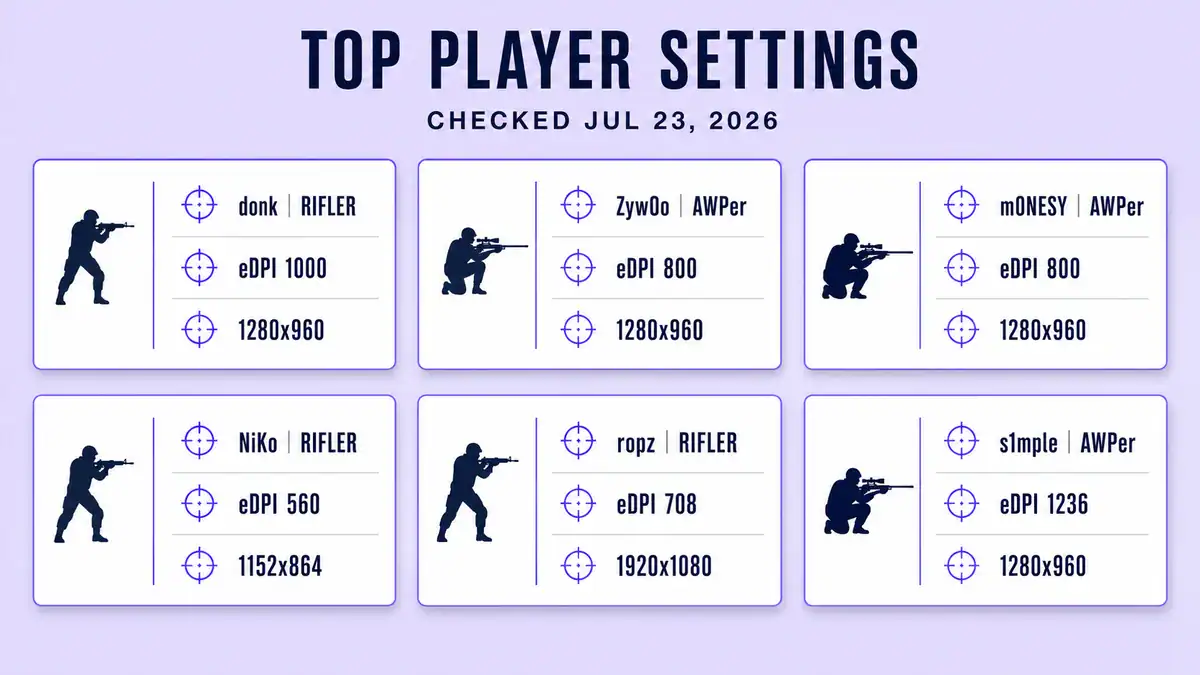
| donk | Team Spirit | Rifler | Logitech G Pro X Superlight | 800 | 1.25 | 1000 | 1280×960 | 4:3 | ProSettings profile | August 4, 2026 |
| ZywOo | Vitality | AWPer | VAXEE OUTSET AX | 400 | 2.00 | 800 | 1280×960 | 4:3 | ProSettings profile | August 4, 2026 |
| m0NESY | Falcons | AWPer | Logitech Superlight | 400 | 2.00 | 800 | 1280×960 | 4:3 | ProSettings profile | August 4, 2026 |
| NiKo | Falcons | Rifler | Logitech Superlight | 400 | 1.40 | 560 | 1152×864 | 4:3 | ProSettings profile | August 4, 2026 |
| ropz | Vitality | Rifler | Zowie EC2 | 400 | 1.77 | 708 | 1920×1080 | 16:9 | ProSettings profile | August 4, 2026 |
| s1mple | BC.Game | AWPer | Logitech Superlight | 400 | 3.09 | 1236 | 1280×960 | 4:3 | ProSettings profile | August 4, 2026 |
| sh1ro | Team Spirit | AWPer | Logitech Superlight | 800 | 1.04 | 832 | 1280×960 | 4:3 | ProSettings profile | August 4, 2026 |
| b1t | NAVI | Rifler | Logitech Superlight | 400 | 1.42 | 568 | 1280×960 | 4:3 | ProSettings profile | August 4, 2026 |
| XANTARES | Aurora | Rifler | Zowie EC2 | 400 | 2.00 | 800 | 1280×960 | 4:3 | ProSettings profile | August 4, 2026 |
| KSCERATO | FURIA | Rifler | Logitech Superlight | 800 | 1.255 | 1004 | 1280×960 | 4:3 | ProSettings profile | August 4, 2026 |
| malbsMd | Team Liquid | Rifler | Logitech G Pro X2 SUPERSTRIKE | 400 | 2.00 | 800 | 1280×960 | 4:3 | ProSettings profile | August 4, 2026 |
| apEX | Vitality | Rifler / IGL | ZOWIE EC2-DW | 400 | 1.91 | 764 | 1280×960 | 4:3 | ProSettings profile | August 4, 2026 |
Profiles change. A player can keep the same sensitivity while replacing a mouse, changing teams, or testing a different resolution. That is why the source and check date sit beside every row instead of being hidden in a generic references section.
Mouse Settings: DPI, Sensitivity, and eDPI
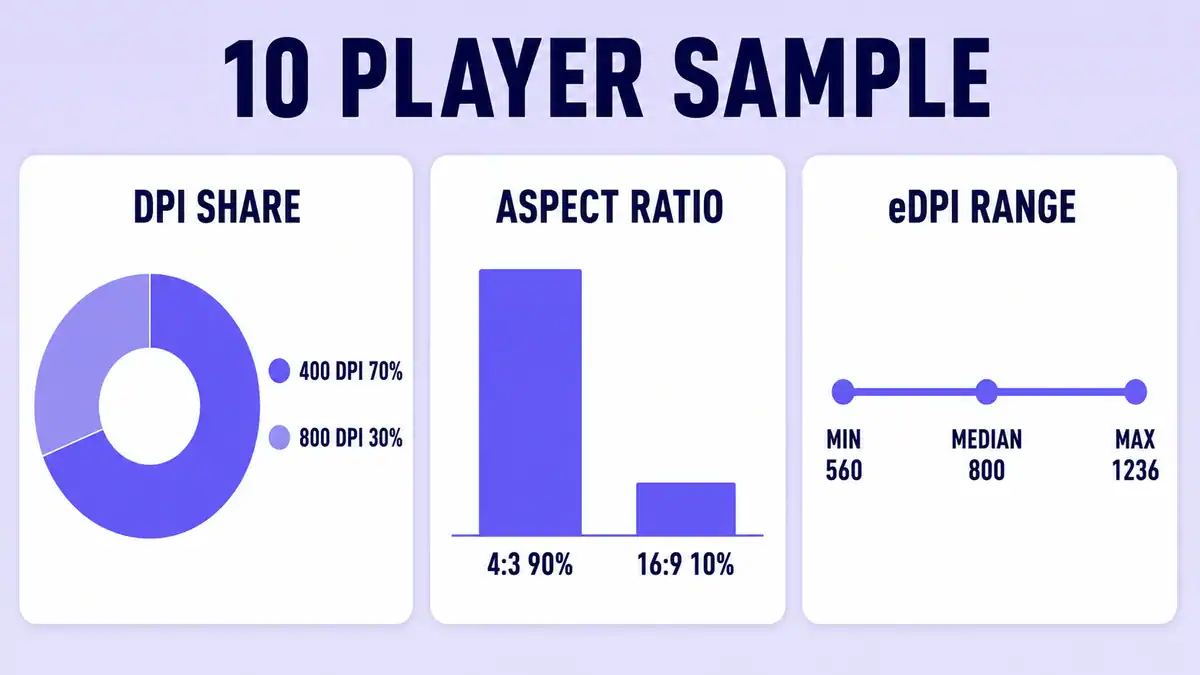
Within this exact sample set, eDPI is distributed between 560 and 1236. The median is 800 and the arithmetic mean is 830.8. Six of the ten players sit from 700 through 1000 eDPI. Those numbers only describe this short list. They are not a universal professional range.
Mouse DPI, Sensitivity and eDPI
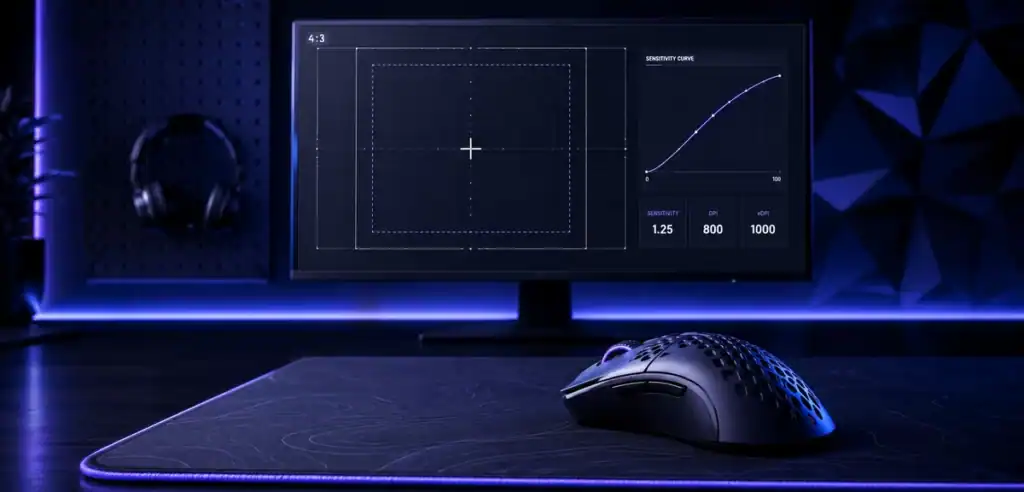
Seven players use 400 D.P.I. and three players use 800 D.P.I. DPI is not enough to tell you how fast the crosshair moves because in game, sensitivity is what changes the outcome. ZywOo and m0NESY achieve 800 eDPI with 400 DPI at 2.00 sensitivity. a 800DPI player could move at the same effective speed as a 1.00 sensitivity setting.
The sample also shows why a single recommended sensitivity is misleading. NiKo’s 560 eDPI and s1mple’s 1236 eDPI are both professional configurations, yet they ask for very different arm movement, mousepad space, and adjustment habits. The useful comparison is the complete input setup, not one isolated number.
Resolution and Aspect Ratio
Nine of the ten players use a 4:3 resolution. Eight use 1280×960 and NiKo uses 1152×864. Both are 4:3. ropz is the only native 16:9 player in the sample at 1920×1080.
Stretching a 4:3 format for the game is often chosen by players because it makes character models appear wider on screen and reduces peripheral detail. This does not change hitboxes, accuracy or server-side movement. Native 16:9 retains a wider field of view and higher level of detail than its counterparts, which is why the proper choice still depends upon individual preference. The deeper trade-offs belong to the best CS2 resolution guide.
Video and Graphics Settings
Competitive video choices usually prioritize stable frame pacing, readable shadows, and low input latency. That does not mean every option should be switched to its lowest value. A setting that removes useful shadow information or creates unstable performance can be worse than a slightly heavier setting that stays consistent.
NVIDIA Reflex is common in competitive configurations, but the appropriate option depends on the player’s hardware and render behavior. Treat it as part of a tested system rather than a mandatory badge. The article on best CS2 settings covers the full graphics menu, while this page stays focused on the comparison data.
The 40-pro advanced-video sample shows the same pattern as the individual profiles: VSync is generally off, FSR is disabled, and shadows are kept high often enough that “everything low” is not a reliable summary. Driver-level choices belong in the best NVIDIA settings for CS2 guide.
Crosshair, Viewmodel, and Audio
Crosshairs and viewmodels change more frequently than core sensitivity. Save a share code before testing another layout, and compare it at the same resolution because stretched 4:3 changes its apparent size. The current best CS2 crosshair codes page maintains those imports without turning this settings article into a second code database.
Most pros use compact viewmodels that leave more of the center screen visible, but the exact offsets are personal. Audio is similar: the important part is consistent directional information, sensible volume, and avoiding processing that masks footsteps. Use the best CS2 audio settings as a category guide, then keep the result stable long enough to learn it.
Test it with your normal weapons and finishes so visibility stays consistent in real matches.
Browse CS2 SkinsPro Settings by Role
| Role sample | Players | Average eDPI | Common resolution | Useful takeaway |
|---|---|---|---|---|
| Riflers | donk, NiKo, ropz, XANTARES, KSCERATO, b1t | 773 | 1280×960, with ropz at native 1920×1080 | The range is wide enough that role does not create one correct sensitivity. |
| AWPers | ZywOo, m0NESY, s1mple, sh1ro | 917 | 1280×960 stretched | Scoped control overlaps heavily with rifler eDPI, despite s1mple’s faster outlier. |
| IGL examples | apEX, Aleksib, karrigan | 777 | 4:3 stretched | Leadership duties do not force a high or low mouse speed. |
Player-by-Player Context
donk pairs 800 DPI with 1.25 sensitivity for 1000 eDPI. It is a relatively fast rifling setup in this sample, fitting an aggressive player who makes large entry and multi-target corrections. His 1280×960 stretched resolution keeps the visual presentation familiar to most of the shortlist.
ZywOo uses 400 DPI at 2.00 sensitivity, which produces 800 eDPI. The value sits at the sample median rather than at an extreme. His role demands both scoped control and fast unscoped corrections. Resolution is 1280×960 at 4:3.
m0NESY reaches the same 800 eDPI with the same 400 DPI and 2.00 sensitivity combination. Matching ZywOo on those inputs does not make the two setups identical. Mouse shape, pad friction, zoom sensitivity, posture, and years of muscle memory still change how the numbers feel.
NiKo has the lowest eDPI in the group at 560, using 400 DPI and 1.40 sensitivity. That slower speed favors deliberate micro-corrections and asks for more physical mouse travel. His 1152×864 resolution is 4:3, not 5:4.
ropz uses 708 eDPI and stands apart visually with 1920×1080 at 16:9. His profile is a useful reminder that native resolution remains viable at the highest level. A stretched image is a preference, not a requirement for competitive accuracy.
s1mple is the high-end outlier at 1236 eDPI, calculated from 400 DPI and 3.09 sensitivity. Copying that speed without the same control habits can make small corrections unstable. The number is evidence of personal adaptation, not a recommended AWPer target.
Sh1ro uses 800 DPI at 1.04 sensitivity for 832 eDPI. Even though his physical Dpi differs from the most players, he is able to get results that are close to the sample mean. Therefore, edpi provides more useful information than dpi when comparing effective mouse speed.
B1t sits near the lower end at 568 eDPI. Like niKo, he also uses 400 DPI with a sensitivity of less than 1.50. Lower effective speed can provide measured crosshair placement, but it also requires sufficient desk space and mousepad space for turns and transfers.
XANTARES uses the sample median of 800 eDPI with 400 DPI and 2.00 sensitivity. His profile demonstrates that a familiar numerical setup can support a very distinctive aiming style. The settings provide the input scale, not the mechanical skill.
KSCERATO combines 800 DPI with 1.255 sensitivity for 1004 eDPI. It is the second-fastest rifler value in the table, just above donk. The comparison is helpful, but the three-decimal sensitivity should not be treated as a magic number.
malbsMd uses 400 DPI and 2.00 sensitivity for 800 eDPI at 1280×960 stretched. The median-style input speed supports fast entries without implying that his mouse choice, pad, or posture can be separated from the number.
apEX uses 400 DPI and 1.91 sensitivity for 764 eDPI at 1280×960 stretched. It is a useful IGL reference because the value is close to the rifler average rather than being a role-specific extreme.
Crosshair and viewmodel choices can change independently of mouse speed. Rather than reproducing another frequently changing code list here, the best CS2 crosshair codes guide handles those imports and previews. Cosmetic inventory is separate from performance; the CS2 skins marketplace only changes the visual loadout.
Launch Options and Autoexec Commands Pros Use
Many current pro profiles use no launch options at all. Others keep a short, explainable string. The profile record matters because old CS:GO bundles still circulate even when a flag is ignored by CS2.
| Entry | Current use | 2026 guidance |
|---|---|---|
| Blank field | Common among current profiles, including jL | The safest baseline. Add only a flag you can explain and test. |
-console | Opens the developer console at launch | Convenient, but not a performance boost. |
-refresh 360 or -freq 360 | Seen in profiles such as apEX and Aleksib | Use only when it matches the monitor’s real refresh rate. |
-allow_third_party_software | Allows compatible capture or overlay tools | Add it only when a required tool needs it. |
+exec autoexec.cfg | Loads a named config at startup | Useful when the file is maintained and commands are current. |
-novid | Still appears in inherited profile strings | Legacy CS:GO habit. Do not treat it as a 2026 FPS optimization. |
-tickrate 128 | Still appears in some old strings | It does not turn official CS2 matchmaking into a 128-tick server. |
The individual ProSettings CS2 profiles show which strings are currently recorded. For building and backing up an autoexec, use the CS2 config file setup rather than copying an unexplained launch bundle.
How to Copy and Adapt Pro Settings
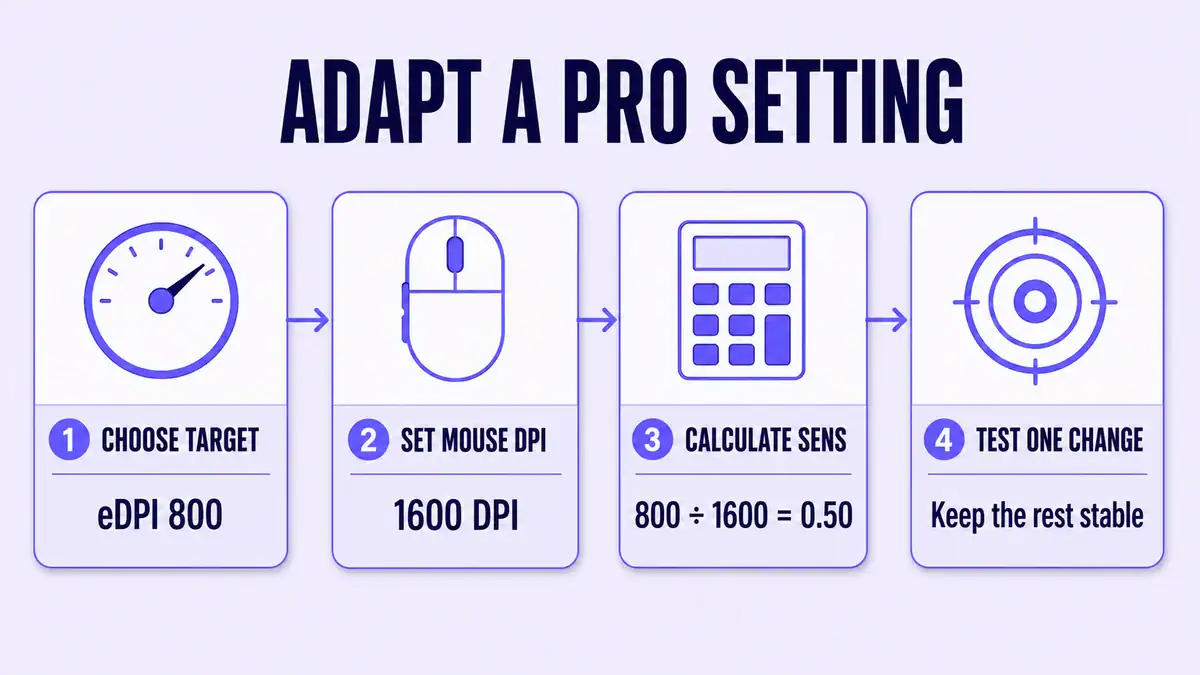
- Choose a relevant starting point. Compare players with similar roles and speeds that are compatible with your available mouse pad space.
- Translate the input correctly. Match DPI or use the CS2 eDPI calculator to preserve effective speed at a different DPI.
- Change one variable. Maintain a constant resolution, crosshair and mouse speed while testing sensitivity so you can pinpoint what caused the result.
- Test real situations. The use of deathmatch, recoil drills, target transfers, scoped flicks and many competitive matches must take place before assessing the system.
Do not force a setup just because a favorite player uses it. A lighter mouse can make the same eDPI feel faster, while a control pad can make it feel slower. Limited desk space can also make a sensitivity difficult to use. Begin with the calculation, then make changes.
Keep a short record of the old DPI, sensitivity, eDPI, resolution, and date. That makes changes reversible and prevents the endless cycle of replacing settings after one poor match. The same principle applies to inventory changes made through a CS2 trade system: the visual loadout is independent of the tested performance configuration.
How to Calculate and Compare CS2 eDPI
eDPI creates a common comparison scale. ZywOo’s 400 DPI multiplied by 2.00 sensitivity equals 800 eDPI. A player using 800 DPI could reach the same eDPI with 1.00 sensitivity. The cursor speed at the desktop would differ, but the effective in-game mouse speed would match.
For donk, the calculation is 800 × 1.25 = 1000 eDPI. For NiKo, it is 400 × 1.40 = 560 eDPI. Those two results make the practical difference clearer than the sensitivity values alone. A sensitivity of 1.25 is not automatically slower than 1.40 when the first player uses twice the DPI.
eDPI cannot measure anything outside the game itself (I.E. Acceleration), mouse weight, polling rate, pad friction, grip or scoped sensitivity. It’s an exact calculation for aiming, not the full picture of one. Use it to establish a baseline, then let controlled testing determine if the value fits you.
Comparison rule: If the DPI changes, divide the target eDPI by the new DPI to find the matching in-game sensitivity. For an 800 eDPI target at 1600 DPI, the matching sensitivity is 0.50.
FAQ
How often do professional CS2 players change their settings?
No specific schedule or time frame has been established for completion of this task. Many pros keep core sensitivity stable because frequent changes disrupt learned movement, however hardware resolution crosshair and smaller options can still change between events. Instead of assuming an old screenshot is current, check the linked profile date.
Should AWPers use a different eDPI from riflers?
Role can influence the choice, but this ten-player sample contains clear overlap. ZywOo, m0NESY, and XANTARES all use 800 eDPI despite different roles. Scoped sensitivity, positioning, and personal control matter alongside base eDPI.
Do CS2 pros use 400 DPI or 800 DPI more often?
In this curated sample, seven use 400 DPI and three use 800 DPI. That is not a claim about every professional player. Compare eDPI because two different DPI values can produce the same effective in-game speed.
Why do many professionals still use 4:3?
4:3 stretched makes the models look wider and lose some of their horizontal information, which can make it easier for players to understand. It does not expand hitbox sizes. The native 16:9 aspect ratio offers a greater view of the world and remains entirely competitive.
Do professional players use NVIDIA Reflex in CS2?
It is common, but not every configuration is identical. Reflex should be tested with the actual GPU, frame rate, and render load. A copied value is less useful than stable latency and frame pacing on your own system.
Can I copy a pro’s config without copying their hardware?
You can reproduce values but you cannot copy player’s hardware feel posture desk space role practice history. Consider the config to be a starting point (which is measurable) and modify one variable at a time.
Which CS2 settings should I avoid changing too often?
Avoid repeatedly changing sensitivity, resolution, aspect ratio, and crosshair together. Those choices affect visual scale and motor learning. Keep them stable long enough to collect useful evidence before making another adjustment.
What launch options do CS2 pros typically use?
Many use none. When a profile has a launch string, it is usually short and functional, such as -console, a matching refresh-rate flag, or a third-party-software allowance. Legacy FPS bundles are not a pro requirement.
Do pros use raw input or Windows sensitivity?
CS2 reads raw mouse input, so the game is not meant to inherit Windows pointer acceleration as an aim tool. Pros still record Windows pointer speed for desktop consistency, but DPI and in-game sensitivity determine the useful eDPI comparison.
How much does mousepad size affect sensitivity choice?
A lower eDPI needs more physical travel for turns and target transfers, so a larger pad gives it room to work. A small pad can make a copied low-sensitivity setup impractical even when the number looks attractive.