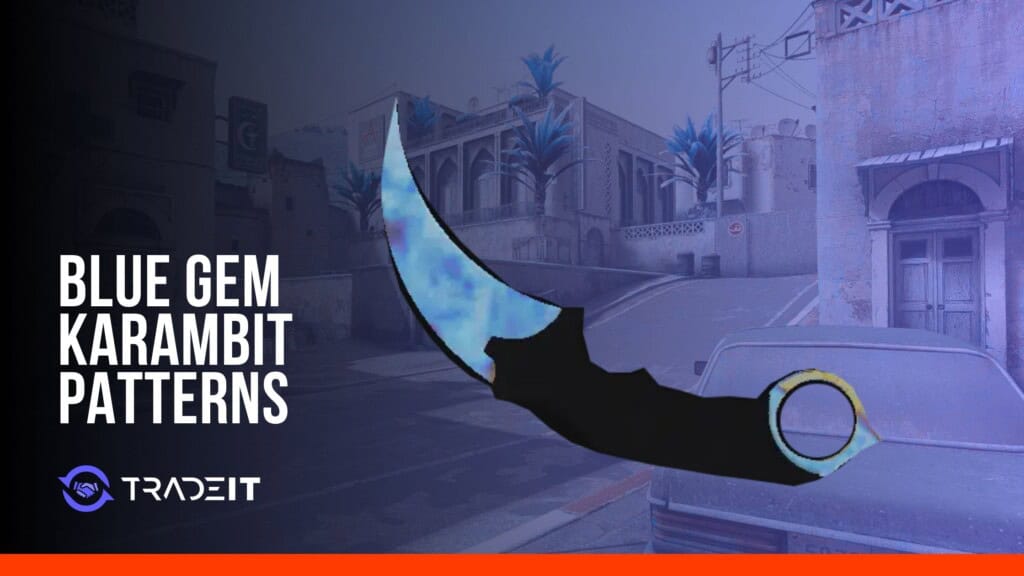


Karambit Blue Gem listings can show quite different knives. The term refers to blue-heavy Case Hardened patterns; it isn’t a promise of an entirely blue blade. Check the seed number and inspect view.
Pattern #387 is the one collectors usually mean when they talk about the top Karambit Blue Gem. Almost the entire play side is blue. Other seeds leave more gold or purple across the blade, even when a seller puts them in a high tier.
Be careful with screenshots taken from the reverse. What collectors call the play side is the face you see in the normal holding position; the other side can look much bluer without giving you that view during a match.
Turning down an offer isn’t the same as selling for that amount. We’ll separate those price stories below, along with the seed rankings that tend to get mixed together.
Direct buying and trading let you select a particular Blue Gem pattern. A case opening or trade-up does not guarantee the exact seed you want.
What Is a Blue Gem Karambit?
A Blue Gem has a lot of blue in its Case Hardened pattern. Its seed fixes where the colors sit, and that layout stays with the item. A case can generate seeds 0 through 999. Trade-ups also allow 1000, which is why a blanket claim that every item’s seed must be below 1000 is incorrect.
Blue coverage can differ sharply between the two blade faces. A gold-heavy play side doesn’t become a top play-side pattern just because the reverse is blue.
We use play-side coverage for the comparisons below. Some lists also reward blue on the reverse, which helps explain why the same seed can get different labels.
A blue tip or a small patch doesn’t make every Case Hardened a Blue Gem. Open the inspect link and match the pattern number before accepting the seller’s description.
Karambit Blue Gem Pattern Tiers
There is no Valve price bracket attached to Tier 1, Tier 2 or any other entry here. The categories group patterns by their blue coverage. A seed close to a cutoff can end up in either neighboring tier, depending on the list.
Use matching inspect views for the comparison. Giving one knife bright lighting and a flattering animation frame, then comparing it with the other’s ordinary idle view, won’t tell you much.
| Community tier | Commonly listed count | Patterns and examples | Play-side criteria |
|---|---|---|---|
| God Tier | 1 | #387 | The recognized near-full-blue play-side benchmark. |
| Tier 1 | 9 in the Western framework | 73, 269, 321, 442, 507, 776, 853, 902, 955 | Only small gold breaks remain across the largely blue play side. |
| Tier 2 | About 31 | Includes 4, 74, 82, 130, 179, 182, 273, 282, 341, 375, 377, 453, 470, 494, 510, 541, 661, 698, 809, 905 | There is still a large blue area, but the mixed sections stand out more. |
| Tier 3 | About 45 | Includes 11, 20, 34, 112, 202, 236, 283, 310, 420, 463, 522, 555, 575, 580, 798, 811, 841, 888 | The blue is divided by more prominent gold and purple sections. |
| Tier 4 | 72 to 74, depending on the guide | Includes 25, 106, 116, 151, 244, 259, 265, 278, 323, 363, 497, 565, 697, 708, 852, 935, 961 | Much of the blade is mixed or gold, with smaller blue patches. Not every list includes these seeds. |
The lower rows aren’t complete inventories of every seed in a tier. Compare two Tier 4 lists and you may find 25, 588, 949 or 985 missing from one of them. These are disputed lower-end inclusions, not different versions of the seeds.
We’d compare the inspected blades before deciding which tier description fits.
#387: The God-Tier Blue Gem
#387 has a broad stretch of blue with very little interruption on the play side. Most lists give it its own spot above Tier 1. You don’t have to find one favorable angle to see why it stands apart.
The other top seeds aren’t interchangeable. Some leave gold near the tip, others along the edge or through the center. Someone paying for the cleanest possible blade may care about a strip you’d barely notice during play.
Why Blue Gem Karambit Tier Lists Disagree
Tier systems are community tools, not Valve data. The widely referenced Steam Blue Gem guide gives patterns 888, 463, 510, and 809 more credit than many Western price guides.
One system may reward a concentrated blue patch; another may be less forgiving about the gold around it. Neither system changes the seed. A listing using the higher label hasn’t discovered a better version of that pattern.
#888 illustrates it well, appearing as Rank 1 in one list but Tier 3 in another. We would price it against another #888 of similar wear, regardless of what either seller calls the tier.
Blue Gem Karambit Pricing by Tier
| Tier | Wear | Pricing context | How to read it |
|---|---|---|---|
| #387 God Tier | Factory New | Reported rejected offer: about €1.2 million in 2021 | A rejected offer for the famous Factory New example, not a completed-sale valuation. |
| #387 God Tier | Well-Worn reference | Part of a publicly reported April 2023 bundle sale | Payment covered the knife and an AK-47 together, so it doesn’t give us a separate knife price. |
| Tier 1 | Factory New to Field-Tested | Price the individual knife, including its collector premium | A named seed, cleaner corner or lower float can separate otherwise similar listings. |
| Tier 2 | Factory New to Battle-Scarred | Usually below top-tier equivalents, with wide seed variation | Blue placement and the specific seed create a wider spread than wear alone. |
| Tier 3 | Factory New to Battle-Scarred | Lower collector tier; compare the same seed and wear | Compare recent sales of the same seed. Generic Case Hardened prices are weak comparables. |
| Tier 4 | Factory New to Battle-Scarred | Entry-level Blue Gem candidates; labels vary between lists | The best-looking disputed seeds can list higher, while weak examples stay near ordinary Case Hardened pricing. |
StatTrak note: There isn’t a reliable multiplier for converting an ordinary Blue Gem price into a StatTrak price. A seller may ask more for a scarce version and still have difficulty finding someone who wants it. Check its own comparable sales, seed and wear.
Notable Sales and Ownership History
Pattern #387 and the Blue King
The famous Factory New pattern #387 has not been publicly documented as a completed $1.5 million sale. The figure comes from a reported private offer in 2021.
No accepted trade means no sale price, however large the offer was.
A completed trade tells you what changed hands. An offer tells you what somebody proposed. A collector’s estimate is a judgment, not a transaction.
Private trades leave gaps in the public record. When the only public figure is a rejected offer, we know the proposed amount, not an agreed sale value.
The ownership trail helps identify the copy involved in a deal. From there, the useful comparison is between that knife’s wear and pattern and the one in your listing.
Public reports linked the famous Factory New #387 to 青い王, or Blue King, also known in the community as Newb Rage. The reported Bitcoin offer was worth roughly €1.2 million when it was refused in 2021. That is the history of a particular offer, not proof of today’s ownership or of how many Factory New copies exist.
Checking Ownership Claims
Start with the claimed owner’s inventory and any documented transfer. If all you have is a display name beside an old screenshot, you haven’t established who has the knife now.
A Completed Well-Worn Transaction
In April 2023, broker zipeL announced a completed bundle sale above $500,000 containing a Well-Worn pattern #387 Karambit and a valuable AK-47. A follow-up confirmed payment and item transfer. This was a Well-Worn copy, not the famous Factory New example, and the bundle total is not a standalone price for the knife.
That distinction matters when somebody cites the sale to price another #387. The seed matches, but the individual knife, its wear and the rest of the bundle still need to be accounted for.
Float Value and Its Effect on Price
A cleaner exterior won’t necessarily make up for a weaker seed. A worn top pattern can cost more than a much cleaner knife with less blue.
Check the blue areas for scratches as well as checking the number. Higher wear can break up an otherwise strong-looking pattern.
Inspect both faces. If most of the blue is on the reverse, it won’t have the same appeal to a buyer looking for a blue blade in the ordinary holding position.
When two patterns have similar coverage, the wear along the curve can help separate them. Compare the actual edges rather than picking the lower float automatically.
Float value describes an item’s wear within the finish’s supported range. Compare it alongside the seed and actual inspect view.
When comparing Karambit skins in our listings, match the pattern and wear before comparing the asking prices.
How to Check Pattern ID and Float
Open the item’s inspect link in CS2. You need the knife’s data and a view of the model, not just the screenshot a seller chose for the listing.
The pattern template number is the seed. Note that number and the float, then examine the tip, middle and curved edge. Scratches and gold areas count even when most of the play side looks blue.
Find a reference for the same seed and blade face. If yours looks different, first compare the angle and lighting before assuming the item data is wrong.
- Load the item’s inspect link in CS2.
- Record pattern template and float value from item data.
- Rotate to the play side and carefully check the edge, tip, and center.
- Match that angle with a trusted reference before assigning a tier.
Pattern-search tools can narrow down the choices. Once you’ve found an item, go back to its inspect link and check that the seed and appearance match.
Ask for an idle view as well as inspect-animation frames when a lot of money is involved. You want to see the edge wear, including the bits a bright, well-chosen screenshot can conceal.
Unboxing Odds and Cases
There are eleven case sources for the original knife pool that includes Karambit Case Hardened: CS:GO Weapon Case, Weapon Case 2, Weapon Case 3, Operation Bravo, Winter Offensive, Operation Phoenix, Operation Vanguard, Revolver, eSports 2013, eSports 2013 Winter and eSports 2014 Summer.
These are older cases, not a closed supply of knives. Players can still open them. The cost and availability of the cases affect how practical that is, but an old release date doesn’t prevent another Blue Gem from being generated.
A gold result alone isn’t enough. It has to be a Karambit, with the Case Hardened finish, and then a seed that qualifies as a Blue Gem. Wanting #387 narrows the target further still.
Cases containing Karambits can also produce other rare items, finishes and seeds. Chasing one high-tier Blue Gem through repeated openings gives you very little control over the result.
Cheaper Karambit Blue Gem Alternatives
A lower-ranked Karambit or another model can give you plenty of blue without #387’s premium. Pick the blade you want to see during matches; owning the highest-ranked seed is a different goal.
Tier 2 and Tier 3 patterns can still show strong blue coverage without the scarcity premium attached to the highest-ranked seeds.
Start the lower-cost comparisons with Case Hardened Flip Knives, Bayonets, Huntsmans and Gut Knives.
You can also compare the M9 and Butterfly, but their strongest blue patterns aren’t necessarily affordable alternatives. It depends on which seed and exterior you’re pricing.
Knife models differ in blade shape and how the finish appears during play. Non-Case-Hardened Karambit finishes can provide strong color without a Blue Gem pattern premium.
Confirm the seed and float, inspect both sides, and price what is visible rather than trusting the tier label in a listing.
Non-knife Case Hardened items, including AK-47 Blue Gem patterns, offer the same pattern-driven appeal with different pricing logic.
How to Buy or Sell a Blue Gem Safely
Before agreeing to a deal, check the seller separately from the item. The knife shown in a message may not belong to the sender, and the item in the trade confirmation may be different again.
- Use the inspect link to check the pattern, float, exterior and play side.
- Match the screenshot angle to your pattern reference so both show the same blade face.
- Verify who holds the knife. Ignore trade links sent by strangers.
- Independently check any escrow service proposed for the deal, or use a marketplace you already know. Don’t rely solely on the counterparty’s introduction.
- At the final Steam confirmation, compare the items with what you agreed to receive.
Large private deals may need written terms and a slower settlement while those checks are made. Treat pressure to skip them as a reason to stop, even when the avatar or display name looks familiar.
With our CS2 skin trading interface, you can review the selected items rather than relying on a promise in a private message. Still check the final Steam confirmation before accepting.
FAQ
Has a pattern #387 Karambit actually sold?
Yes. A Well-Worn copy was included in the completed April 2023 bundle sale. The rejected 2021 offer concerned a different, Factory New copy.
Is backside blue less valuable?
Yes, buyers focus on the visible play side.
Can identical patterns differ in price?
Yes, float and context still affect value.
Does StatTrak increase value?
Sometimes, but a percentage added to an ordinary knife’s price won’t tell you how much. Look at StatTrak sales for similar patterns and condition.
Can lower tiers still qualify as Blue Gems?
Yes, the label is dependent upon overall coverage.
How do you verify before buying?
Use the inspect view and confirm the pattern ID.
Why do tier lists differ?
They are community driven and not standardized.
How much is a Blue Gem Karambit worth?
There isn’t one price for the whole category. Match the seed, wear and play-side coverage, then compare actual transactions where available. The reported €1.2 million offer for the Factory New #387 in 2021 was rejected; it is not a sale price you can apply to another knife.
How many Karambit Blue Gem patterns are there?
Community lists commonly include roughly 150 to 175, depending on their cutoffs. Valve has no official Blue Gem category or count, so you’ll find disagreement around the lower tiers.