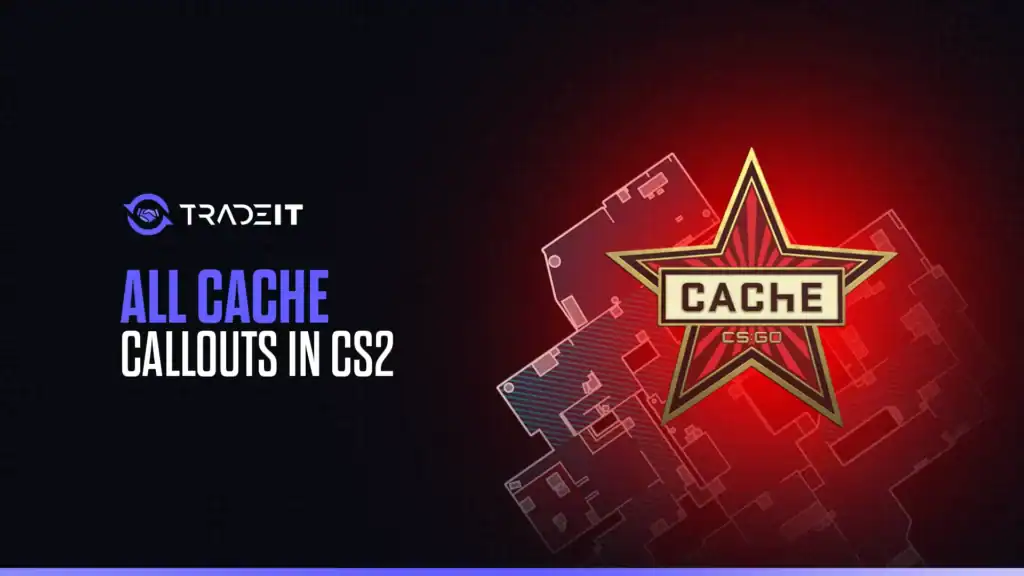

Cache is officially back in CS2 in 2026, and that makes learning its callouts relevant again for official matches, not just Workshop play. Valve reintroduced Cache to Competitive, Casual, Deathmatch, and Retakes on April 28, 2026, even though it is still outside the current Premier / Active Duty pool.
Whether you are defending as CT or pushing as T, knowing the names of each key position on Cache helps your team rotate faster, trade better, and avoid messy site hits.
This guide breaks down the most important Cache callouts in CS2, plus the strategy and communication tips that matter most in 2026.
Cache Is Back in CS2 in 2026
Cache is no longer just a community remake. Valve officially brought it back to life, CS2 on April 28, 2026, adding it to Competitive, Casual, Deathmatch, and Retakes. That means players can now use these callouts in official modes again.
The only important limit is that Cache is still not part of Premier / Active Duty, so it has returned to CS2 without fully rejoining the top seven-map competitive pool.
Cache Callouts

Below are the most important Cache callouts. The higher your CS2 rank, the more of them you should know. Since Cache is back in official CS2 modes in 2026, these callouts matter again for real matchmaking and not just private servers.
Catwalk (Cat)
This narrow elevated walkway connects Mid to A Site, allowing quick rotations and aggressive plays.
- CTs may hold Cat to control Mid or surprise A Main pushes.
- Watch for boosted Ts using Mid Boost to access Cat early.
Highway
Highway connects Mid (via the boost or Mid Box) to A Site. It’s often used by rotating CTs or Ts, gaining Mid control.
- A Highway lurk is a common T tactic to flank A from behind.
- Sandbags sit at the beginning of the highway and are a common CT hold.
Middle (Mid)
A critical part of Cache’s control, Mid gives access to both bombsites. It’s contested early in rounds, with both sides using nades and smokes.
- White Box – Centerpiece of Mid; a CT or T may hold this to gain vision.
- Sandbags – Hidden corner next to Mid Boxes; molotovs are often used here.
- Vent Room Entrance – From Mid, leads toward the Vent Room and Checkers.
- Mid Boost – The CT spot behind White Bo,x, where teammates can boost each other to Catwalk or Overboost.
Vent Room (Vents)
The small room connecting Mid to B Site. It contains the vent—a breakable grate players can jump through to Checkers or B Site.
- CTs often play inside vents to contest Mid or B.
- Destroying the vent alerts the enemy to a potential push.
Checkers (Heaven Room)
Checkers is just before the B Site and offers angles into the site, Heaven, and Vent Room.
- It’s a vital control point for both retakes and site holds.
- Close Checkers and Back Checkers help identify enemy positioning more clearly.
B Main
Primary entry for Ts into the B Site.
- It’s a corridor with a crate (for peeking) and an entrance to Checkers.
- CTs may push here for early info or hold aggressively behind the box.
B Site
The B bombsite, located near Checkers and B Main, has numerous callouts:
- Default Plant – Behind the tall double stack of boxes.
- Headshot – Position where a player can peek with only the head visible.
- Back Site – Rear of B Site near the wall and barrels.
- Quad Stack – A group of boxes that Ts can plant around or CTs use to surprise.
Heaven
This elevated area is accessible from the CT spawn and looks over the B Site.
- CTs often rotate into Heaven to defend B or retake.
- It’s also a powerful AWP position, though vulnerable to molotovs and flashes.
Terrorist Spawn (T Spawn)

The round begins here for the Terrorist side. From T Spawn, players can branch out towards A Main, Mid, or B Halls. Communication often starts here as players call the default plan.
A Main
A Main is the primary entry route for Terrorists pushing A site. It’s a long corridor with crates for cover and leads directly to A Site through a chokepoint. Defenders may hold angles from Quad, Forklift, or Catwalk. Common callouts include:
- Entrance (beginning of A Main)
- Lockers (the wall and corner near the entrance)
- Close Left/Right (used when entering A from A Main)
Door (A Door)
The squeaky door area gives Ts another entry into A Site. It allows quick access for fast plays or fakes and is often used with a teammate pushing A Main.
- Squeaky refers to both the door and the small room behind it.
- Players often pre-nade or molly Squeaky to deny pushes.
A Site
This is the bombsite located near A Main and Forklift. It has multiple holding positions:
- Default – The standard plant spot behind the tall boxes.
- Quad – The four stacked boxes at the back-right corner of A Main.
- Forklift – Named after the yellow forklift nearby; offers strong angles onto A Main.
- NBK – A tight corner between A Main and Quad, named after pro player NBK.
- Backsite – The area behind Default and Quad.
CT Spawn

The CT side begins here.
- Connects to Heaven, Mid, and A Site.
- Communication about enemy locations and rotation plans is critical here.
Truck
The CT vehicle parked just outside A Site, connecting CT Spawn to A.
- Truck offers limited cover but a good angle on plant spots.
- Sometimes referred to as Truck Corner or Behind Truck.
Boost (Mid Boost/Overboost)
This elevated area allows CTs to boost each other up to get a vision over Mid.
- Sometimes called Window Boost or Overboost.
- Enables early peeks onto Mid, Catwalk, or even A Main with proper jumps.
T Garage (Garage)
Area between T Spawn and Mid.
- Offers Ts a staging point for Mid control.
- Also includes the Blue Door wall and the Tractor area, sometimes referenced by players.
Blue Door Room
The same as Squeaky/A Doo,r but sometimes referred to differently in regional calls or by older players.
Common Strategies Using Callouts

Here are some key strategies to use on Cache:
Tips for Effective Callouts

If you want to become a better Cache player and improve your communication, follow these rules:
Conclusion
Mastering Cache callouts can still make the difference between a messy round and a coordinated win, especially now that Cache is back in official CS2 modes in 2026.
Whether you are solo queuing or playing with a team, these names are the shared language that makes site hits, retakes, and Mid control much easier to handle. Learn the key positions first, then build speed and confidence from there.
FAQs
Is Cache officially playable in CS2 in 2026?
Yes. Cache officially returned to CS2 on April 28, 20,26 and is now playable in Competitive, Casual, Deathmatch, and Retakes. It is still not part of Premier / Active Duty.
Do Cache callouts matter again in official matches?
Yes. Since Cache is back in official CS2 modes, learning its callouts now helps in real matchmaking again, not just Workshop or community-server games.
What are callouts in CS2?
Callouts are named locations on the map used to quickly communicate enemy positions and strategies with your teammates.
Why are Cache callouts important?
They improve coordination, enable fast reactions, and make team communication more precise during both attack and defense.
What’s the difference between A Main and Squeaky on Cache?
A Main is a wide corridor to A Site, while Squeaky is a small room with a door leading to the same bombsite.
What is “Sandbags” in Mid?
Sandbags is a hidden corner in Mid, often used by CTs to surprise attackers. It’s a key spot to check Mollylly.
How do Ts control Mid on Cache?
Ts use smokes, flashes, and the White Box boost to take Mid, enabling splits toward A or B through Highway and Vent Room.
What is “Heaven” on B Site?
Heaven is the elevated position overlooking B Site, accessible from the CT spawn. It’s a common CT hold or retake spot.
What does “Default” mean on Cache?
“Default” usually refers to the standard plant spot on a bombsite—behind boxes on either A or B Site.
How is “Forklift” used defensively?
It’s a corner on A Site that gives a great angle to cover A Main and defend the default plant area.
What is the purpose of “Checkers”?
Checkers connects B Main to B Site and Vent Room. It’s vital for both site defense and executing a B push.
Where is “Truck” and why is it important?
The truck is between A Site and CT Spawn. It’s often used by CTs rotating to A or holding the site with long-range vision.