
If you’ve been playing and following Counter-Strike 2 matches for at least a few weeks, you’ve probably wondered more than once: what does ADR mean in CS2? This guide will give you the answer and explain how you can boost your ADR.
Table of Contents
What Does ADR Mean in CS2?
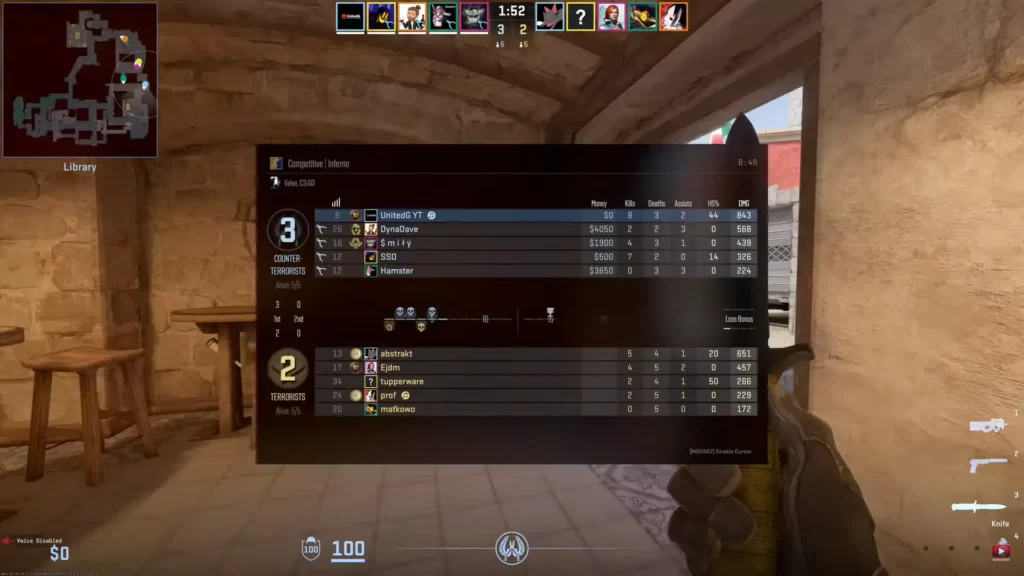
In CS2, ADR is very easy to understand. It represents the average damage dealt by a player per round. This statistic is updated after each round, signifying the player’s effectiveness and impact in the match.
You can check your ADR by waiting for it to be displayed on the end-game screen or by using the in-game scoreboard for a real-time update. That’s the easy part. But the question is: how do you improve it?
Calculating ADR in Counter-Strike 2
ADR in CS2 is calculated by dividing the total damage dealt by the number of rounds played. This encompasses all types of damage inflicted by a player, including bullet damage and utility damage (from grenades, for instance).
Understanding this calculation helps players realize the impact of their actions in each round and allows them to strategize accordingly to improve their performance.
How to Check Your ADR?
Knowing how to check your ADR is crucial for tracking your performance and making necessary adjustments. Here’s how you can check your ADR during and after a game:
Press TAB to open the scoreboard and track your ADR in real time, helping you adjust your gameplay on the fly.
Review your post-match stats, including ADR, kills, deaths, and assists to evaluate your overall performance.
By regularly checking your ADR, you can track your progress and see how your gameplay changes affect your damage output.
Tips to Improve Your ADR in CS2
Enhancing your ADR in Counter-Strike 2 requires more than simply honing your aim. It requires strategic gameplay, wise utility use, and smart navigation of enemy territory.
Keep your crosshair at head level and pre-aim common angles to reduce reaction time and secure more headshots.
Master weapon recoil patterns and use burst firing to maintain accuracy at all ranges.
Learn map layouts and hold high-traffic areas to create more damage opportunities.
Use footsteps and gunfire cues to predict enemy movements and prepare engagements.
Watch professional gameplay to learn positioning, movement, and utility usage for better performance.
Precision Matters: Headshots Deal More Damage
Headshots significantly increase damage output and can secure faster kills.
Many rifles and pistols can eliminate enemies with a single headshot.
The first shot is highly accurate, making precise aim essential for landing headshots.
Tap firing and recoil control improve accuracy and help maintain higher ADR.
One proven strategy to enhance your headshot skill is to study and mimic the aiming strategies of professional CS2 players. Their techniques, honed over countless hours of gameplay, can lead to better headshot accuracy and an increased ADR.
Utilizing Grenades Wisely
Effective use of grenades in CS2 is another aspect that can influence your ADR. Remember, your ADR includes both bullet damage and damage from utilities.
Explosive grenades, for example, can inflict damage to multiple opponents when thrown with knowledge of enemy common positions and map geometry, effectively raising your ADR. But, it’s not just about causing damage.
Navigating Enemy Territory
Holding key angles where enemies appear increases your advantage and overall damage output.
Predicting enemy movement lets you take fights on your terms and improve ADR consistency.
Studying enemy patterns and adjusting your positioning creates a stronger tactical edge in duels.
High ADR players excel at controlling space and forcing enemies into disadvantageous fights.
Understanding the Significance of ADR for Team Success
High ADR reflects steady damage output each round, contributing to round wins.
ADR measures meaningful involvement through damage, kills, and assists—not just frags.
ADR influences team strategies, player roles, and overall match outcomes.
Good ADR improves with teamwork, coordinated pushes, and effective utility usage.
Winning depends on consistent impact from all players, not just top fraggers.
Comparing ADR to Other Performance Stats
While KDR (Kill/Death Ratio) is a widely recognized metric, it primarily focuses on the number of kills a player secures relative to their deaths.
However, this doesn’t provide a full picture of a player’s overall impact. ADR, on the other hand, includes all damage dealt, offering a more holistic view of a player’s contributions.
Another metric, ACS (Average Combat Score), used in games like Valorant, combines damage, kills, and other factors, but ADR remains a key indicator in CS2 for assessing a player’s ability to consistently contribute to the team’s success through damage.
Thus, ADR can often be a more reliable measure of a player’s effectiveness in various scenarios.
Summary
ADR is a vital metric in CS2, offering a comprehensive insight into a player’s performance. It provides a measure of a player’s consistent impact in the game, taking into account all forms of damage dealt.
By focusing on improving their ADR, players can significantly enhance their effectiveness in the game, contributing to the victory of their team.
FAQs
What is a good ADR in CS2?
A good ADR in CS2 is generally around 70–80. Skilled competitive players often average 80+ ADR in ranked matches.
What does ADR stand for in CS2?
ADR stands for Average Damage per Round. It measures how much damage a player deals to enemies on average each round.
How is ADR calculated in CS2?
ADR is calculated by dividing the total damage you deal by the number of rounds played in the match.
How can I check my ADR during or after a match?
You can view your ADR by opening the scoreboard with the TAB key during a match, or at the end of the game on the post-match scoreboard screen.
How can I improve my ADR in CS2?
You can improve ADR by increasing your accuracy, especially headshots, using utility like grenades more effectively, and taking smarter fights in key map areas.