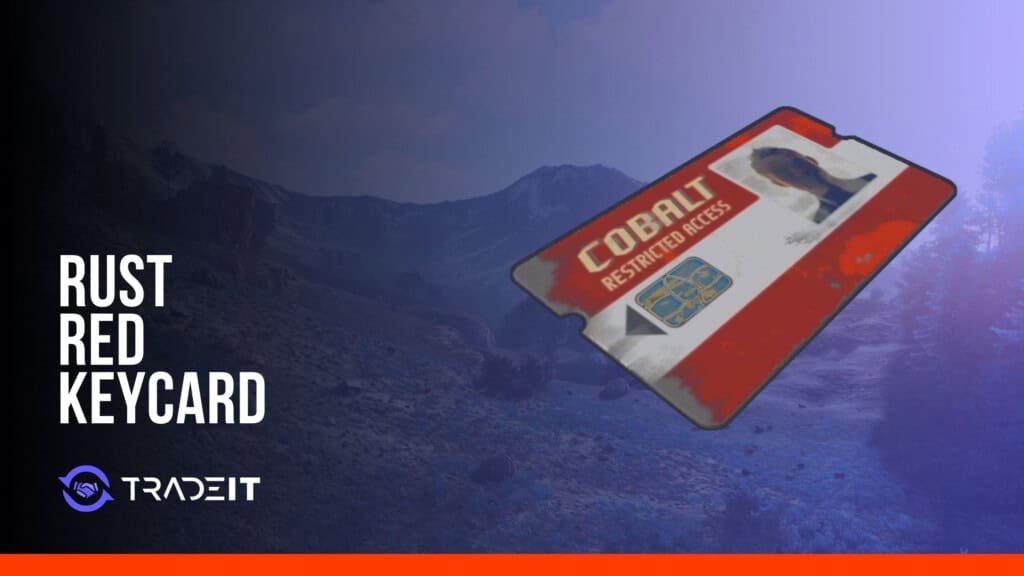


A Blue Keycard gets you into the rooms where red cards are found. A Red Keycard gets you into a different set of locked rooms. Mixing those two lists is an easy way to arrive at a monument with the wrong kit, so the acquisition routes come first below, followed by the places to spend your card.
A card is only one item on the packing list. Radiation gear, ammunition and earlier keycards also matter for progression through Rust monuments. A short trip to collect a card can need a very different kit from the red-door run afterwards.
Rust Red Keycard Locations and Uses at a Glance
| Where to Get | Where to Use |
|---|---|
| Water Treatment Plant | Launch Site |
| Airfield | Military Tunnels |
| Power Plant | Small Oil Rig |
| Train Yard | Large Oil Rig |
| Arctic Research Base | Underwater Labs |
| Livestock vendor (randomized offer) | Missile Silo |
Where to Get a Red Keycard in Rust
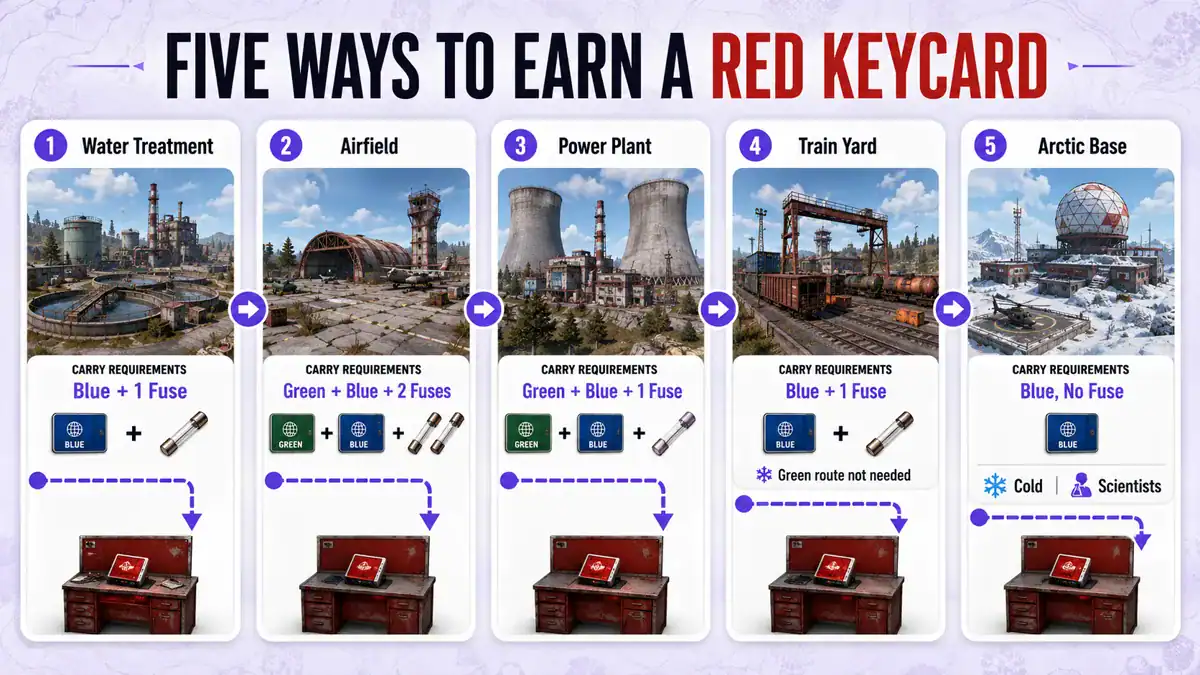
Water Treatment Plant
Prerequisites and Fuse Count: Blue Keycard, 1 fuse
For Water Treatment, the card in your bag should be blue and the card you leave with should be red. One fuse powers the puzzle. Radiation gear is still needed, and so is a look around before you start: another player may be near the building regardless of whether the reward room is available.
Airfield
Prerequisites and Fuse Count: Green and Blue Keycards, 2 fuses
Airfield needs both your Green and Blue Keycards, plus two fuses. Leave either card behind and you cannot finish the access chain. Learn where the next stage is before starting the timed parts, and bring radiation protection. How busy it is depends on your server and map, so check the area rather than counting on an empty run.
Power Plant
Prerequisites and Fuse Count: Green and Blue Keycards, 1 fuse
For Power Plant, bring one fuse and both Green and Blue Keycards. You have buildings and changes in elevation to navigate between puzzle stages. That is a reason to learn the route before committing your fuse, not a reason to rush across exposed ground. Check your radiation protection too.
Train Yard
Prerequisites and Fuse Count: Blue Keycard, 1 fuse
One fuse and a Blue Keycard are enough for Train Yard’s Red Keycard route. The Green-card puzzle is a separate route; you do not have to complete it for this reward. Take radiation protection and check the approaches. Fewer card requirements do not mean fewer players nearby.
Arctic Research Base
Prerequisites and Fuse Count: Blue Keycard, 0 fuses
There is no fuse to pack for Arctic Research Base’s Blue Keycard puzzle. You do need the Blue Keycard. The trade-off is the trip itself: bring warm clothing for the cold and enough ammunition and healing to deal with the scientists.
Livestock Vendor at the Stables
Requirements: Grown Livestock, Randomized Offer
There is a chance of a red-card offer when bartering grown livestock at the Stables. It is rare, though. The vendor’s offers depend on the animal and include a random element. Useful if the offer appears while you are there; not something to build a guaranteed card route around.
Can You Buy a Red Keycard at Bandit Camp?
Bandit Camp Buys Cards From You
The Scrap 4 Sale listing can be easy to read backwards. You give the vendor a Red Keycard; the vendor gives you scrap. You cannot buy the card there for 80 scrap. Selling a spare is an option, but selling your only one means finding another before the next red-door trip.
Where to Use a Red Keycard in Rust
Launch Site
Puzzle Prerequisites: Green and Red Keycards, 2 fuses, radiation protection
Launch Site’s packing list is two fuses, a Green Keycard and a Red Keycard, with radiation protection. Several switches and earlier doors stand between the start and the red reader. Having all the items is only half of it: you also need to know the route well enough to reach each timed stage. The rocket area is no place to discover that your radiation protection is inadequate.
Approach and Hazards
There is little benefit in taking exactly enough supplies for a flawless attempt. A wrong turn can cost fuse time, and damage on the way in can use up healing you meant to save. A spare fuse and extra medical supplies allow for those mistakes. Other players may also be approaching, even if the building was empty when you entered.
Consider the return trip before going in. Which way will you leave the building, and where can you move out of the open? Those are easier decisions to make without someone shooting at you. The buildings stay in the same places; the other players will not.
Military Tunnels
Puzzle Prerequisites: Green, Blue, and Red Keycards, 1 fuse, 25 radiation protection
All three colors are needed at Military Tunnels, alongside one fuse. Green leads into Blue and then Red access. If your inventory contains only the red card, the earlier stages still stop you. The heading’s list is for the whole route, not just the final reader.
Approach and Hazards
The scientists are the reason this trip needs a combat kit. A loaded weapon alone is not much use once its magazine and your spare ammunition run out. Bring enough for the tunnels, with medical supplies for the damage you take along the way. Narrow corridors make a hurried fight particularly awkward.
Watch the fuse timer without letting it make every decision for you. An uncleared corridor is still dangerous when the clock is running down. Remember the doors you passed on the way in; having to work them out again under fire makes the return trip harder.
Small Oil Rig
Small Oil Rig’s red reader works without a fuse. Your supplies are mostly for reaching it: the scientists, exposed platforms and the trip across the water. The boat is also your route back. Another crew can arrive while you are looting, so leaving it accessible matters as much as getting onto the rig.
Large Oil Rig
Large Oil Rig also has a red door that needs no fuse. The larger rig gives you more ground to clear before and after that swipe. Check each level, keep an eye on exposed angles and watch for arrivals by boat or air. A Red Keycard opens the room, not a safe route home.
Underwater Labs
A Red Keycard alone is not the full kit for Underwater Labs. The red puzzles use electricity; two-fuse configurations exist, and some need a Blue Keycard too. The generated modules are what prevent one packing list or exact route from fitting every lab. At the lab you find, trace the power and card readers for that particular room.
Diving gear gets you to the lab, but you still need supplies for the rooms inside. Expect scientists and close-range fights. Between ladders, compartments and short corridors, there is not much of a view of what comes next. A weapon, ammunition and healing should be ready before entering.
In a different lab, that familiar module may have a different room attached to it. A route learned elsewhere can therefore be a dead end here. Work back from the card reader through its connected rooms and puzzle components, and retrace your steps if the passage does not lead where you expected.
Missile Silo
Bring your Red Keycard to Missile Silo. You need it for access; this is not a Blue-card puzzle with a red card waiting as the reward. Ammunition and healing are essential for the scientists along the enclosed route.
Extra ammunition is worth the inventory space on a silo trip. There is less open ground to retreat across when a fight goes badly. The same goes for medical supplies: the first scientist you meet is not the last obstacle on the way to the loot and back out.
Using a reader while taking fire leaves the immediate problem unresolved. Finish that fight before working the door. The route back matters too; even on a layout you know, a player arriving behind you can block the way you intended to leave.
Browse weapon and gear finishes in our Rust skin catalogue.
Browse Rust SkinsBest Green-to-Blue-to-Red Keycard Route
Solo Route
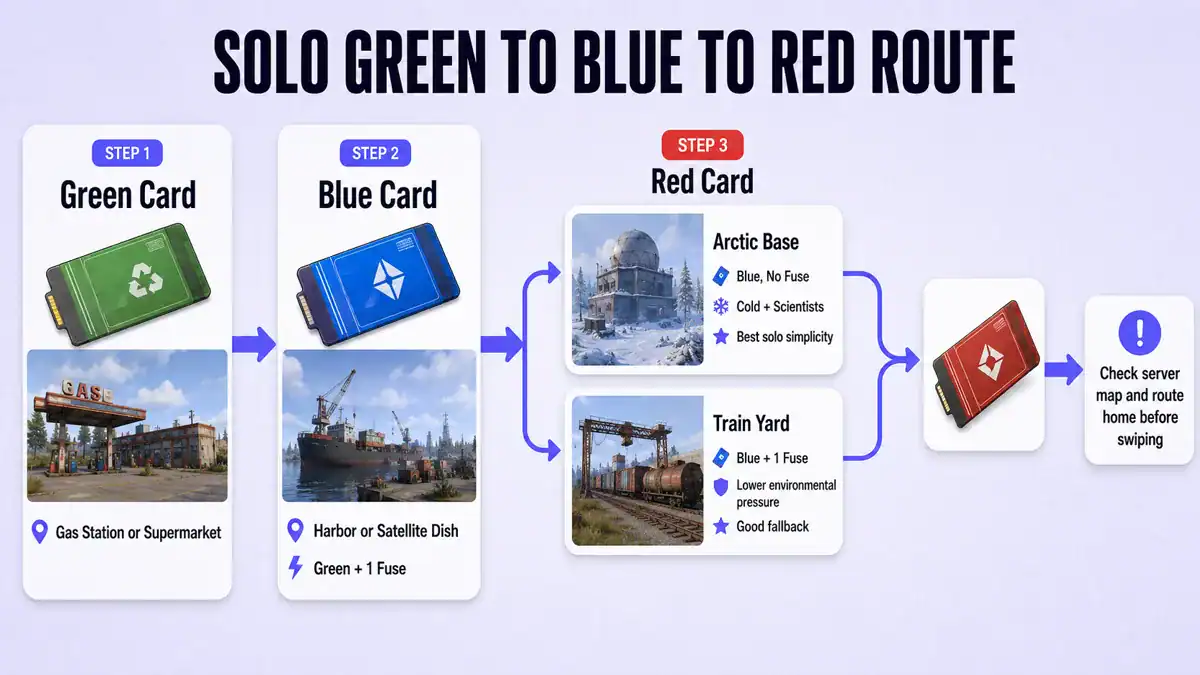
Start with Green, use it to obtain Blue, then use Blue for a Red Keycard reward. There is no requirement to do all three stages before returning home. A card safely stored at base gives you another attempt if the next trip goes badly; a card carried into a fight can be lost with the kit.
- Get a Green Keycard
Gas Station and Supermarket are familiar Green Keycard locations to start from. Check for other players before entering and allow for the card already having been taken. - Upgrade to a Blue Keycard
Green-tier puzzles at Harbor, Sewer Branch and Satellite Dish lead to Blue Keycard rewards. Bring the fuses and gear required for the route you choose. - Farm a Red Keycard
Once you have a Blue Keycard, move to either Train Yard or Arctic Research Base. Train Yard requires one fuse plus Blue access, while Arctic Research Base requires only a Blue Keycard and no fuse.
The next Blue Keycard route might be close to home or halfway across the map. Distance is worth weighing against the traffic at that monument. A short route through a busy area is not necessarily the safer choice, and a circuit copied from another map may be a poor fit here.
Train Yard asks for a fuse; Arctic asks you to cope with cold and scientists instead. Which sounds more manageable with the kit in your base? That is a more useful question than which route is easiest in the abstract. Being able to reach one quickly can also decide it.
For Train Yard, check the fuse and radiation gear before setting off. For Arctic, check warm clothing, ammunition and healing. The walk home still has to be covered after the card is in your inventory, so do not spend the last of your supplies getting to the reward room.
Team Route
At Airfield or Power Plant, one teammate can handle the puzzle while the others watch approaches and cover the exit. Bring the card home before deciding on the next run. Missile Silo is a later destination for that Red Keycard, not another way to exchange a Blue Keycard for one.
What to Bring on a Red Keycard Run
Look at the destination’s requirements, then look at your inventory. Is the earlier Green or Blue Keycard there? Are the fuses there? The table also includes the less obvious parts of the trip, such as transport and supplies for leaving with the loot.
Another early-wipe obstacle is the destructible blocker. Some can be broken with a melee weapon; stronger examples need much more damage. They stay gone once destroyed. If another player has opened the route already, there is nothing left to spend ammunition on there.
| Category | What to Bring | Why It Matters |
|---|---|---|
| Keycards | Green, Blue, Red as required | Most red routes depend on earlier access chains |
| Fuses | 1 to 2 spare electric fuses | Allows retries if timing or routing fails |
| Protection | Radiation gear or cold clothing | Required for survival in harsh monument zones |
| Weapons | Reliable firearm and extra ammunition | Needed for scientists and potential PvP |
| Healing | Medical syringes, bandages | Supports sustained fights and recovery |
| Mobility | Boat, vehicle, or diving gear | Important for Oil Rig and Underwater Labs access |
| Food and Water | Basic supplies | Prevents avoidable downtime during runs |
| Exit Plan | Clear path or transport option | Leaving safely is as important as entering |
Opening the reward room leaves one job unfinished: bringing the loot back. Other players may have reached the monument after you went inside. Some spare ammunition and healing, plus transport you can still reach, give you a better chance of getting through that return trip.
Red Keycard Durability, Despawn, and Death
A fresh Red Keycard lasts for two uses. Check the remaining durability on a card you already have; it may not have both swipes left. Dropped cards despawn after about one hour. Death does not protect yours: another player can loot it from your inventory.
One slot holds one red card. If you carry a spare, it takes another slot and has a separate durability value. A looted card may already be partly used, so check it before planning the next door around it.
Frequently Asked Questions
Can I stack multiple Red Keycards in one inventory slot?
No. Each Red Keycard takes a slot of its own. Two cards need two slots, even if both are unused.
Can you buy a Red Keycard at Outpost or Bandit Camp?
No fixed-price purchase is available at either one. Bandit Camp buys the card from you for scrap. A rare livestock-vendor barter at the Stables can give you a card, but the offer is randomized.
Do Red Keycards respawn at monument desks?
Yes, the card can return when the monument puzzle resets. Do not count on one universal countdown. Server settings, population and the state of the puzzle can affect the wait.
Is it possible to obtain a Red Keycard from the Normal or Elite crates?
Not in the standard vanilla loot tables. Use the monument reward rooms, or check for a rare livestock-vendor offer. A custom server can change crate drops, so its rules may be different.
Which route is easiest for a solo player?
Arctic Research Base has no fuse requirement, which removes one thing to manage. It still has cold and scientists. Train Yard needs a fuse but may be closer to your base. Pick the trip your equipment can handle rather than assuming one is easiest for everyone.
Are the locations identical on Rust Console Edition?
Do not assume so. Console Edition can have different monument availability and updates from PC. Check the map and the Console version you are playing before using a PC route.
Which monument gives the best loot for a Red Keycard run?
Launch Site, Military Tunnels and the Oil Rigs all have high-tier rewards. That does not make one the best choice for every player. Your kit, teammates and other players on the server affect the relative difficulty of Rust monuments, and whether you can bring the loot home.