

Use the searchable table when you need a quick answer, then jump to the matching keycard section for route notes and hazards. The access column shows the highest card used by the monument’s locked puzzle rooms; it does not mean you need that card simply to enter the wider area. Procedural maps spawn only a subset of the full pool, and server owners can change monument layouts, loot, NPCs, radiation, or vendors.
This page deliberately avoids ranking locations. For a comparison of efficiency, risk, and expected returns, use our separate Rust monuments tier list. Here, each location is documented as a practical reference.
What Is a Monument in Rust?
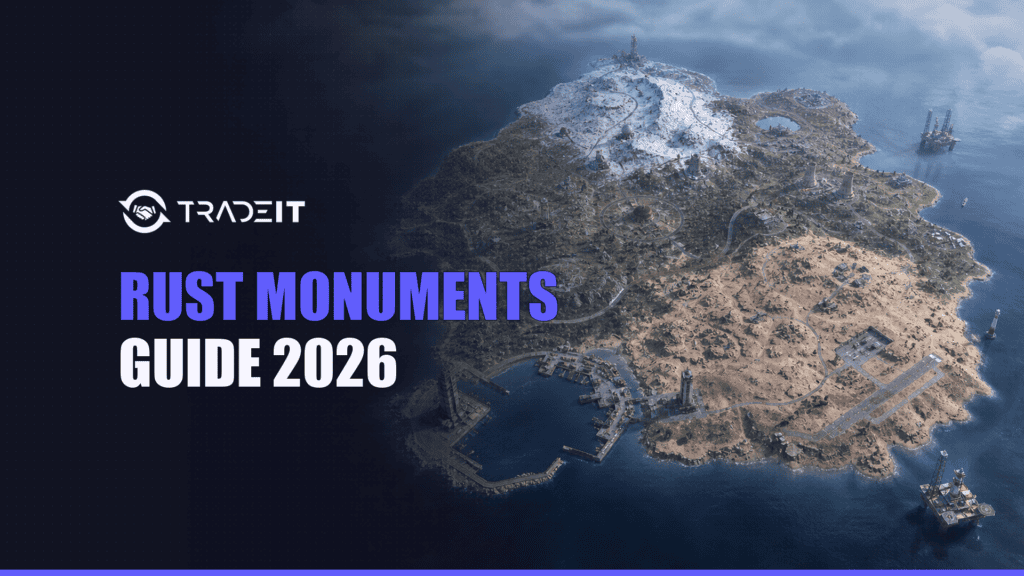
A monument is a designed world location that gives players a reason to leave their base. Some are visible industrial landmarks such as Airfield or Power Plant. Others are roadside buildings, NPC Safe Zones, underground networks, offshore platforms, mobile events, buildable caves, or resource-extraction sites. Their roles differ, but each concentrates useful services, loot, movement, or conflict into a recognizable location.
On a procedural map, the seed and map size determine which eligible monuments appear and where they sit relative to roads, railways, coasts, and biomes. Large monuments normally have map labels; smaller procedural locations can be easier to miss. Custom and modded servers may add, remove, duplicate, or redesign them, so always treat the in-game map and server rules as the final authority.
Monuments are world content, not a character-selection system. Rust’s account-bound appearance is a separate subject covered in our guide to all Rust character models.
There is no single useful number for every seed because variants and world events complicate the total. This guide counts 43 named families: standard map monuments, underground and offshore systems, Cargo Ship, and the 2026 Deep Sea locations. Small and Large Harbor remain one family in the count, as do the three quarries and other procedural variants. Chinook 47 is covered as an event, not counted as a place.
How Monuments Fit Into Your Wipe Progression
Monuments give structure to a wipe. Open roadside and no-card locations help you establish components, food, fuel, green cards, and recycler access. Green-card puzzle rooms produce blue cards. Blue-card routes produce red cards. Red-card rooms, locked-crate events, and high-NPC locations support later progression, but they also demand more preparation and a cleaner exit plan.
Open-route setup
Collect components, food, cloth, fuel, basic weapons, green cards, and recycler access.
Green puzzles
Bring a green card and usually a fuse to reach a blue card and denser component loot.
Blue puzzles
Use blue clearance at large monuments to obtain a red card and advanced route loot.
Red and event routes
Prepare for scientists, high radiation, locked-crate timers, counters, and longer extraction.
Progression is not strictly linear. A team can buy or recover cards, contest an event early, fish up a blue card, find another player’s kit, or skip a puzzle entirely. The sequence above is simply the dependable vanilla route that makes the card colors easy to understand.
A full server wipe rebuilds the world and its monuments. Facepunch’s monthly forced wipe is the predictable reset shared by official update cadence; dates and timing are covered in our Rust force wipe schedule. Community servers may wipe maps, blueprints, or both on a different schedule.
Full List of Rust Monuments (2026 Quick-Reference Table)
Search by name, biome, loot purpose, or hazard, or use the filters to narrow the 43 location families. “Recycler” means a dependable static recycler in current vanilla data; moving events and randomized layouts are not credited with one unless the service is part of the location’s current design.
| Monument | Puzzle access | Area | Recycler | Main use / loot | Main hazard |
|---|---|---|---|---|---|
| Abandoned Cabins | OpenOpen | Small inland | No | Green keycard desk spawn, basic crates, early components | Player ambushes and exposed cabins |
| Abandoned Military Base | OpenOpen | Medium / randomized | No | Scientist loot, military crates, components | Scientists and a layout that changes by seed |
| Abandoned Supermarket | OpenOpen | Roadside | Yes (1) | Food, components, green keycard spawn, recycling | Compact close-range PvP |
| Airfield | BlueBlue | Large mainland | Yes (2) | Blue-card route to a red card, components, diesel | Scientists, radiation, long sightlines |
| Apartment Complex | OpenOpen | NPC safe zone | No | Rentable rooms and shops, storage, wipe-start utility | Safe-zone rules; a master key can expose occupied rooms briefly |
| Arctic Research Base | BlueBlue | Snow biome | Yes (1) | Blue-card rooms, red keycard, scientist and component loot | Cold, scientists, radiation |
| Bandit Camp | OpenOpen | NPC safe zone | Yes (2) | Vendors, utilities, gambling, current keycard sales | Safe-zone weapon and hostility rules |
| Cargo Ship | EventEvent / no card | Mobile world event | No dependable recycler | Timed locked crates, scientists, military loot | Counters from sea or air and a fixed departure window |
| Caves | OpenOpen | Underground / procedural | No | Build locations, ore access, hidden routes | Darkness, falls, choke points, campers |
| Ferry Terminal | GreenGreen | Coast / rail connection | Yes (1) | Green-card puzzle to a blue card, recycler, car lift | Open approaches and transit traffic |
| Fishing Villages | OpenOpen | Coastal NPC safe zones | No | Boat, diving, fishing and transport vendors | Safe-zone rules; exposure begins after departure |
| Giant Excavator Pit | OpenOpen + diesel | Large desert industrial | Yes (1) | Diesel-powered bulk resource excavation | Scientists, radiation and a global activation cue |
| Harbors (Small and Large) | GreenGreen | Coastal industrial | Yes (1 each) | Green-card puzzle to a blue card, recycler, maritime access | Container angles, ladders and shoreline counters |
| HQM Quarry | OpenOpen + diesel | Small industrial | No | Diesel-powered high-quality metal extraction | Noise, exposure and predictable return trips |
| Jungle Ruins | OpenOpen | Small jungle / procedural | No | Early loot, cover and jungle-route supplies | Dense visibility, close PvP and wildlife |
| Jungle Ziggurat | OpenOpen | Jungle landmark | Yes (1) | Crates, recycler and vertical jungle routes | Vertical ambushes, falls and wildlife |
| Junkyard | OpenOpen | Small industrial | Yes (1) | Vehicle shredder, recycler, green keycard spawn | Exposed lanes and machinery noise |
| Large Barn | OpenOpen | NPC safe zone | No | Horse purchase and equestrian supplies | Safe-zone rules; road exposure outside |
| Large Oil Rig | Up to redCards optional; up to red | Offshore | No | Locked-crate event, card rooms, military and elite loot | Scientists, heavy reinforcements and player counters |
| Launch Site | RedRed | Large mainland | Yes (1) | Red-card route, elite loot, Bradley, diesel | High radiation, scientists, Bradley and open PvP |
| Lighthouse | OpenOpen | Coastal landmark | Yes (1) | Green keycard spawn, barrels and recycling | Spiral stairs, roof angles and shoreline counters |
| Military Tunnels | RedRed | Underground military | Yes (1) | Red-card route, elite loot, advanced fragments | Large scientist presence, radiation and chokepoints |
| Mining Outpost | OpenOpen | Roadside | Yes (1) | Components, crates and convenient recycling | Small footprint and fast close-range fights |
| Nuclear Missile Silo (map label: Missile Silo) | RedRed | Underground military | No | Red-card access, elite crates, advanced fragments | Many scientists, severe radiation pockets and forced corridors |
| Small Oil Rig | Up to redCards optional; up to red | Offshore | No | Locked-crate event, card rooms and military loot | Scientists, heavy reinforcements and boat counters |
| Outpost | OpenOpen | NPC safe zone | Yes (3) | Vendors, utilities, workbenches and recycling | Safe-zone weapon and hostility rules |
| Oxum's Gas Station | OpenOpen | Roadside | Yes (1) | Green keycard spawn, food, fuel and recycling | Tight rooms, roof angles and road campers |
| Power Plant | BlueBlue | Large industrial | Yes (3) | Blue-card route to a red card, components and diesel | High-radiation pockets and multi-building PvP |
| Radtown | GreenGreen | Roadside / industrial | Yes (1) | Green-card puzzle to a blue card, components and recycling | Radiation, compact cover and frequent traffic |
| Ranch | OpenOpen | NPC safe zone | No | Horse purchase and equestrian supplies | Safe-zone rules; road exposure outside |
| Satellite Dish Array | GreenGreen | Small industrial | Yes (1) | Green-card puzzle to a blue card and recycling | Radiation, open bowl and dish-top angles |
| Sewer Branch | GreenGreen | Medium underground | Yes (2) | Green-card puzzle to a blue card and component loot | Radiation, water exits and close corridors |
| Stone Quarry | OpenOpen + diesel | Small industrial | No | Diesel-powered stone extraction | Noise, exposure and predictable return trips |
| Sulfur Quarry | OpenOpen + diesel | Small industrial | No | Diesel-powered sulfur extraction | Noise, exposure and predictable return trips |
| The Dome | GreenGreen | Medium industrial | Yes (1) | Green-card puzzle to a blue card, open-route crates and recycling | Radiation, ladders, falls and roof campers |
| Train Tunnel Network | OpenOpen | Underground network | No dependable recycler | Tunnel-dweller loot, components and rail travel | NPCs, darkness, long extraction and station campers |
| Train Yard | BlueBlue | Large industrial / rail | Yes (1) | Blue-card route to a red card, rail utility and components | Scientists, radiation and vertical sightlines |
| Underwater Labs | VariableVariable; up to red | Offshore / procedural | No | Randomized card rooms, military and elite loot, components | Random layouts, dwellers, radiation pockets and underwater exits |
| Water Treatment Plant | BlueBlue | Large industrial | Yes (1) | Blue-card route to a red card, components and diesel | Radiation, wide sightlines and roof control |
| Water Wells | OpenOpen | Small procedural | No | Water, food, small-route supplies and local services | Not a Safe Zone; open PvP around a compact footprint |
| Floating Cities | OpenOpen | Deep Sea safe-zone event | Yes (varies) | Vendors, recycler, workbench, research and refining services | Intermittent Deep Sea access and long naval extraction |
| Ghost Ships | EventEvent / no standard card | Deep Sea event | No | Scientist loot and, on some ships, hackable crates | Scientist patrol boats, boarding fights and extraction |
| Tropical Islands | EventEvent / no card | Deep Sea event | No | Resources, ruins, shoreline loot and boat services | Intermittent access and naval competition |
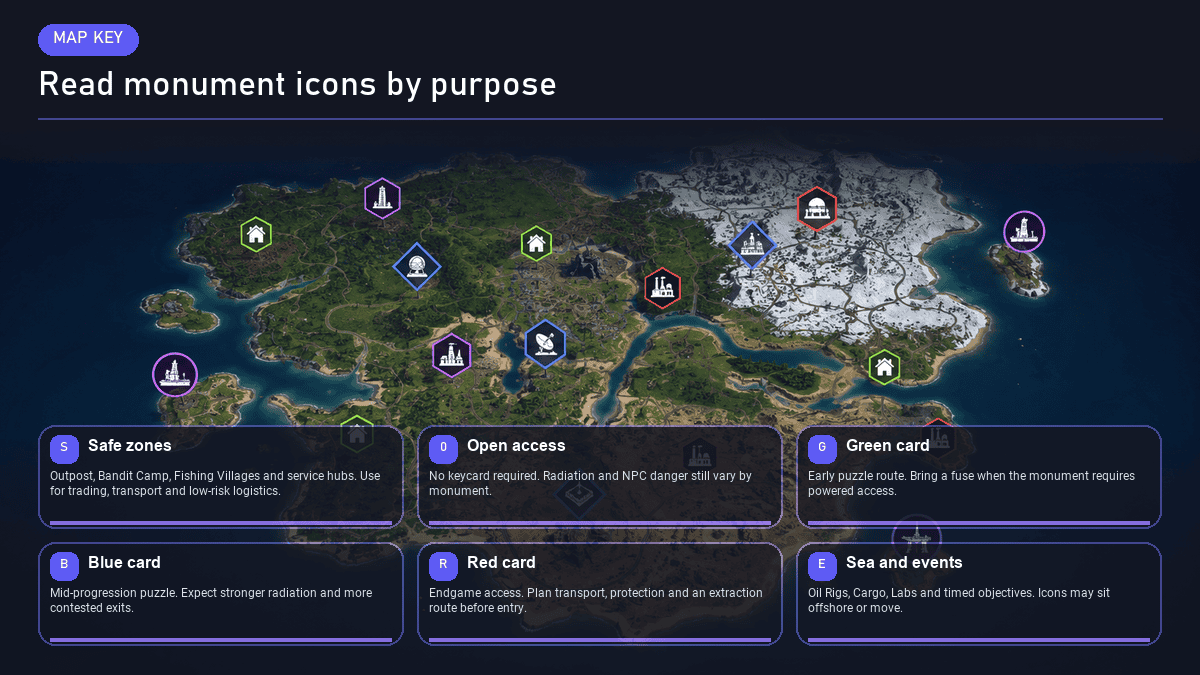
The Apartment Complex joined the monument pool on July 2, 2026. Deep Sea locations – Floating Cities, Ghost Ships, and Tropical Islands – arrived as an intermittent world-event region in February 2026 and received access and respawn adjustments in March. They are listed here as event locations rather than ordinary mainland monuments.
Monument Puzzles and Keycards Explained
Rust’s standard puzzle chain uses three clearance colors. Green is the entry-level card, blue is the middle clearance, and red opens advanced card rooms. Most card puzzles also use an Electric Fuse, one or more power switches, and a timed reader. The exact switch order and exit route differ by monument, so scout the exterior and identify the fuse box before swiping.
Vanilla card chain
Open route > Green card + fuse > Blue card + fuse > Red card
The card chain is a progression shorthand, not an entry restriction for the full monument grounds.
Cards lose durability when used, and fuses drain while powering a puzzle. Carrying a spare fuse is sensible on a long run, especially when you cannot confirm whether another player has left the circuit partially used. A card reader can be reachable even when the surrounding monument is open to everyone; “green monument” or “blue monument” describes the locked route, not the entire footprint.
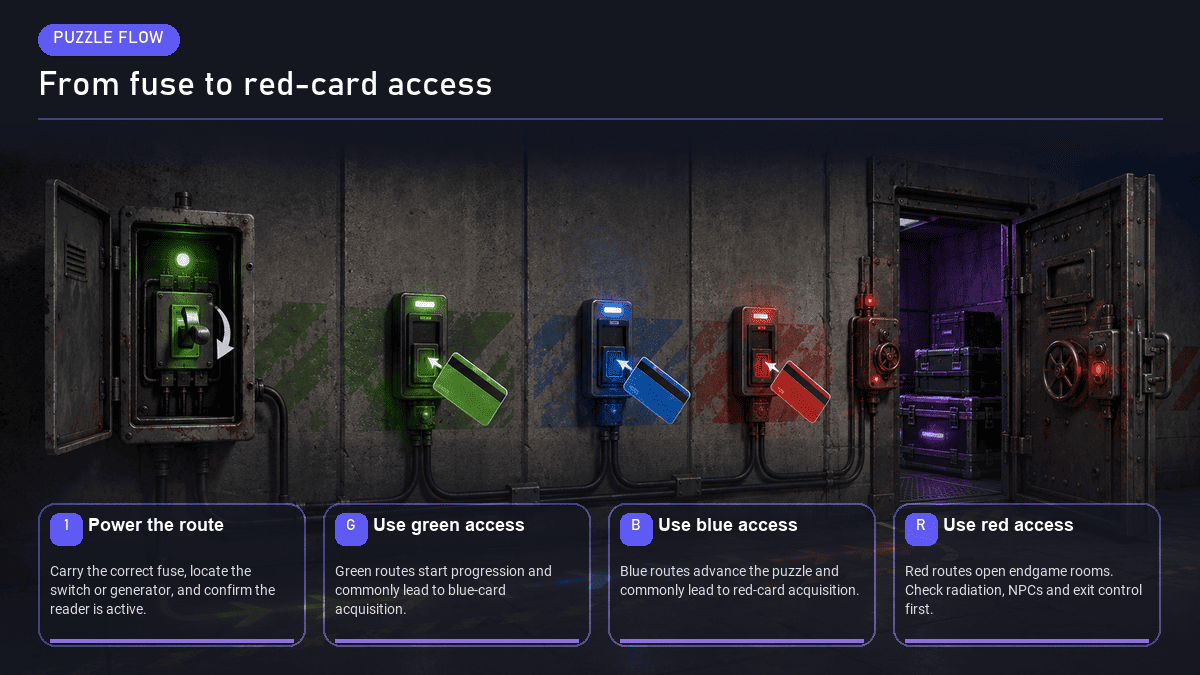
Current vanilla puzzles start their refresh cycle after a puzzle-room container is looted. Before the loot refresh, severe radiation can appear around puzzle loot and electrical elements; once that phase starts, the puzzle needs a player-free period before it fully resets. Do not wait beside a reader or loot box expecting an immediate respawn – the reset radiation is intended to force players away.
Facepunch moved much of the monument loot in October 2025. The same buildings and card colors still identify the route, but old videos can point to crates that have moved. That update also added green-card puzzles to The Dome, Ferry Terminal, and Radtown, and changed Nuclear Missile Silo from blue-card access to red-card access.
Monuments by Keycard Requirement
The sections below use the highest card required for each standard locked route. Several large monuments contain an earlier green step before the blue reader, and open loot remains available outside the locked rooms. Offshore and randomized locations are separated later because their access does not fit one fixed mainland route.
Safe Monuments (No Keycard, No Radiation)
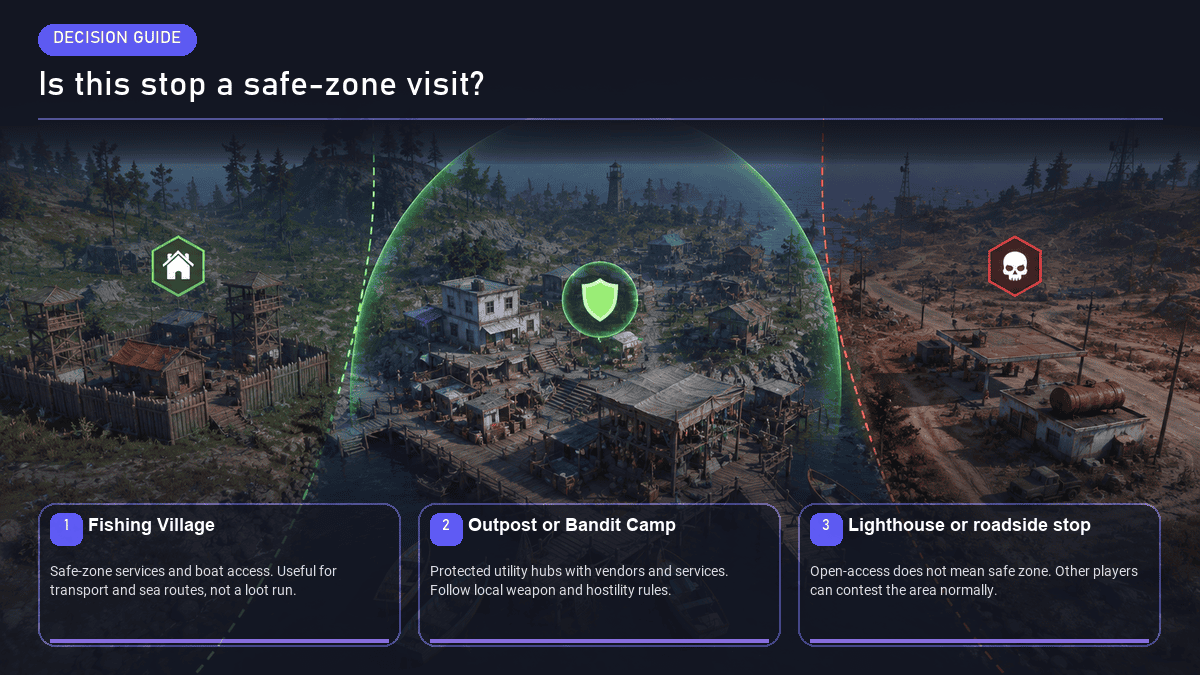
“Safe” can mean two different things in Rust. A shield-marked NPC Safe Zone enforces weapon and hostility rules. A no-card, no-radiation monument may still be an unrestricted PvP area. The first six locations below are true Safe Zones; the remaining open locations have no standard ambient radiation but do not protect you from players.
Apartment Complex
Rent a room from the receptionist for a wipe-start base with storage and room-specific utilities; the building also supports rentable shops. A master key can be found elsewhere on the island and can unlock occupied rooms for a short burglary window, so the Safe Zone does not make stored items permanently inaccessible.
Outpost
A general-purpose hub for vending, workbench access, utilities, trading, and safe recycling. Holster weapons before entering and understand the hostility timer before returning after combat; safe-zone recyclers also return less material than standard monument recyclers.
Bandit Camp
A vendor and utility hub with gambling, recycling, and current vanilla Scrap 4 Sale listings for keycards. Vendor stock is patch-sensitive and can be changed by community servers; the older Outpost blue-card purchase route was removed in November 2025.
Fishing Villages
Small, Large, and other current village layouts support boats, diving gear, fishing supplies, missions, and maritime travel. They have no recycler; plan the return route before leaving because protection ends outside the Safe Zone.
Ranch and Large Barn
These equestrian Safe Zones sell horses and related supplies. They are practical transport stops rather than loot monuments, and neither normally provides a recycler.
Abandoned Cabins
A compact no-radiation stop with basic loot and a green keycard desk spawn. The buildings are easy to check quickly but also easy to watch from tree lines and nearby terrain.
Abandoned Supermarket
Provides food, small crates, components, a green card spawn, and a recycler in a small roadside footprint. Check the roof, rear entrance, and road before committing to a recycling stack.
Mining Outpost
A compact component-and-recycler stop with no card or ambient radiation. Its convenience produces fast contests, and there are few places to disengage once another player enters the building.
Oxum’s Gas Station
Combines food, low-grade fuel, roadside components, a green card spawn, and recycling. Clear the shop, garage, roof, and nearby roadside cover before using the recycler.
Lighthouse
A coastal source of barrels, a green card, and recycling, with multiple vertical levels and a clear view of the water. The spiral interior and roof access make footsteps and exit timing especially important.
Junkyard
Use the recycler and vehicle shredder, collect components, and check the green keycard spawn. Running machinery advertises activity, while scrap piles and wrecks create many short sightlines.
Jungle Ruins
Procedural ruin variants provide early loot and cover along jungle routes. Dense foliage reduces warning time, so clear both the ruins and the surrounding vegetation rather than treating the walls as a secure perimeter.
Jungle Ziggurat
A larger vertical jungle landmark with crates and a recycler. The stair-step architecture creates strong high ground but also predictable ladders and ledges for ambushes.
Water Wells
Small procedural stops for water, food, and local services. They are not Safe Zones, even when a vendor or service makes the location look civilized, so do not stand exposed while managing inventory.
Caves
Cave variants can support concealed bases, ore routes, and underground movement. Darkness, falls, one-way drops, narrow exits, and defenders who know the layout are the real access requirements.
HQM, Stone, and Sulfur Quarries
Each quarry converts diesel into its named resource stream. There is no card puzzle or dependable recycler; the challenge is holding an exposed machine, returning for output, and surviving players drawn by the engine noise.
Open-Access Monuments (No Keycard, Hazards Vary)
These locations do not use a standard keycard route, but they are not starter-safe. Scientists, radiation, underground visibility, diesel activation, and large footprints can make them equipment checks even though the entrance is open.
Abandoned Military Base
The base uses one of several layouts and contains military crates, components, and armed scientists without a keycard gate. Scout the generation before assuming a doorway, tower, or escape lane matches a guide recorded on another seed.
Giant Excavator Pit
Clear or avoid the scientists, load diesel, select the resource, and collect output from the corresponding pile. Activating Excavator now produces a world-level environmental cue, so assume other players can identify that it is running.
Train Tunnel Network
Stations and tunnels support component farming and rail travel without a card reader. Bring reliable light, healing, and ammunition, and remember that the longest danger is often the return through stations where players can hear or predict the work cart.
Green Card Monuments
Green-card routes are the first repeatable step in the puzzle chain. Bring a green card and an Electric Fuse unless you have verified that the specific route is card-only. Successful green rooms normally contain a blue card, letting you move into the next clearance level.
Ferry Terminal
The coastal terminal links road and rail utility with a green-card puzzle, recycler, and vehicle services. Power the route before swiping, then leave with the blue card rather than lingering around the terminal’s visible approaches.
Small and Large Harbor
Both harbor families support the same progression role: a fuse-and-green-card room that yields a blue card, plus a recycler and maritime access. Container stacks and water approaches give counters several ways to watch the puzzle building.
Satellite Dish Array
Power the reader, use the green card, and collect the blue card from the locked route. The bowl-like terrain and dish structures create long angles, so clear high positions before committing to the fuse box.
Sewer Branch
A fuse-and-green-card route leads through the underground section to component loot and a blue card. Water, stairs, and close corridors make sound cues useful but can also trap you between the puzzle exit and a player holding the surface.
The Dome
The open climbing route still exists, while the newer green-card puzzle provides a blue card and the monument now has a recycler. Fall damage and ladder campers remain separate hazards from the locked room itself.
Radtown
The revived roadside monument now includes a green-card puzzle that advances to blue, alongside a recycler and component route. Bring radiation protection even though the footprint is smaller than the large industrial monuments.
Blue Card Monuments
Blue-card monuments are larger or more exposed routes that normally produce a red card. Many include a preliminary green-reader step, extra switches, scientists, or meaningful radiation. Carry enough healing and card durability for the full route instead of treating the blue swipe as the only requirement.
Airfield
The underground puzzle route uses green and blue clearance and leads to a red card. Scientists, broad runways, hangars, tunnels, and multiple rooflines make the entry and extraction as important as the room itself.
Arctic Research Base
Use blue clearance to access the locked research route and collect a red card. Cold exposure, scientists, and the snow biome add equipment pressure even when the radiation requirement is manageable.
Power Plant
The full route uses lower clearance before the blue room, then produces a red card. Multiple buildings, hot radiation zones, towers, and several recyclers reward a planned path rather than an improvised lap through the whole site.
Train Yard
The main powered puzzle uses blue clearance and yields a red card; a smaller green-reader route can also exist within the broader complex. Rail cars, towers, scientists, radiation, and roof control create several overlapping fights.
Water Treatment Plant
Use the powered blue-card route to obtain a red card, while open buildings and tanks provide component and diesel spawns. The large footprint offers many entrances but also lets opponents hold roofs and long sightlines above the puzzle path.
Red Card Monuments
Red-card rooms sit behind the longest standard progression routes. A red card is only one part of the loadout: these locations can include strong NPC pressure, high radiation, multi-stage power, elite containers, and exits that are easy to hold. Oil Rigs and Underwater Labs also use red cards but are covered in the offshore section because their routes are optional or procedural.
Launch Site
The red-card route sits inside a large, highly visible complex with severe radiation zones, scientists, and Bradley APC patrols. Separate the card run from any Bradley plan unless your team and equipment are prepared to handle both.
Military Tunnels
A long underground combat route leads to the red-card area, elite loot, and advanced blueprint fragments. Chokepoints, radiation, and a large scientist population consume ammunition and healing before another player ever appears.
Nuclear Missile Silo
The monument is commonly labeled “Missile Silo” on the map; it is the same Nuclear Missile Silo, not a second location. Current access is red-card clearance, with a deep forced route, many scientists, elite containers, and radiation that can spike sharply in parts of the complex.
Sea and Event Monuments
Offshore and event locations break the normal mainland pattern. They require transport, create predictable arrival lanes, and often announce activity through timers, radio cues, or global environmental sounds. Always budget fuel and a second extraction option; winning the room does not guarantee a safe trip home.
Small and Large Oil Rig
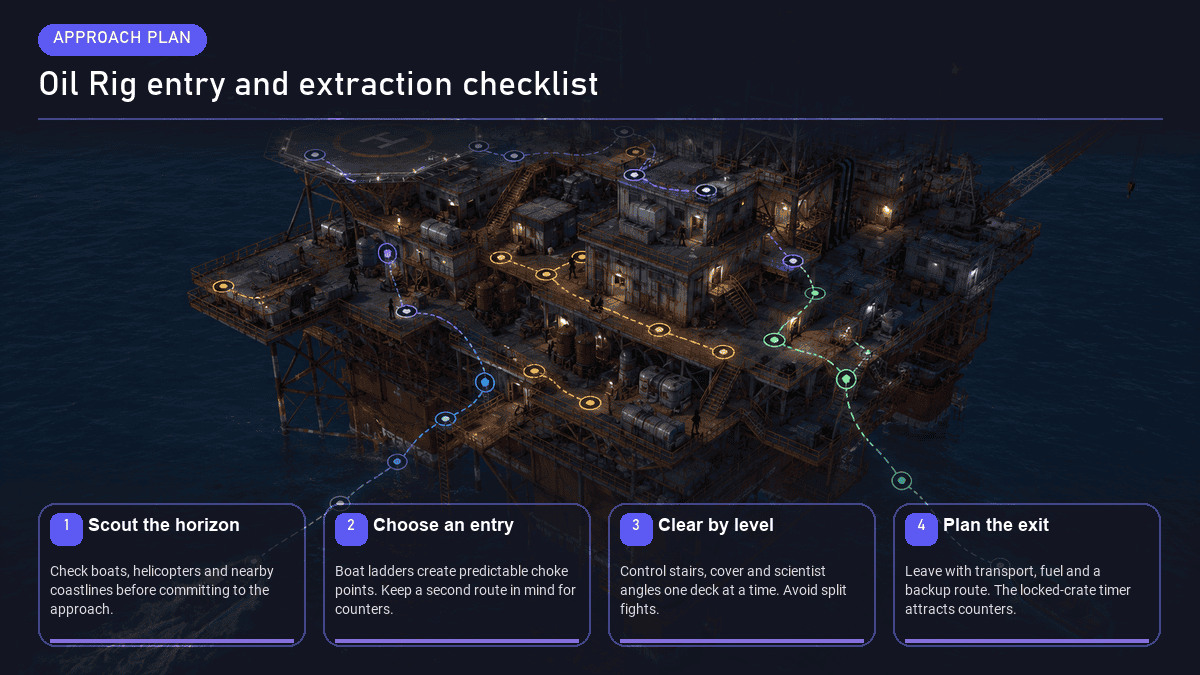
Both Oil Rigs are permanent offshore monuments guarded by scientists. Their green, blue, and red rooms are optional side progression: you can board and trigger the locked-crate event without completing every card room. Starting the hack calls in heavy scientist reinforcements and gives other players time to approach by boat, submarine, minicopter, or other aircraft.
Small Oil Rig
A more compact stack of decks with roughly 15 regular scientists before the locked-crate reinforcements. The smaller footprint shortens the clear but also gives counters fewer places to land and makes footsteps and ladder approaches easier to track.
Large Oil Rig
A multi-deck platform with roughly 27 regular scientists before the locked-crate reinforcements, more card-room space, and more approach angles. Clear methodically from cover, preserve healing for the event wave, and watch the horizon throughout the hack.
Oil Rig resets now produce a global environmental sound. Treat that cue as public information: it helps you identify availability, and it helps every nearby counter do the same.
Cargo Ship
Cargo Ship is a mobile world event, not a seed-fixed monument. It travels around the island with scientists, military loot, and multiple timed locked crates, then eventually leaves the map. The event has no standard keycard gate: access depends on boarding safely, clearing decks, surviving the hack windows, and extracting before departure.
The inbound Cargo cue is global. Boats, submarines, aircraft, deck ladders, and the ship’s own routes all create counterplay, so keep fuel and a departure vehicle ready instead of assuming the ship itself is the extraction plan.
Chinook 47 and Locked Crates
The CH47 event carries a hackable locked crate to a randomly selected eligible monument. It is an event delivery system, not another monument in the 43-location count. Once dropped, the crate broadcasts its position and begins a timed hack, creating a temporary objective inside an otherwise familiar monument.
Approach the crate as a layered fight: clear the local monument hazards, identify the hack timer, hold angles against arriving players, and leave enough resources for the final extraction. Current progression also makes hackable crates a guaranteed source of advanced blueprint fragments, which adds strategic value without changing the host monument’s normal keycard route.
Underwater Labs
Underwater Labs are procedurally assembled offshore facilities. A generated lab may contain green, blue, red, and fuse rooms in different combinations, so there is no universal card route or room map. Use the map marker to find the lab, bring diving or submarine access, then read the signage and module layout after entering.
Labs contain dwellers, component and military loot, and radiation that can vary sharply by module. Mark the moon-pool or submarine exit before moving deep into the layout; an unfamiliar lab is easy to enter and surprisingly slow to leave under pressure.
The Deep Sea (2026): Floating Cities, Ghost Ships, and Tropical Islands
The Deep Sea opens intermittently as a world-event region beyond the normal island waters. Facepunch introduced it in February 2026, then adjusted access and loot behavior in March: the region no longer opens immediately after a wipe, RHIBs cannot enter, and loot now respawns slowly instead of remaining permanently empty after the first visitors.
Floating Cities
Four ramshackle city variants act as Deep Sea safe havens. Depending on the layout, they provide vendors and practical services such as recyclers, workbenches, research tables, and refineries for crews operating far from the mainland.
Ghost Ships
Stationary derelicts guarded by scientists on deck and in nearby patrol boats. Some ship variants contain hackable locked crates, turning boarding into a timed defense against both AI boats and players exploring the same event region.
Tropical Islands
Small islands with resources, ruins, shoreline loot, and boat services. They provide staging and resupply opportunities, but the open water around them makes arrivals and departures visible.
Radiation, Hazmat, and Monument Safety
Radiation is route-specific. A monument can have safe exterior ground, low-radiation utility buildings, and a much hotter locked room in the same footprint. Procedural layouts can vary, and reset radiation near a puzzle can be intentionally unsurvivable. Watch the radiation indicator as you cross thresholds instead of relying only on the monument name.
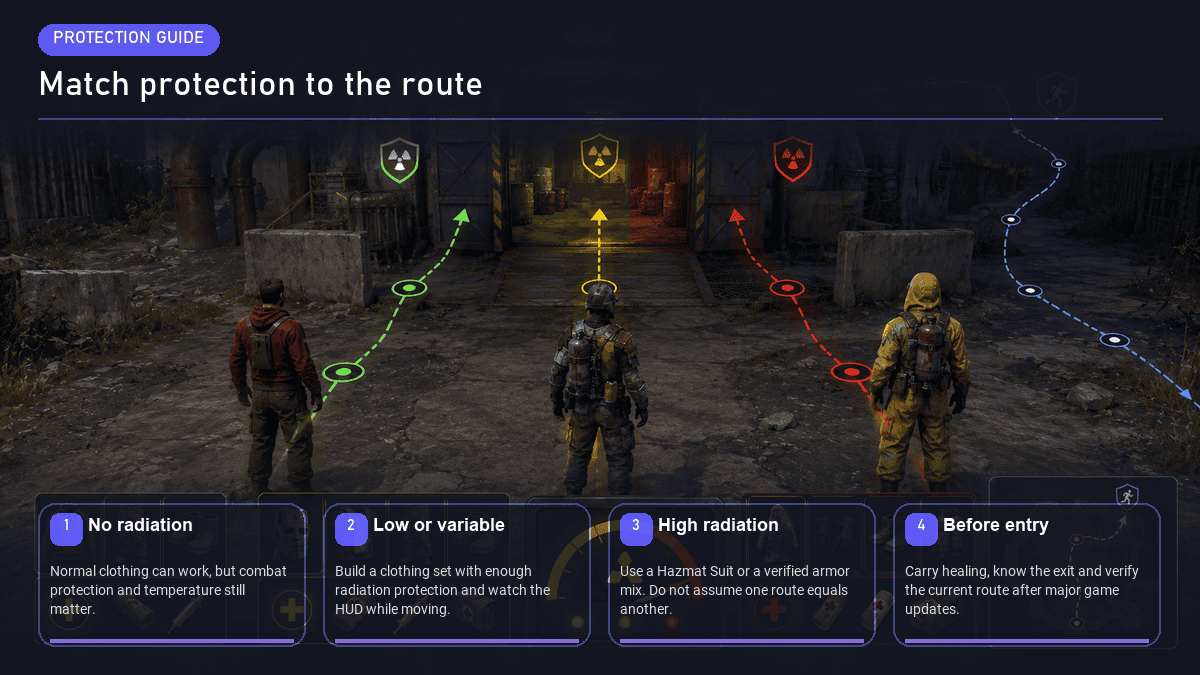
Bring enough radiation protection for the hottest room you plan to enter. Launch Site, Military Tunnels, Missile Silo, Power Plant, and some lab modules can punish a marginal kit.
A standard Hazmat Suit is convenient one-slot protection, but it is not strong projectile armor. Mix protection and combat readiness for the route and biome.
Loot the puzzle, take the card, and exit. Do not wait beside the boxes when severe reset radiation begins.
The standard Hazmat Suit is a practical all-in-one option for many routes, while suit variants and armor combinations can trade radiation protection for cold, bite, or combat protection. For cosmetic options and the differences worth checking before you equip them, see the best Rust hazmat suit skins.
Confirm card durability, bring the required fuse plus a spare for longer routes, carry healing and water, wear route-appropriate radiation protection, leave inventory space for components, and choose an exit before powering the puzzle. For offshore runs, add fuel, low-grade backup, cold protection when relevant, and a second way home.
Gearing up for your next wipe?
Skip the grind – buy the Rust skins you actually want on Tradeit and jump straight into the fight.
Which Monuments Are Best? (See Our Tier List)
Separate search intent
Use the ranking guide for comparisons
This article answers reference questions: what exists, where it appears, which card it uses, whether it has a recycler, and what hazards to expect. Questions about efficiency, risk-adjusted loot, scrap output, or which location to prioritize belong in our Rust monuments tier list.
Keeping the two resources separate makes both easier to use: this page remains a neutral lookup guide, while the tier list can compare locations using a clearly stated scoring method.
Ready to trade Rust skins?
Buy, sell, or trade Rust skins instantly on Tradeit – no Steam Wallet lock-in.
FAQ
How many monuments are there in Rust in 2026?
This guide tracks 43 named monument and event-location families as of July 20, 2026. The number actually spawned on a procedural map is lower and depends on map size, seed, biome, and current world events. The 43 count groups variants such as harbors, caves, quarries, fishing villages, jungle ruins, water wells, and Deep Sea layouts; it does not count CH47 as a location.
Which Rust monuments have recyclers?
Current dependable recycler locations in this guide are Airfield, Arctic Research Base, Bandit Camp, The Dome, Ferry Terminal, Giant Excavator Pit, Small and Large Harbor, Jungle Ziggurat, Junkyard, Launch Site, Lighthouse, Military Tunnels, Mining Outpost, Outpost, Oxum’s Gas Station, Power Plant, Radtown, Satellite Dish Array, Sewer Branch, Abandoned Supermarket, Train Yard, Water Treatment Plant, and Floating Cities when the active variant includes one. Airfield and Sewer Branch normally have two; Bandit Camp has two; Power Plant and Outpost normally have three; most other listed locations have one. Server owners can change these placements.
Do monuments reset after a Rust server wipe?
Yes. A map wipe regenerates the world, so procedural monument selection, positions, and layouts are rebuilt from the new seed. Loot and puzzles also reset repeatedly during the wipe on their own timers. Community servers decide their wipe schedule and whether blueprints reset; Facepunch’s forced monthly update wipe is separate from ordinary puzzle respawns.
Where do keycards come from in Rust?
Green cards spawn at several open monuments and can drop from relevant scientists. Green-card puzzle rooms normally provide blue cards, while blue-card routes provide red cards. Blue cards can also come from fishing. As of this fact-check, Bandit Camp’s current vanilla shop data lists green, blue, and red cards for 15, 40, and 80 Scrap respectively, but vendor stock and prices are patch-sensitive and may differ on modded servers.
Are Oil Rigs solo-friendly?
They are solo-capable for an experienced, well-equipped player, but not forgiving. You must clear multiple scientists, manage heavy reinforcements during the locked-crate event, monitor several boat and air approaches, and preserve a reliable extraction vehicle. Small Oil Rig is more compact; Large Oil Rig has more decks, NPCs, and approach angles. Neither is protected from counters.
Can I camp outside a monument for scientist drops?
You can hold approaches and loot scientists you kill on normal PvP monuments, subject to the server’s rules, but there is no guaranteed “outside” drop cycle. Remaining too close to puzzle loot can interfere with the player-free reset window, and the current reset system uses severe radiation to clear puzzle areas before refresh. NPC Safe Zones also enforce their own hostility and weapon rules.
What is the difference between a green, blue, and red keycard?
Green is the first puzzle clearance and usually leads to a blue card. Blue is the middle clearance used at larger monument routes and normally leads to a red card. Red is the advanced clearance for locations such as Launch Site, Military Tunnels, Nuclear Missile Silo, Oil Rig card rooms, and eligible Underwater Lab modules. A higher-color card does not replace a lower card when a route has multiple readers – you need each required color.
Fact-check date: July 20, 2026. Vanilla Rust changes monthly; custom servers can override monument generation, loot, NPCs, radiation, recycler positions, card vendors, and wipe rules.